French ex-president Sarkozy sentenced to five years in Libya funding case
By Dmytro Melnyk, 11 April 2026 Former French President Nicolas Sarkozy appeared before a Paris appeals court on Tuesday, April 7, 2026, to contest the most serious conviction of his legal career. Overview Nicolas Sarkozy was sentenced to five years in prison after being found guilty of criminal conspiracy in a trial over the alleged illegal financing of his successful 2007 presidential campaign with funds from the government of then-Libyan leader Muammar Gaddafi. The sentence was delivered by the Tribunal de Paris on September 25, 2025, m
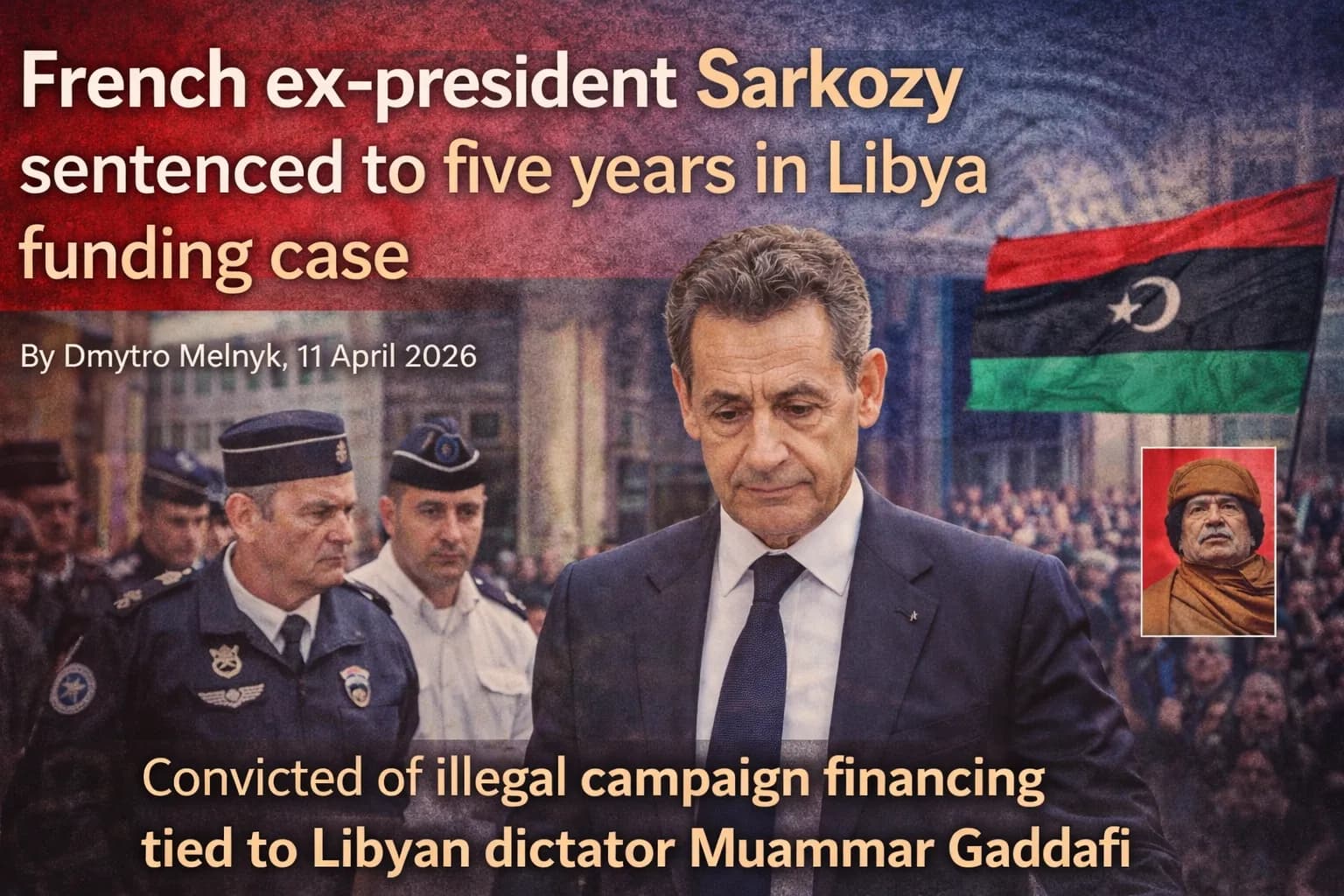
Overview Nicolas Sarkozy was sentenced to five years in prison after being found guilty of criminal conspiracy in a trial over the alleged illegal financing of his successful 2007 presidential campaign with funds from the government of then-Libyan leader Muammar Gaddafi. The sentence was delivered by the Tribunal de Paris on September 25, 2025, making Sarkozy the first former French president to receive a prison sentence. Context The origins of this affair stretch back more than a decade. The allegations that Libya, at the direction of Muammar Gaddafi, spent up to 50 million euros funding Sarkozy's 2007 presidential campaign surfaced in March 2011, from Saif al-Islam Gaddafi, the son of Muammar Gaddafi, after France intervened in the Libyan civil war.
The timing was striking: France under Sarkozy had just voted in favour of international military intervention against the very government that was alleged to have funded his rise to power four years earlier. The claim was subsequently supported by former Libyan Prime Minister Baghdadi Mahmudi, and the French investigative outlet Mediapart published documents and testimony that suggested large cash transfers. Other evidence included diaries belonging to former Libyan oil minister Shukri Ghanem, who was later found dead, floating in the Danube river in Vienna, thereby preventing his direct testimony. 2 French prosecutors claimed that when he was interior minister, Sarkozy made a corrupt agreement to support Gaddafi's government on the international stage in return for financing worth millions of euros to help pay for his presidential campaign. The agreement was alleged to have been carried out via a network of Libyan officials, a convicted terrorist, arms dealers and millions of euros shipped to Paris in suitcases. The formal judicial investigation that followed these revelations lasted a decade before the case came to trial. What the Lower Court Found When the Paris Criminal Court delivered its verdict in September 2025, the outcome was significant but also carefully bounded.
The court acquitted Sarkozy of all other charges, including illegal campaign financing and passive corruption. The judge stated there was no evidence that Sarkozy personally struck a deal with Gaddafi or that funds sent from Libya ended up directly in his campaign, even though the timing aligned and the money's routes were described as "very opaque." However, she found Sarkozy guilty of criminal conspiracy for allowing close aides to contact Libyan individuals in an attempt to secure campaign financing. The conviction imposed a five-year prison sentence, a 100,000 euro fine, and a ban from holding public office for five years. Although Sarkozy spent only approximately 20 days in custody before being released under judicial supervision, the ruling was historic. Nine co-defendants were convicted alongside him, including Claude Guéant, his former close aide and chief of staff, and Éric Woerth, his former head of campaign financing. The Appeal Hearing At Tuesday's appeal hearing in Paris, Sarkozy told a three-judge panel: "I owe the truth to the French people."
He insisted that not a single cent from Libya had helped fund his 2007 presidential campaign and denied that Gaddafi had any hold over him "financially, politically or personally." Sarkozy pointed to France's leading role in the 2011 NATO military intervention in Libya as evidence of his independence from the regime. "I took the initiative, France took the initiative. Why? Because Gaddafi had no hold over me," he 3 told the court. His wife, singer and former supermodel Carla Bruni-Sarkozy, was present at the hearing in a show of support that drew significant media attention across France. The 12-week appeal trial, which began in mid-March 2026 and is scheduled to run until June 3, is re-examining all evidence and testimony related to Sarkozy and his nine codefendants, including three former ministers. A final verdict from the appeals court is expected in autumn 2026. If convicted again at the appeals stage, Sarkozy faces up to 10 years in prison. Anti-corruption civil parties present in the case have pushed back firmly on Sarkozy's claims. Vincent Brengarth, lawyer for the French anti-corruption group Sherpa, told reporters outside the court: "Defendants have so far been unable to explain all the inconsistencies that may exist in this case."
Why This Case Matters The Sarkozy-Libya affair isn’t merely a legal dispute concerning one former head of state. It raises foundational questions about the integrity of democratic elections, the relationship between Western governments and authoritarian regimes, and whether individuals at the very top of political power are genuinely subject to the rule of law. Anti-corruption organisations including Sherpa, Anticor, and Transparency International France have described the trial as a crucial test of accountability and the strength of democratic institutions in France. The case has also cast a long shadow over France's role in the 2011 Libyan war, which resulted in the overthrow and killing of Gaddafi. Some legal observers and journalists have noted that the conflict effectively destroyed much of the documentary evidence that investigators had sought. Key witnesses either died or became unavailable. The diaries of Shukri Ghanem, found floating in the Danube, were one of the more remarkable pieces of evidence in the proceedings. The alleged 50 million euro arrangement, if proven, would represent one of the most brazen instances of foreign interference in a Western democratic election in recent memory.
4 The autumn 2026 verdict will determine whether France's most decorated post-war president ends his public life as a convicted criminal facing a decade in prison, or as a man ultimately vindicated by the courts. Either outcome will carry profound implications for French politics, European standards of political accountability, and the enduring question of whether power truly ends where the law begins. This article is based on information from Euronews and Al Jazeera. All details have been independently rewritten in original language and presented following professional journalistic standards
Dmytro Melnyk
Contributing writer at EUReflect.
Follow EUReflect
See more of our reporting on Google
Mark EUReflect as a preferred source and our stories are ranked higher for you in Top Stories, Discover and Google News — and carry a “preferred” badge when they are cited in AI results.
Add EUReflect as a preferred source