Guldursun-Kala: The Ancient Stronghold and the Tragic Legend Behind Its Name
Why should we visit Guldursun-Kala in Karakalpakstan, Uzbekistan? Hidden in the windswept plains just 9 kilometers north of Turtkul lies a forgotten titan of history — the awe-inspiring fortress of Guldursun-Kala.
Why should we visit Guldursun-Kala in Karakalpakstan, Uzbekistan?
Hidden in the windswept plains just 9 kilometers north of Turtkul lies a forgotten titan of history — the awe-inspiring fortress of Guldursun-Kala.
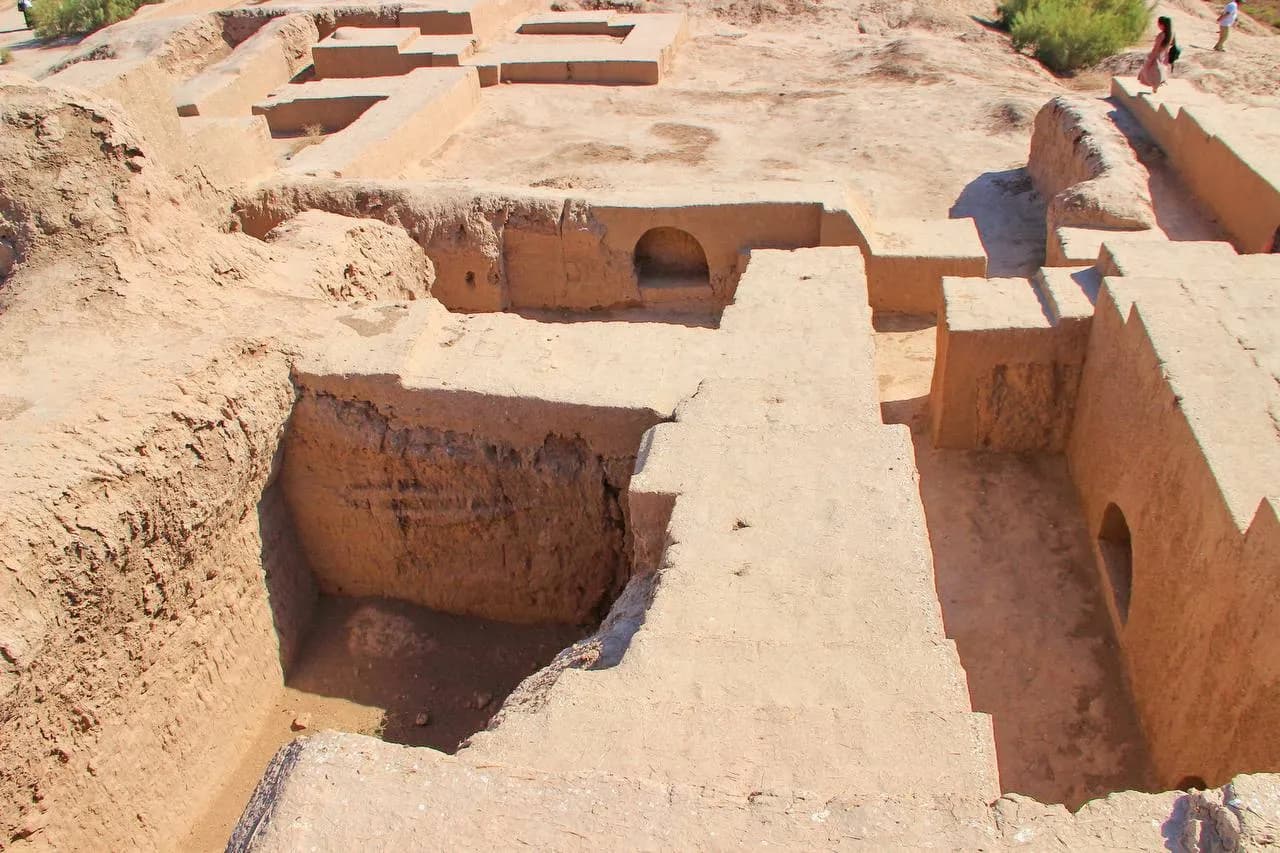
Once a bastion of power and pride, this sprawling 35-hectare citadel, with its towering clay-brick walls and twin defensive rows, whispers tales of ancient glory and devastating betrayal. Dating back to the 2nd century BCE and standing firm until the 11th century CE, Guldursun-Kala is more than a ruin — it is a living legend. Its arrow slits and crumbling ramparts echo with the voices of warriors, rebels, and rulers whose fates were sealed within these walls. And through the oral traditions of the Karakalpak people, its story endures — a saga of resistance, heartbreak, and the enduring spirit of Khorezm.
From Strategic Outpost to Silent Ruin
For unknown reasons, the fortress fell into ruin in the 5th century CE. But by the early 12th century, Guldursun-Kala was revived — this time as a critical military outpost guarding the steppe frontiers of the Khorezmshah State. Its importance, however, could not save it from the fate that awaited in the 13th century: the Mongol invasion. In 1220, during the reign of great Muhammad Khorezmshah, Mongol forces once again reduced the fortress to ashes. Archaeological excavations later uncovered vast collections of ancient and medieval ceramics, bronze artifacts, coins, and jewelry — physical remnants of both daily life and violent upheaval. However, in recent years government took rtesponsibility to recover the citadel into his original guise. The site was first examined in 1937 by archaeologist Y.G. Gulyamov, then studied further by S.P. Tolstov in 1940, and finally explored in depth between 1987–1994 by O.T. Dospanov.
The Legend of Guldursun: Love, Treason, and Tragedy
Guldursun-Kala owes its name to a Karakalpak folk epic, recorded by Tolstov in 1957. The poem captures the resilience of the Khorezmian people during the Mongol siege and centers around the fortress’s namesake: Princess Guldursun.
According to the epic, the Mongol army had besieged the city for a long time. As starvation spread and supplies dwindled, the city’s elders devised a clever ruse: they fed their remaining grain to livestock and released them through the fortress gates. When the Mongols captured the animals and saw their stomachs filled with wheat, they believed the city was still well-stocked. Discouraged, they prepared to retreat.
But fate had other plans. Princess Guldursun, watching from the fortress walls, had fallen in love with one of the Mongol warriors. Fearing she might never see him again, she secretly fired a letter to him with a bow, revealing the city’s deception. With the truth in hand, the Mongols launched a final assault, breaching the fortress and burning it to the ground. The surviving citizens were enslaved, and the city’s ruler was beheaded — his head hung from the city gates as a symbol of total defeat. When Guldursun met the Mongol prince she had betrayed her people for, she claimed her reward — to be his wife. But instead of love, she met judgment. The prince declared:
“If you could betray your own father and your own people for me, how could I ever trust your loyalty?” He ordered her execution: she was tied to a horse and dragged to death. After this, her story came to a tragic end. The ancient fortress was named after her, so that her tale- and its lesson would never been forgotten. The fortress stands as a silent witness to both the heights of human courage and the depth of human weakness.
Conclusion: A Fortress Beyond Stone and Clay
Guldursun-Kala is more than just an ancient ruin in the desert — it is a symbol of strategic genius, cultural identity, and the moral choices that define a people’s legacy. While its walls have crumbled and its towers have fallen, the story of Guldursun lives on — whispered by the wind across the steppe andpreserved inthe hearts of the Karakalpak people.
Literary and Academic Sources:
1. Tolstov, S.P.
Following the Tracks of Ancient Khorezmian Civilization. Moscow: USSR Academy of Sciences, 1948.
(One of the earliest archaeological researchers of Guldursun-Kala; recorded the “Guldursun” epic in 1957.)
2. Gulyamov, Ya.G.
History and Archaeology of Khorezm. Tashkent: Fan Publishing, 1959.
(Conducted archaeological surveys of the fortress in 1937.)
3. Dospanov, O.T.
Archaeological Research in Karakalpakstan (1987–1994). Institute of Archaeology of the Republic of Uzbekistan.
4. Karakalpak Folk Epic “Guldursun”
(An oral folk poem transcribed by S.P. Tolstov in 1957.) 5. Maps and Monument Data – Institute of Archaeology, Academy of Sciences of the Republic of Uzbekistan.
Aydana Xiyatova
Contributing writer at EUReflect.
Follow EUReflect
See more of our reporting on Google
Mark EUReflect as a preferred source and our stories are ranked higher for you in Top Stories, Discover and Google News — and carry a “preferred” badge when they are cited in AI results.
Add EUReflect as a preferred source