Interview with H.E. Sayasat Nurbek
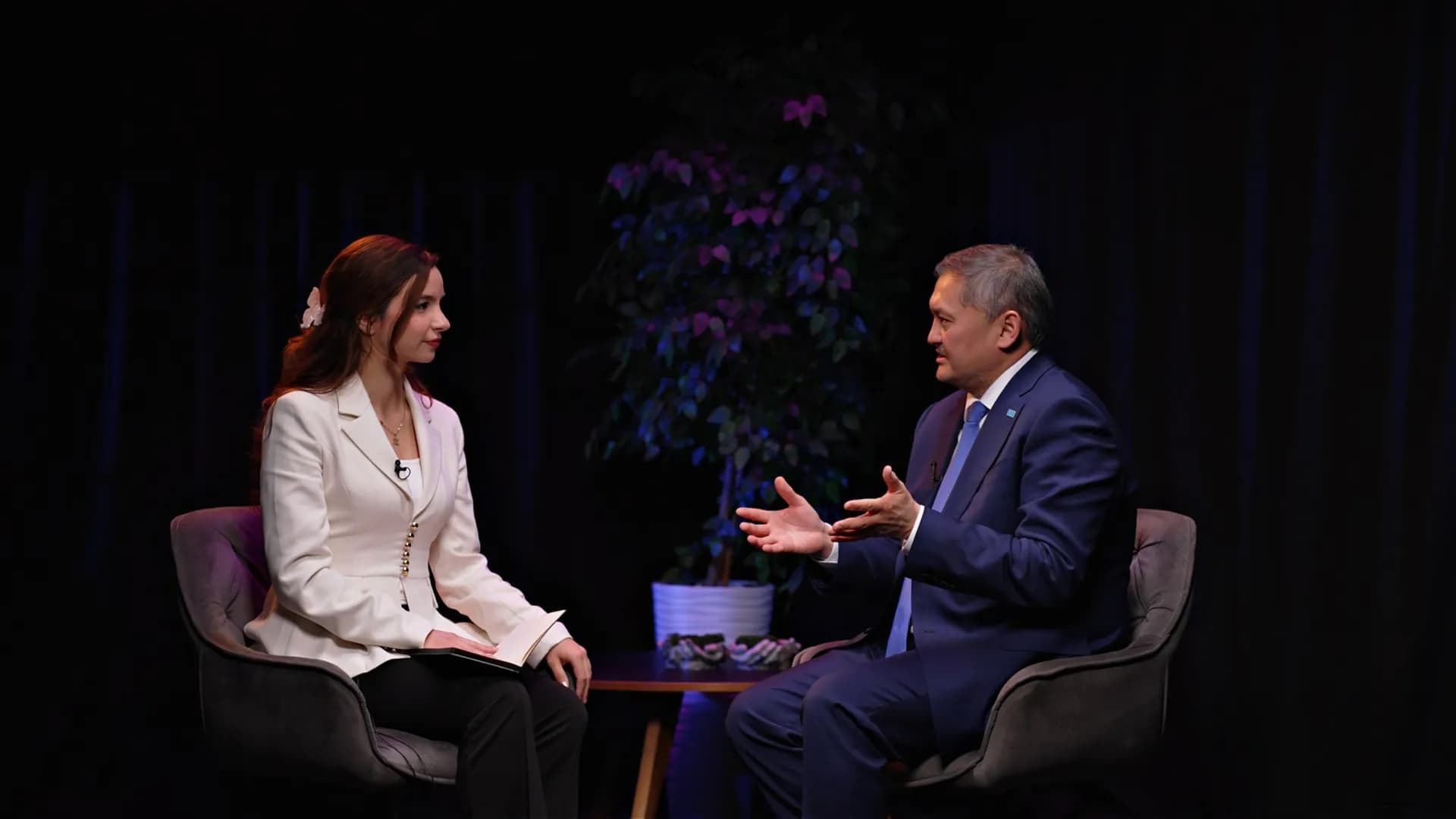
Derya Soysal interviewed His Excellency Sayasat Nurbek, Minister of Education of Kazakhstan, during the week of Digital Bridge 2026, hosted by Kazakhstan. The interview focused on artificial intelligence, education, Kazakhstan’s AI strategy, international university partnerships, and the future of higher education in Central Asia.
Derya Soysal
Today, we will have an interview with His Excellency, the Minister of Education of Kazakhstan, Sayasat Nurbek. We are in the week of Digital Bridge, as Kazakhstan is hosting AI and Digital Bridge 2026. The President of Kazakhstan, Kassym-Jomart Tokayev, said that this year is the year of artificial intelligence in Kazakhstan.
The President also mentioned that they will invest in education. Dear Minister, how will artificial intelligence change education in Kazakhstan and Central Asia?
Sayasat Nurbek
Not only in our country; it is changing everything. AI is a really powerful technology.
It’s even more than technology. For the very first time in the history of humankind, we’ve created something more than just a tool, just a mechanism. It has this agentic nature; it’s autonomous.
The impact of AI on every aspect of our lives is imminent. It’s so profound. You will see so many changes happening so fast.
Just a few days ago, algorithms solved one of the mathematics Millennium Problems, the Navier-Stokes equation. And now the mathematical society, the scientific society, is asking, “What’s going on?”
The very first Nobel Prize in Chemistry by a non-chemist, Demis Hassabis, a genius AI founder of Google DeepMind, and all these great algorithms have also shocked the scientific community. How can a person with nothing to do with this very specific field of science, with no prior education, but using the power of AI, receive the highest scientific awards out there, the Nobel Prize?
So we in Kazakhstan have fought really hard to answer the question: how can we harness the true power of AI?
Our President is very focused on AI. He believes that AI for Kazakhstan is not just a technology; it’s a great equalizer.
It can bring us a new competitive advantage. One of the strategies that Kazakhstan implements in our national vision of AI is what we call “AI-Ready Nation.”
We want to prepare Kazakhstan as much as we can for this new age of AI: AI-fused knowledge, AI-fused technology, and AI-fused industries.
One thing I think you would agree with me on is that the world was not ready for social media. We didn’t have classroom teaching, we didn’t have proper education, and a lot of people were not introduced to social media.
And what happened, happened.
All these problems we have with fake news, hatred, and waves of deceit happened because we were not taught to use social media properly.
Now think about this: an even more powerful technology will be available very soon to millions, if not billions, of people, because AI is becoming cheaper very fast, cheaper every day.
What problems would society and the world face? Forget about social media problems. You’ll have fake identities, you’ll have this huge surge in cybercrime. It’s really, really difficult to imagine the consequences.
So we said in Kazakhstan, and our President said, “We have to start with education.”
So this year is declared, as you mentioned, the Year of AI and Digital.
Starting from last year, every single student in Kazakhstan has to take AI courses. It’s compulsory.
Not many countries do that. We were one of the first countries to start doing this.
We trained 100% of our undergraduate students last year.
Every year, we select 100,000 students and teach them how to use AI properly and how to build their own agents.
Starting from the new academic year, this September, these AI courses will be mandatory for primary and secondary education.
We start from schools. We start from first grade. Students are introduced to AI: what AI is and how to use it ethically and properly.
Can it really solve all our problems? No.
Can it help solve many problems? Yes.
Can it amplify your knowledge? Yes.
Can it replace your knowledge? No.
One of the most debated results in the academic world at the moment comes from PISA. You’ve heard about the PISA results.
PISA said, “We have a problem.”
Students who rely on AI do really well until the exams. When exams come, if you replace your thinking and outsource your thinking to chatbots, you’re doing really well every day. You deliver lightning-fast answers; you can solve any problem.
But when it comes to testing your real way of reasoning, your thinking, your abstract thinking, and your logical capability, when it comes to exams, that’s it.
The students who performed so well during the week and on a daily basis fail the exams.
And so I know what will happen in the academic community after PISA 2026.
Everybody will say, “AI is evil. Let’s ban AI.”
But there was another conclusion, another result.
The students who used AI properly—not to replace their thinking, but to help them think, to serve as tutors and mentors, and for co-learning purposes.
Students said, “ChatGPT, whatever, Google Gemini, whatever bots or agents they use, help me learn this, test me, talk to me, find me better ways to memorize, find me better ways to learn, quicker ways to adapt, to consume that information, explain it to me, break it down.”
So here’s the very simple message I want to leave our audience with today, Derya.
What was the biggest problem of the modern education system?
Among all the problems, there was a key problem: how do we personalize education? How do we make sure every student, including yourself, including myself, gets the best education?
Because the modern education system cannot give each student the best possible education. It’s general.
You went to school, I went to school, you went to university, we all went to university. We’re lucky ones, by the way.
There are billions of kids out there who can’t get higher education.
We’re very lucky ones.
The system targets the whole classroom. It targets the school. It targets the university.
It doesn’t target the individual student because we can’t.
We never had the technology to truly personalize education.
Now, what does this new possibility open up for education systems?
Imagine a prince. Imagine the Ottoman Empire, Osmanlı.
You had a prince, and he had the best people in the empire teaching that prince.
Is that correct?
Remember the golden age of the Ottomans? The best people of his age were teaching and tutoring him.
He would receive the best tutors possible: the best poets, the best historians, the best religious people, the best mathematicians, the best linguists to teach him languages, algebra, math, astronomy, and poetry.
You know that Suleyman the Magnificent was a great poet.
He had a pen name. He would write poetry in Farsi and Persian.
Imagine if, with the power of AI, we could create a large number of teachers.
The biggest limitation in the current education system is teachers. You can’t teach everyone because you have only so many teachers. You have a limited number of teachers.
Good schools and good universities are always measured by the ratio of teachers to students.
When you pick a good school for your kid, you ask, “How big is your classroom?”
If it’s 1 to 40, that’s bad quality because one teacher cannot cover 40 students.
The smaller the class size, the better the education.
That’s the general formula.
Imagine if we create so many great agents, AI agents that have all the knowledge of humankind. They are the best teachers ever possible.
They have all the knowledge. They have these large language models and datasets.
They know everything about pedagogy, teaching, and psychology.
They have all the vast libraries. They have read and absorbed all the books possible on this particular topic.
They’re the best of the best.
It’s not a 1-to-1 ratio. The best education we ever had was 1-to-1.
Imagine every single kid could be a prince.
You could be a prince or princess. I could be a prince. Everybody could be a prince, where you have the best possible group of mentors, AI teachers, teaching that kid.
They give them the best. They give them all the best knowledge they could consume.
That is a dream.
That is my personal dream: to create an education system where every single kid, every single child, will have the best possible teachers and access to the best possible education and will be trained like a prince.
Imagine everyone will be trained like princes.
Could you imagine a world where everyone has their full potential? Everyone has this fullest potential.
He knows all the languages. He’s really good at what he is doing and what he loves.
The education system brings out the best of his talents, the best of his natural inclinations.
He can live in this kind of world, and they are trained properly. They are brought up properly.
This kind of education system is a dream.
Is it possible? We don’t know.
Now we’re experimenting. We’re partnering with all the best companies: OpenAI, Coursera, Google, NVIDIA, Microsoft, and all these great tech giants.
We’re experimenting and trying to find a formula.
The AI-Sana program I mentioned is the way we want as many citizens of Kazakhstan as possible to master AI and harness the power of AI.
We believe that back in the days in Silicon Valley, there was this notion of the 10X employee: the best employees, senior software engineers who could do things 10 times faster, 10 times better than normal employees.
We believe that if we use this AI-SANA program properly and systemically, anyone can become a 10X employee.
Anyone can become a great entrepreneur, build a new company, or simply be a good employee, go to a small or medium-sized enterprise, a coffee shop, any shop, and just say, “Okay, I know something about AI. Let me do something with your customer relations. Let me do something with your data.
Let me do something just to bring at least some value out of this.”
AI can provide value anywhere, anytime.
That’s the whole idea of this AI-SANA program.
Derya Soysal
Dear Minister, do you know that the government just opened a university dedicated to artificial intelligence? How can this investment in AI help Kazakhstan become a leader in artificial intelligence education in Central Asia, but also in the Eurasian region, because you are also going to Tokyo?
Sayasat Nurbek
When we started the AI-SANA program, we started implementing what we call the AI + X model, where students learn their major, their academic major—journalism, chemistry, IT, arts, agriculture, whatever—plus we give them that heavy, in-depth AI component so that they can fuse AI with their studies.
They become AI architects, AI chemists, like Demis Hassabis. Despite not being a chemist, he got the Nobel Prize in Chemistry in 2024.
There’s a great documentary, The Thinking Game, on Netflix about Demis Hassabis’ life journey. I really recommend watching it.
So, AI + X model.
Then we realized that we needed a university that would be a different kind of university, because AI is changing higher education as well.
So they call them AI-enabled universities, and there’s a huge experiment now happening in the world.
There are universities like Mohammed Bin Zayed University of Artificial Intelligence in the Emirates, Shanghai Innovation Institute in Shanghai, China, Tsinghua AI-Assisted Research Institute, Northeastern in Boston, and Carnegie Mellon.
There are some universities that are trying to go into full AI-mode university, and it’s really interesting to see how this experiment is evolving.
Basically, you have a campus which is run by an algorithm.
You get truly personalized individual student journey maps, student journey trajectories.
I went to university. Back in the day, in my time, it was five years, not four years. That’s before a bachelor’s degree, before we joined the Bologna Process.
In those five years, I learned something, I read some books, but I didn’t get the full experience of the campus.
Imagine a situation, imagine a smart campus, where you come to the campus and the campus says:
“Sayasat, you’re studying political international public law. There’s a public lecture in the afternoon, the day after tomorrow, which we think would be interesting to you.”
You didn’t know about it, but we’re giving you the information. We want you to register. It’s half of the credit that you need.
Your book has to be returned; the one-month period has expired. So you take the book, go to the library, return the book, go to the lecture, and get your credit.
It’s much more complex than that.
But basically, the AI-enabled university gives you an idea: you’re co-living with AI. It’s called Human-Centered AI.
So Qairu, Kazakhstan AI Research University, will be the first-ever university in Central Asia, in this region, that will be fully AI-enabled.
We’re going to test that AI + X model, and it will be a university where the experience and the model of this university will then be scaled to all these different universities in Kazakhstan.
So we believe we’re doing something really, really interesting, something that nobody has done before.
And you know, that education systems are very conservative. We resist change.
We declare, “We want to build a future-proof education system,” but in reality, we’re very conservative.
Through this technology, through breaking the mold, breaking the standards, and letting algorithms run some background processes, there’s a very interesting project we’re doing with OpenAI.
OpenAI has launched a project called OpenAI for Countries in eight countries, and Kazakhstan is among the first eight countries in the world, where we train 100% of our faculty members.
One thing we’ve learned: the bottleneck is not the students; it’s the faculty, the teachers.
They resist the change. They resist AI.
So instead of them resisting the change, we said, “Okay, let us train them,” and we started training 68,000 faculty members in Kazakhstan, 100% of them in higher education, in AI.
Each one of them has received a free copy, a free license, of GPT Education.
It’s a special edition of GPT that is trained in all things AI.
So it can help teachers to teach, to become better teachers and better researchers.
We’ll see how it goes.
It’s a very bold experiment. We’ll report by the end of this year.
All in all, this new AI research university will be helping Kazakhstan to test new ideas in higher education, to test these new AI + X models and AI-enabled campuses, and become a role model, a best practice for scaling this new university model to as many universities as possible in Kazakhstan.
Derya Soysal
You said that the educational system is very conservative, but when I come to Kazakhstan, I see a huge transformation.
And you were in Brussels—we met in Brussels—and you were in Berlin.
What role can European universities play in Kazakhstan, but mainly also in the educational system and the transformation of the education system here in Kazakhstan?
Sayasat Nurbek
Five years ago we launched a program, a strategy, and our President said we should open up to the world and we should bring as many good universities to Kazakhstan as possible.
So, in the last five years, we traveled—I traveled a lot—and I’m traveling again.
In the last five years, we traveled the world. I’m going to show you the map, and we brought about 40 really great universities to Kazakhstan, and they opened their branch campuses.
Now we are one of the largest academic hubs in this region.
We are officially in the top 14 academic destinations in the world, and you could see some really great universities like Colorado School of Mines, Cardiff, University of Arizona, Arizona State University, Heriot-Watt, Coventry, University of Minnesota, KAIST, Korean Advanced Institute of Science and Technology, and New York Film Academy.
There are really great universities.
The message was very simple. I travel to Europe a lot, and we’ve been to Germany, France, and the UK.
A very simple message: if you can’t get enough students from our part of the world, come to the middle of the action.
Extend your services in the region through Kazakhstan with the full support of the Kazakh government, and we fully support our partners.
In just five years, we’ve been able to establish 40 partnerships and attract over 40,000 international students.
It’s almost 41,000 international students now studying in Kazakhstan.
That’s our historic record.
We never had this number of international students.
Europe and European universities are a big part of this strategy.
We have very active British university participation.
We have the University of Lorraine from France.
We are now dealing with this famous Institute of Nuclear Physics, INP, from Grenoble. It’s a leading European and French institution in nuclear engineering and nuclear physics.
And Kazakhstan has great plans. We have three nuclear power plants in the pipeline.
So we need to train a lot of nuclear engineers.
We have Anhalt, the very first German university, Hochschule Anhalt, opening a branch campus in Almaty.
We have this great consortium of German universities in the west of Kazakhstan, where we train people for green hydrogen production.
There’s a great consortium of German universities in east Kazakhstan, where we have a big research center in metallurgy, critical minerals, and rare earth minerals.
Next week, we’re having a big delegation of Belgian universities.
His Majesty, the King of Belgium, is traveling on a state visit to Kazakhstan.
So we’re going to have a large number of Belgian universities.
We’re setting up a math research center, an AI research center in mathematics and applied mathematics.
We have the University of Ghent.
We have a great Department of Mathematics at KU Leuven, Catholic University of Leuven.
We are opening a rare earth metal research facility in east Kazakhstan, in Oskemen.
So Belgian, French, German.
There’s a Polish university, Bydgoszcz, in east Kazakhstan.
There are Hungarian universities, a couple of Hungarian universities.
Here it is, Debrecen, French.
So we want to partner with the European Union.
We want to partner with European countries.
Europe needs Kazakhstan.
Europe needs Central Asia for many reasons.
For the Middle Corridor, for transport, for transit potential, for critical minerals.
Kazakhstan is number three in critical mineral deposits. It’s China, Brazil, and Kazakhstan.
For the nuclear program, nuclear is back on the menu.
Europe is suffering. You need access to reliable supply chains of fuel, oil, and uranium.
And Kazakhstan is the number one uranium producer in the world.
43% of all the uranium is produced in Kazakhstan.
So all these great technological advancements, innovation, and engineering potential of European countries, combined with access to the critical minerals and natural resources of Kazakhstan, are a natural fit.
Through these academic partnerships, we’re building industry links.
I’ll give you just one example.
When Cardiff opened its branch campus in Astana last year, AstraZeneca, one of the leading European pharmaceutical companies, said, “Wow, now we’ve been in the region, in Kazakhstan,” and we’ve relocated their regional office from Moscow to Astana.
They said, “We’ve never done any clinical research in the region, but now, having Cardiff, having that research potential and research ethics, we know, we trust, we’re going to open up funding.”
And now the first million-euro funding is with one of the universities in North Kazakhstan in partnership with AstraZeneca because we have the University of Arizona, a great biomedical school in Nazarbayev University.
So you see, academic partnerships are bridges.
They’re bringing investments, they’re bringing partnerships, they’re bringing industry links.
And so Europe should look much, much closer to the region and to Kazakhstan for another reason: demographics.
Now this region produces more babies than anywhere in the world after Africa. Africa is number one.
And this particular region of Central Asia, of Greater Eurasia, about half a million babies are born in Kazakhstan on average annually, about a million babies in Uzbekistan, five million babies in Pakistan, and 60,000 babies daily in India.
So I’ll give you just two shocking figures.
Japan: 122 million population last year, 671,000 babies were born in Japan.
About 33-plus, 44-plus million in Uzbekistan, a million babies.
52 million in South Korea, 254,000 babies were born in South Korea last year.
Kazakhstan: 20 million, 646,000 babies.
So there’s a boom.
Southeast Asia is not the engine of human growth anymore.
It’s this particular region of Greater Eurasia where more babies are being born now, with quite good literacy and quite good education.
So any venture capital, any pharmaceutical company, any food company, agriculture company, any education company should have a much closer look at this region, which is rich both in natural resources and human resources.
Derya Soysal
So we can say that the future is Central Asia and the future is Kazakhstan?
Sayasat Nurbek
It will be one of the centers of growth: financial growth, economic growth, technological growth, and human growth.
That is for sure.
Derya Soysal
To conclude, you were mentioning the visit of the King of Belgium. He will come to Astana.
Why should Belgian universities invest here?
Sayasat Nurbek
For all the reasons I mentioned.
And, by the way, we are opening a United Nations University in Almaty also next year.
So, for all its demographics, its access to critical minerals, its vast territory with huge agricultural potential, it has all the natural resources and fuel, including alternatives and nuclear.
So all the major resources that any economy, any high-tech industry needs in the next 10 to 15 years, including computing power, are here.
The biggest project Kazakhstan will be running is called Data Centers Valley in Ekibastuz. It’s close to Astana.
It has some of the cheapest energy available in the region, at around two to two and a half cents per kilowatt.
So NVIDIA’s CEO, Jensen Huang, will be traveling to Astana on 23 October because NVIDIA and all these large tech companies are looking for cold, energy-cheap locations to run their data centers, to have more compute, more compute, and more compute.
So, for all the existing reasons—traditional, conventional reasons—and all these new high-tech, data, AI, and digital reasons, Kazakhstan and the whole region of Central Asia are very, very unique locations.
Derya Soysal
Thank you very much, Sayasat Nurbek.
Let’s make Kazakhstan closer to the EU, but also Kazakhstan closer to Belgium.
Sayasat Nurbek
Yes, of course.
I think His Majesty’s visit will pave a new chapter, will open a new chapter in bilateral relations, but also in European and Central Asian relations.
Related Topics
Derya Soysal
Contributing writer at EUReflect.
Follow EUReflect
See more of our reporting on Google
Mark EUReflect as a preferred source and our stories are ranked higher for you in Top Stories, Discover and Google News — and carry a “preferred” badge when they are cited in AI results.
Add EUReflect as a preferred source