Iran on the Edge: Protests, Power Struggles and the Risk of Foreign Intervention
Iran is entering a critical phase as nationwide protests continue for a second week, overwhelming security forces and pushing hospitals into crisis mode. The government has responded with harsh repression, internet shutdowns, and mass arrests, while international pressure on Tehran is growing. The United States and its allies are avoiding direct military intervention but are increasing political, informational, and economic pressure on the regime. With no unified opposition leadership inside the country, Iran now faces three possible paths: violent suppression, slow internal collapse, or escalation into a wider regional crisis.
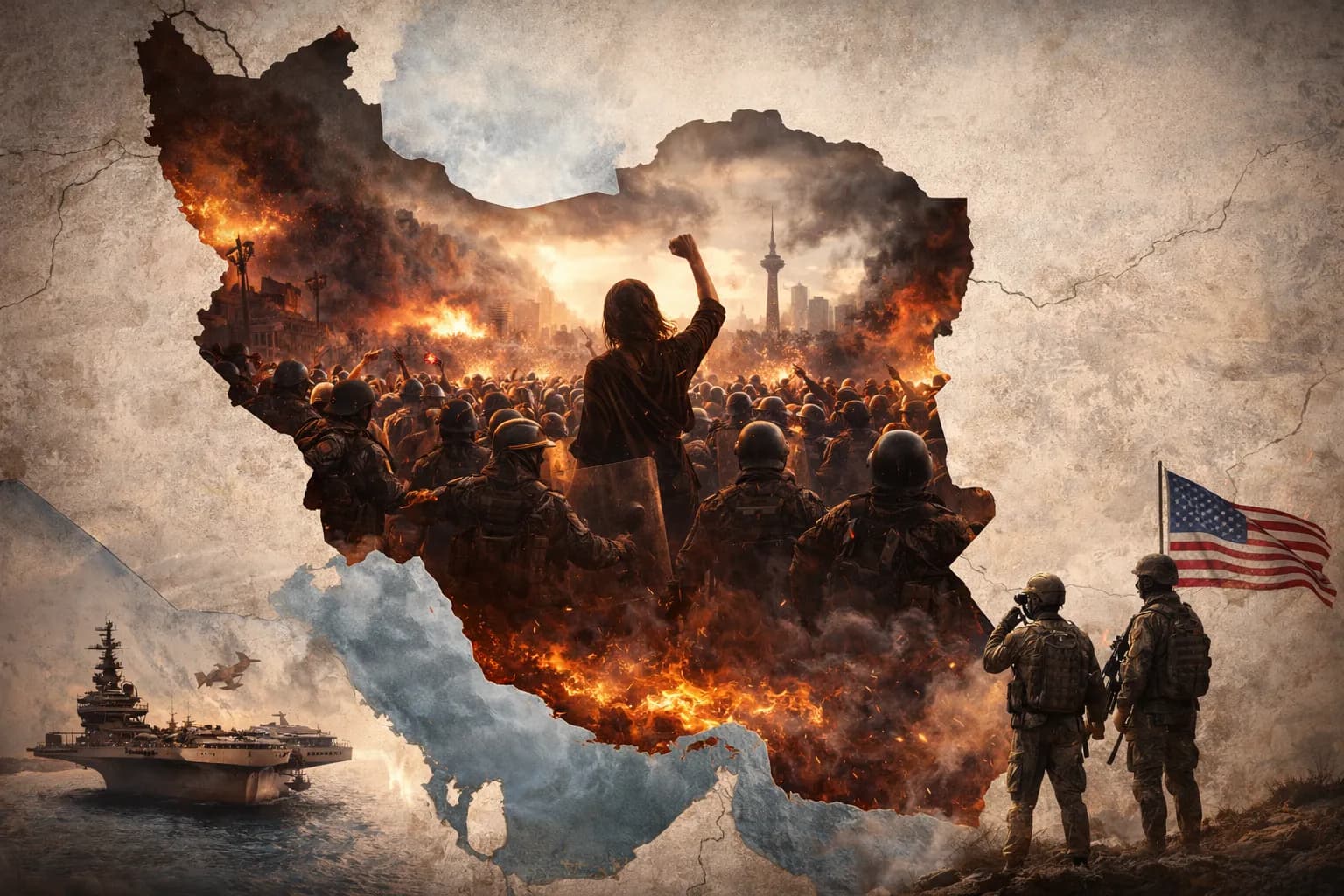
Introduction
The wave of protests that has swept across Iran for more than two weeks has ceased to be a routine episode of domestic unrest. Demonstrations spreading across dozens of cities, combined with heavy-handed security crackdowns, hundreds of injured protesters, and dozens of deaths, are now testing the very capacity of the Iranian state to maintain control. Nationwide internet shutdowns, hospitals operating in crisis mode, and increasingly aggressive state rhetoric all reveal a regime that is deeply afraid of losing command of the situation.
This crisis is no longer simply a confrontation between the Iranian people and their rulers. It has become a new front in the global struggle over Iran’s political future. Harsh messages from Washington, human-rights warnings from European leaders, and increasingly organized calls from exiled opposition figures show that the situation has moved onto the international stage.
1. The Growing Rift Between State Power and Public Anger
The Iranian leadership no longer frames the protests as demands for reform. They are now officially labeled as “subversive attacks against the regime.” The National Security Council, the Revolutionary Guards, and the judiciary are speaking with one voice, signaling full consensus in favor of repression. Protesters are branded as “armed vandals” and “terrorist elements,” giving security forces a free hand.
Reports from hospitals reveal the real meaning of this policy. Large numbers of wounded people with gunshot injuries to the head and eyes suggest not crowd control, but a deliberate strategy of intimidation and deterrence. Iran is no longer facing a law-and-order challenge—it is drifting toward a form of internal conflict.
As repression intensifies, the space for compromise disappears. The crisis is becoming zero-sum: either the state reasserts full control, or its authority begins to fracture.
2. Washington’s Position: Regime Change or Controlled Collapse?
President Donald Trump’s statements show that Washington is not merely observing events from the sidelines. Yet the U.S. approach is very different from the Iraq-style intervention of 2003. By repeatedly ruling out the deployment of ground troops, the White House signals that it prefers indirect pressure rather than direct invasion.
The real American objective appears to be the erosion of the regime’s legitimacy. Washington is pursuing this through three main channels:
Information warfare: opening alternative communication channels such as Starlink
Diplomatic pressure: mobilizing the UN, Europe, and regional actors to isolate Tehran
Psychological pressure: encouraging divisions and defections within the Iranian system
This strategy is not designed to overthrow the regime overnight, but to weaken it from within. For Tehran, this is far more dangerous than tanks at the border.
3. The Weakness of the Opposition and the Opening for External Influence
The strength of Iran’s protest movement lies in the streets; its weakness lies in leadership. Figures such as Reza Pahlavi have symbolic value, but inside Iran there is no unified, organized alternative government waiting to take power. This creates both opportunity and danger for foreign actors.
It is an opportunity because a fragmented opposition is easier to influence. But it is also a risk: if the regime collapses, the resulting power vacuum could trigger chaos. Iran is full of ethnic, sectarian, and social fault lines. That makes scenarios similar to Libya or Syria disturbingly plausible.
Conclusion: Three Possible Scenarios
Scenario 1: Harsh Repression and a Temporary Regime Victory
The state crushes the protests through overwhelming force. Internet blackouts continue, arrests multiply, and the streets fall silent. In the short term, the regime survives—but at the cost of becoming more isolated, more authoritarian, and more fragile. Iran drifts toward a North Korea-style model: stable on the surface, brittle underneath.
Scenario 2: Managed Regime Erosion
The U.S. and its partners intensify economic, technological, and psychological pressure without launching a war. Protests continue in waves, elite defections begin, and the system slowly loses coherence. This “slow collapse” is the most dangerous scenario, because it produces instability without clear resolution.
Scenario 3: A Regionalized Intervention
If mass killings escalate, the U.S. and its allies may move toward limited military action—air strikes, cyber warfare, and targeted operations against regime elites. This would likely drag Iran, Israel, Lebanon, and the Gulf into a wider regional war. It is the most destructive option for everyone.
EUReflect News
Site Administrator
Follow EUReflect
See more of our reporting on Google
Mark EUReflect as a preferred source and our stories are ranked higher for you in Top Stories, Discover and Google News — and carry a “preferred” badge when they are cited in AI results.
Add EUReflect as a preferred source