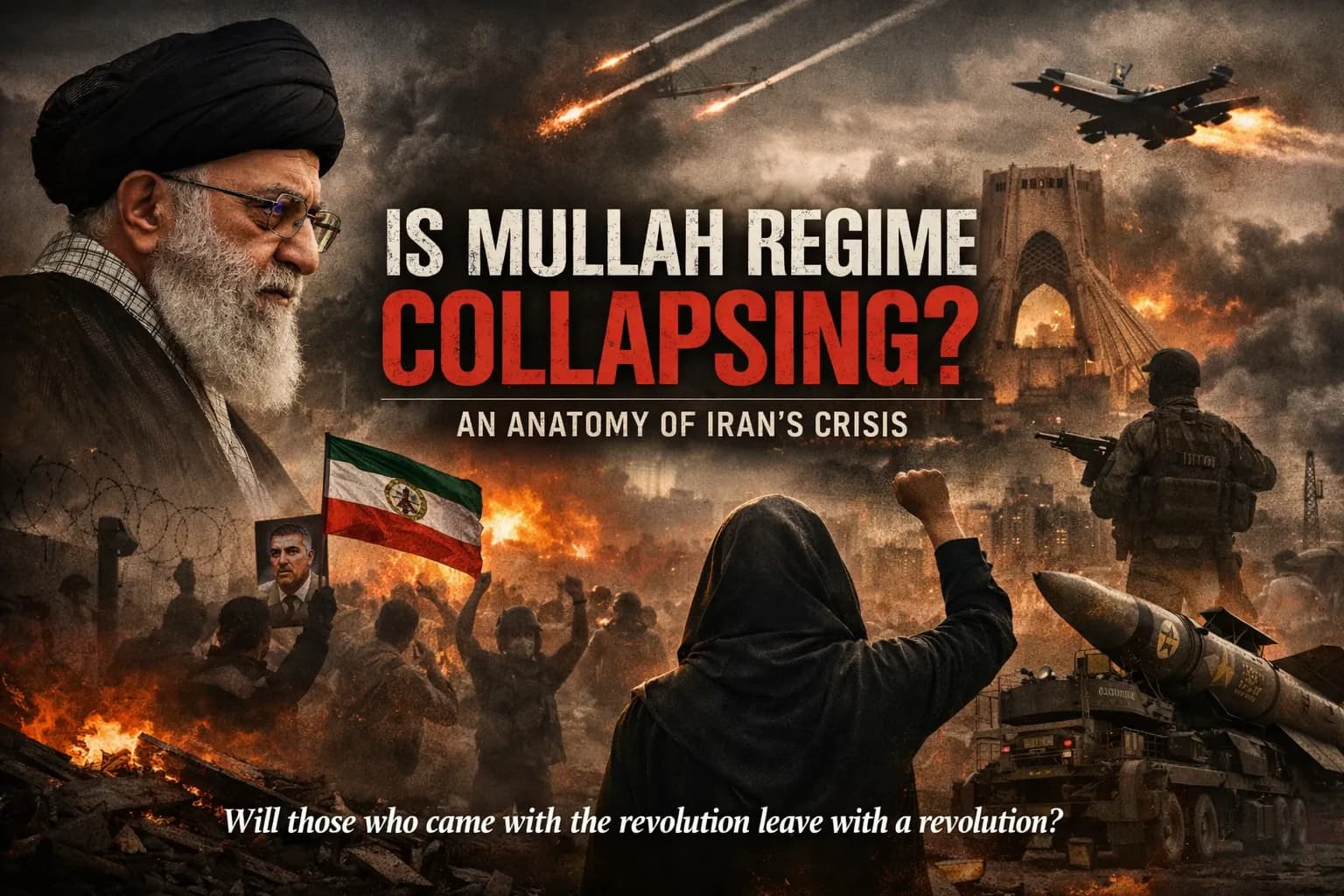
IS MULLAH REGIME COLLAPSING?: AN ANATOMY OF IRAN'S CRISIS
"Will those who came with the revolution leave with a revolution?" The Iranian mullah regime came to power in 1979 through a popular revolution against the Shah. In this process spanning nearly half a century, the regime's initial promise of an "exportable revolution" has today been replaced by a struggle for survival. So, how possible is it today for the mullah regime to depart through another social explosion or external intervention?
The Middle East is a geography where stability has not been established for decades. At the center of this instability are two main actors who stir up chaos due to their geopolitical interests: Israel and Iran. Iran's "forward defense" strategy, inherited from the Shah era and dressed in an ideological cloak by the mullah regime, has long threatened regional countries. This policy, called the "Axis of Resistance," was based on the logic expressed during the Shah's era as, "If we do not fight on the Mediterranean coasts, we will have to fight on our own lands." The post-1979 regime institutionalized this strategy by combining it with the Shiite Crescent and anti-US/Israel sentiment.
The Severed Arteries: How the Fall of Damascus Strangled the Resistance Axis: However, the regime change in Syria at the end of 2024 broke the backbone of this axis not only politically but also physically. Syria was not just an ally for Iran; it was the heart of the "Logistics Land Bridge"extending from Tehran through Baghdad and Damascus to Beirut. With the fall of Assad, the Islamic Revolutionary Guard Corps' (IRGC) access to the Mediterranean was physically severed. This led to the total isolation of Lebanese Hezbollah, the cessation of ammunition supplies, and the destruction of Iran's most strategic "forward outpost" on the Israeli border. This military depth, built over 40 years with billions of dollars of investment, turned into a strategic encirclement overnight.
THE FORTRESS OF SOLITUDE: STRATEGIC ENCIRCLEMENT AND PROXY DECAY
The mullah regime conducted a "proxy war" through the Houthis in Yemen, Hezbollah in Lebanon, and Shiite militias in Iraq to maintain its regional influence. However, as of 2025, these groups have entered a period of historical weakening. In particular, Israel's operations along the Lebanon and Syria line throughout 2025 largely liquidated the deterrence Iran had established through "proxy forces." The Arab world further deepened the bloc it started with the "Abraham Accords" against Iran's expansionist policies in 2025, condemning Iran to regional "loneliness."
ENGINEERED PARALYSIS: THE "SURRENDER NEGOTIATIONS" AND THE ANATOMY OF INSIDE-OUT COLLAPSE
Donald Trump’s return to the White House in early 2025 became the "worst-case scenario" for Tehran. Trump initiated a process in April 2025 via Oman, referred to in diplomatic circles as the "Surrender Negotiations." These negotiations were a harsh ultimatum presented to the regime rather than classical diplomacy: "Completely stop the nuclear program, withdraw your hand from regional proxy forces, and liquidate the missile program; otherwise, be destroyed economically and militarily."
Trump managed this process to paralyze the decision-making mechanisms within the regime using these specific methods:
● Divide and Rule Diplomacy: While the Trump administration targeted economic assets under the control of the IRGC with the heaviest sanctions, it opened secret channels with the "Ministry of Foreign Affairs and the civil bureaucracy," promising that "if the IRGC is liquidated, sanctions on the civil sector will be lifted." This turned into an open conflict within the state apparatus between civil technocrats, who see the IRGC as a "tumor," and the military wing.
● Information Operations and Direct Address: Trump addressed the Iranian people through social media and direct video messages with the theme: "Your money was stolen not for a nuclear bomb, but for the failed adventures of IRGC generals in Syria." By branding every sanction as being "not for the people, but for the luxury life and terror budget of the IRGC," he successfully isolated the radical wing in the eyes of the public as the "sole architect of hunger and war."
● Strategic Leaks: Intelligence notes intentionally leaked from the talks in Oman, suggesting that "some Iranian generals were ready to sell out Khamenei for their own survival," created a wave of terrible paranoia within the regime. With this tactic, Trump created an environment of "decision-making paralysis" where the regime could not trust each other even in the most critical moments.
SHATTERED AMBITIONS: THE "12-DAY WAR" AND THE NUCLEAR DEAD END
The year 2025 became the "year of decision" for the Iranian nuclear issue. The realization that Iran might be weeks away from building an atomic bomb by continuing uranium enrichment at 60% and above turned regional tension into war. In June 2025, the coordinated strike by Israel and the US on critical nuclear facilities, primarily Natanz and Fordow ("Operation Midnight Hammer"), dealt a blow to Iran's nuclear program that would take at least 10 years to recover from. The response given by Iran with missile attacks (the "12-Day War") also registered the inadequacy of the regime's military technology against Western defense systems.
THE IDEOLOGY OF DARKNESS: WHEN "STRATEGIC DEPTH" MEETS DOMESTIC DESPAIR
Following the strikes on its nuclear facilities, Iran was left facing a major economic and social crisis internally. During the massive power outages and natural gas shortages in the winter of 2025, the slogan "You have condemned us to darkness!" rising from the streets became the most powerful social motif of this period.
This slogan was not just an energy complaint; it represented an ideological anger against the regime's sacrifice of the people's most basic rights to heating, light, and food for the sake of nuclear ambitions and regional wars. The people, seeing their "cities left in darkness" instead of the regime's "strategic depth" tales, faced once again the reality that ideology does not put food on the table.
THE PHOENIX DOCTRINE: TRANSITIONING FROM DISSIDENT MOVEMENTS TO A SOVEREIGN ALTERNATIVE
Amidst the "Prince, return to your country" slogans echoing in the protests, Reza Pahlavi was hosted in Washington and European capitals throughout 2025 with the "Transition Period Leader" protocol. This protocol showed that the West now accepted Pahlavi not just as an opposition figure, but as a "legitimate interlocutor and a guarantor of stability" in the event of the regime's potential collapse.
The "Phoenix Project" presented by Pahlavi serves as a shield against the public's greatest fear of "chaos and civil war." The project provides a concrete "Day After Plan" on issues such as how the transition government will repair energy grids, how it will stabilize the currency, and how it will restore the legal system. In this way, the Iranian people are overcoming the anxiety of "Will we become like Syria or Libya if the Mullahs go?" and are being convinced that change is not a destruction, but a professional restoration.
THE SUCCESSION GAMBIT: MOJTABA, THE IRGC, AND THE WAR FOR THE THRONE
The greatest internal danger in Iran today is the "Succession Crisis" (Struggle for the Throne) triggered by the critical health condition of the 86-year-old Khamenei. At the root of this struggle lie two main focal points: Khamenei's son Mojtaba Khamenei and the Islamic Revolutionary Guard Corps (IRGC).
While Mojtaba wants to turn the regime into a kind of "religious dynasty" by inheriting his father's religious and political legacy, the IRGC, which controls all economic resources and the armed power of the country, does not want to put its own autonomy under a "heir." The preference of some generals within the IRGC for a weaker figure under their control instead of Mojtaba leads to a serious intelligence war and purges within the regime. This internal division has brought the regime to its most vulnerable point in history against popular uprisings and external operations.
THE GHOST OF NIZAM AL-MULK: WHY INJUSTICE CANNOT ENDURE
The striking warning written by Vizier of the Seljuk dynasty in Iran, Nizam al-Mulk a thousand years ago is felt in the streets of Tehran today: "A kingdom may endure with unbelief, but it will not endure with injustice." The departure from the stage of history of those who came with the revolution in 1979, under this military collapse, the social darkness brought by the energy crisis, and the deepening succession crisis of 2026, now appears as an inevitable end.
Abdullah Yakup Üner
Contributing writer at EUReflect.
Follow EUReflect
See more of our reporting on Google
Mark EUReflect as a preferred source and our stories are ranked higher for you in Top Stories, Discover and Google News — and carry a “preferred” badge when they are cited in AI results.
Add EUReflect as a preferred source