Italy’s Foreign Policy Turns Right
Meloni's government has moderated its Euroscepticism, seeking to influence EU policy from within, notably on migration, rather than confronting Brussels.
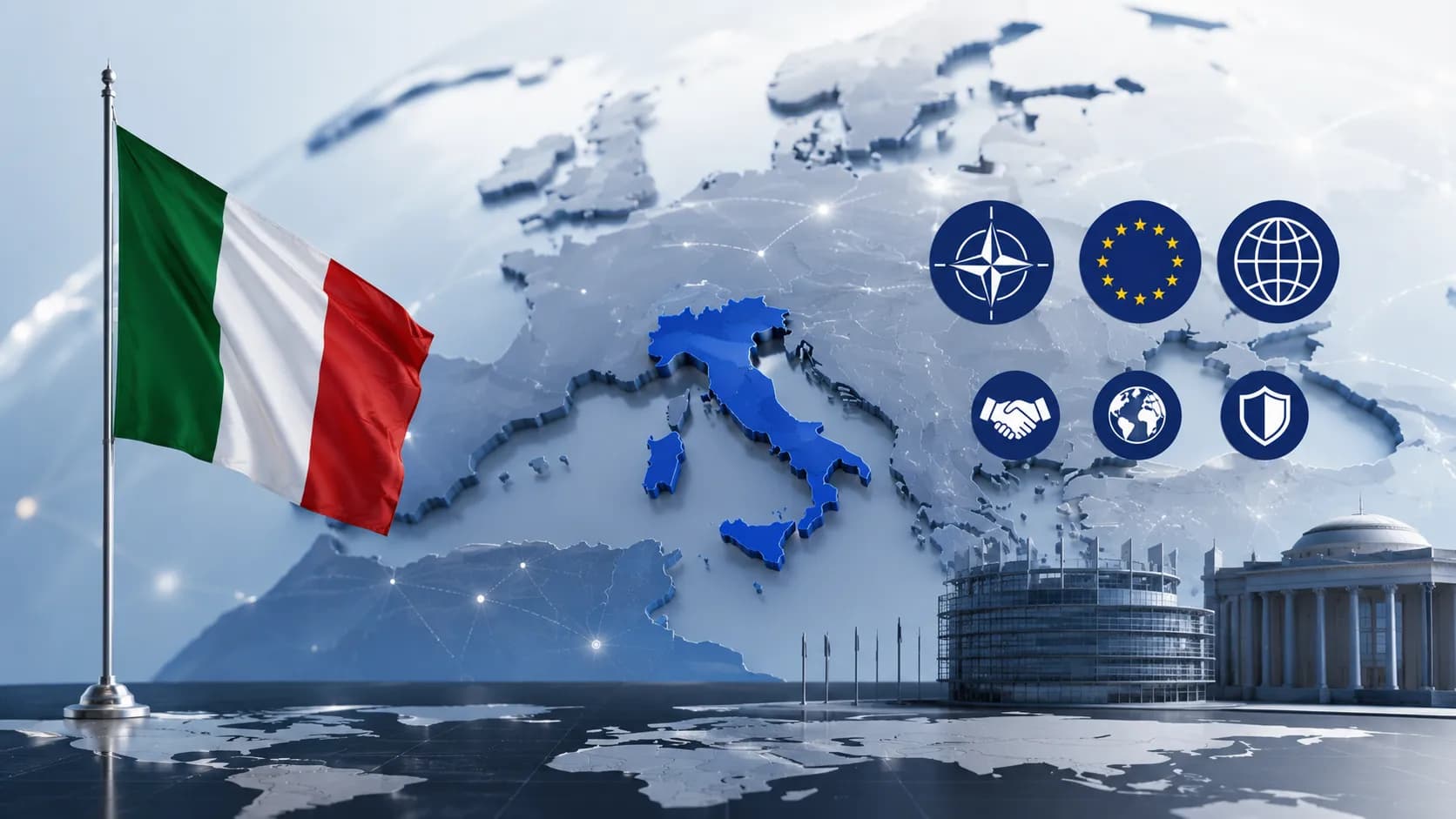
Italy's political shift to the right under Prime Minister Giorgia Meloni has changed the priorities and language of Italian foreign policy, but it has not produced the radical break with Europe or NATO that many initially expected.
Instead, Rome has developed a more pragmatic form of conservative foreign policy: strongly Atlanticist on security, increasingly restrictive on migration, more focused on the Mediterranean and Africa, sceptical of some EU regulatory policies and determined to use international relations more directly in pursuit of Italian national interests.
By August 2026, this combination has become one of the defining characteristics of the Meloni government.
From Euroscepticism to Influence Inside Europe
Before entering government in 2022, Meloni's political movement was frequently associated with national sovereignty and criticism of deeper European integration.
Government responsibility has moderated that position.
Rather than confronting the European Union from outside its political mainstream, Meloni has increasingly attempted to influence European policy from within.
Migration provides the clearest example.
Rome has pushed for stronger external borders, faster returns of irregular migrants, tougher action against smuggling networks and agreements with third countries.
In August 2026, Meloni and Danish Prime Minister Mette Frederiksen — despite coming from different political traditions — jointly called for stronger European action against uncontrolled migration and greater use of third-country solutions. The Italian government argues that border security and migration have consequently moved closer to the centre of the European political agenda.
Italy's ideological shift has therefore not translated into withdrawal from Europe. It has increasingly meant trying to move Europe toward Italian conservative priorities.
Ukraine Shows the Limits of Ideology
Ukraine provides perhaps the strongest evidence that ideology does not fully determine Italian foreign policy.
Meloni has consistently maintained support for Kyiv and Italy's NATO commitments despite resistance from parts of the Italian right.
Foreign Minister Antonio Tajani reaffirmed this week that Italy continues to support Ukraine's defence, reconstruction and energy resilience while maintaining pressure on Russia. Rome is also preparing another assistance package for Kyiv.
But maintaining this position is becoming politically more complicated.
Meloni faces opposition within her own conservative coalition, particularly from Matteo Salvini's League, where scepticism about continuing military assistance to Ukraine is considerably stronger.
The government is reportedly preparing its thirteenth military assistance package for Ukraine while attempting to reduce the domestic political visibility of the issue.
This creates an important contradiction in Italian politics.
The government has shifted right domestically, but on Russia and NATO, Meloni remains substantially closer to Europe's Atlanticist governments than to political movements advocating accommodation with Moscow.
Defence Reveals the Same Tension
Defence policy exposes similar divisions.
Italy formally requested €8 billion from the EU's SAFE defence financing programme this week, despite disagreements inside the governing coalition. Italy is eligible for as much as €14.9 billion from the €150 billion European programme.
Defence Minister Guido Crosetto supports using the programme, while Salvini's League has expressed reservations.
The dispute illustrates how Meloni's government increasingly separates ideological rhetoric from strategic necessity.
Italy wants greater national sovereignty, but modern defence requires cooperation with NATO and European partners.
Rome therefore seeks influence within European security structures rather than independence from them.
The Mediterranean Returns to the Centre
One of the clearest ideological effects has been geographical.
The Meloni government has placed the "enlarged Mediterranean" at the centre of Italian foreign policy.
North Africa, the Sahel, the Balkans, the Middle East and the Gulf are increasingly viewed as interconnected regions affecting Italy's security.
This reflects geography but also the government's political priorities.
Migration routes originate or pass through many of these regions. Italy's energy supplies depend heavily on Mediterranean relationships. Instability in Libya, Tunisia, the Sahel and the Middle East can directly affect Italian security and trade.
Rome consequently wants Italy to become a major diplomatic actor between Europe, Africa and the wider Mediterranean.
Recent diplomacy illustrates this ambition. Italy is hosting contacts involving Lebanese and Israeli delegations, while Foreign Minister Tajani has emphasized Italy's interest in Lebanon's stability and its relationships with Gulf countries.
Africa Becomes Strategic
Africa represents perhaps the most distinctive element of Meloni's foreign policy.
The government's flagship Mattei Plan for Africa attempts to combine development cooperation with energy security, infrastructure, agriculture, education, investment and migration management.
The strategy has expanded considerably since its introduction.
According to the Italian government, more than 70 projects have now been launched through the Mattei framework using a combination of public and private resources.
The programme originally focused on nine African countries before expanding to include Angola, Ghana, Mauritania, Tanzania and Senegal.
This represents an important change in Italian diplomacy.
Africa is no longer treated primarily as a development-policy issue. It is increasingly considered part of Italy's economic, energy, migration and national-security strategy.
Migration Becomes Foreign Policy
The ideological transformation is even clearer in migration.
Previous Italian governments often approached irregular migration primarily through humanitarian policy, European burden-sharing and domestic reception systems.
Under Meloni, migration has increasingly become an external-security question.
The government argues that irregular migration should be addressed before migrants reach Italian or European territory.
That means agreements with transit countries, stronger external borders, action against trafficking organizations and greater use of returns.
Following the recent Ceuta migration crisis, Meloni argued that protecting Europe's external borders is necessary both for security and for preserving free movement within Schengen.
Migration policy therefore increasingly overlaps with diplomacy toward Tunisia, Libya and other African and Mediterranean states.
National Interest Becomes More Visible
The broader transformation can be described as a shift from values-centred diplomacy toward more explicit interest-based diplomacy.
Energy security, migration control, Mediterranean stability, defence industry, exports and access to strategic markets have become increasingly visible components of Italian international engagement.
An analysis by Rome's Istituto Affari Internazionali describes Italy's recent approach as increasingly interest-driven, with particular emphasis on the enlarged Mediterranean, Africa, energy diplomacy and migration management.
This does not mean Italy has abandoned multilateral institutions.
Rome remains firmly embedded in the EU, NATO and the transatlantic alliance.
The difference is that these institutions are increasingly viewed as instruments through which Italy can defend national strategic interests.
Italy Is Changing Without Breaking With the West
The most significant consequence of Italy's ideological transformation is therefore not withdrawal from the Western alliance.
It is a change in priorities within that alliance.
Under Meloni, Italy has become more restrictive on migration, more assertive about national sovereignty, more focused on Africa and the Mediterranean, more critical of certain EU regulatory policies and more explicit about connecting diplomacy with economic and security interests.
At the same time, Rome continues supporting Ukraine, participating in European defence initiatives and maintaining its strategic relationship with Washington.
This creates a foreign policy that is simultaneously nationalist and internationalist.
Italy wants greater sovereignty, but it also recognizes that its economic and military influence depends heavily on alliances.
The emerging Meloni doctrine is therefore less about taking Italy out of Europe's political mainstream than about changing that mainstream from within.
As European politics itself moves toward greater emphasis on borders, defence and economic security, Italy's ideological shift may ultimately influence not only Rome's foreign policy but also the direction of European foreign policy as a whole.
Ahmet Balakan
Contributing writer at EUReflect.
Follow EUReflect
See more of our reporting on Google
Mark EUReflect as a preferred source and our stories are ranked higher for you in Top Stories, Discover and Google News — and carry a “preferred” badge when they are cited in AI results.
Add EUReflect as a preferred source