Japan’s Tech Comeback Goes Global
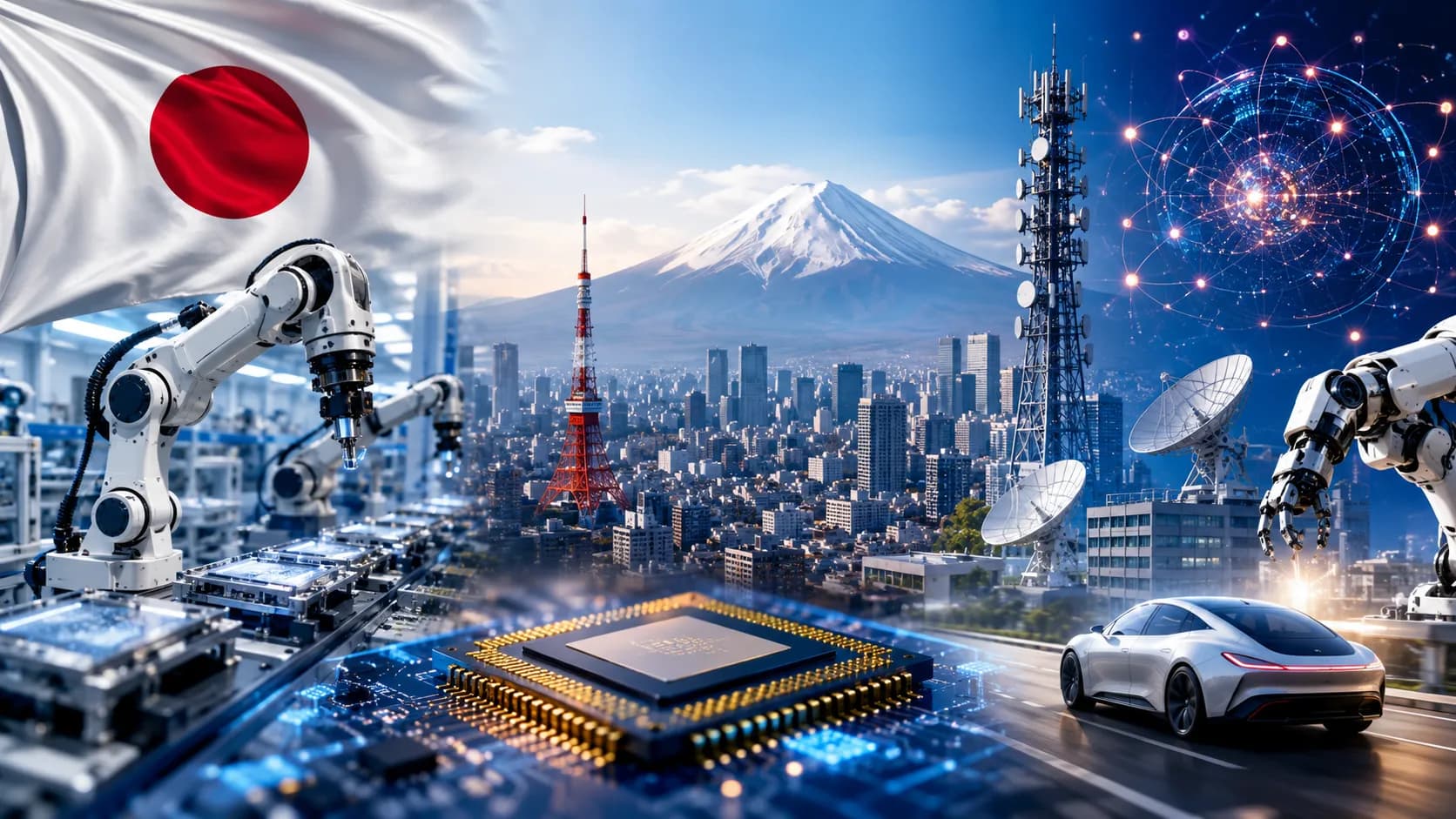
Tokyo's strategy includes a goal of deploying 10 million AI-equipped robots, linking AI development with its robotics industry.
Japan’s Tech Comeback Goes Global
Japan is entering a new phase of technological investment, shifting from its traditional strength in precision manufacturing toward a broader strategy built around artificial intelligence, advanced semiconductors, robotics, quantum technology and digital infrastructure.
The scale of the shift is significant. In June, the Japanese government unveiled a long-term investment framework targeting more than ¥370 trillion, roughly $2.3 trillion, in combined public and private investment through fiscal 2040 across 17 strategic sectors. Around ¥101.6 trillion is expected to be directed toward artificial intelligence and semiconductors, making advanced computing one of the central pillars of Japan’s future industrial strategy.
Japan’s strategy is particularly important because it comes as technological competition is increasingly dividing the global economy into competing industrial ecosystems centered on the United States, China and, to a lesser extent, Europe.
Tokyo appears determined to establish a fourth position: not necessarily competing with the United States and China across every technological field, but becoming indispensable in strategically important parts of the global technology supply chain.
Semiconductors Return to the Center
Semiconductors provide the clearest example.
Japan dominated significant parts of the global semiconductor industry during the 1980s but gradually lost its position in advanced chip manufacturing. Tokyo is now attempting to rebuild that capability.
The government-backed Rapidus project is central to this effort. The company is developing next-generation 2-nanometer logic semiconductor technology, with mass-production ambitions for 2027. In February, Rapidus secured ¥267.6 billion in new government and private-sector funding, while additional government support approved in April further strengthened the project.
Japan is also strengthening its position in memory.
On August 27, Kioxia and U.S.-based Sandisk announced plans to invest more than $31 billion in Japan through 2032, expanding semiconductor technology and production capacity as global AI infrastructure drives demand for advanced memory. The scale of the project demonstrates how the AI investment cycle is beginning to reshape Japan’s industrial base.
This matters globally because Japan already occupies critical positions in semiconductor materials, manufacturing equipment and precision technologies. Restoring advanced fabrication would allow the country to connect these existing strengths with domestic production.
Japan Is Looking Beyond Generative AI
Japan’s technological strategy is broader than building large language models.
Tokyo plans to develop a domestic AI ecosystem while connecting artificial intelligence with one of Japan’s strongest traditional industries: robotics.
The government has outlined an ambition to have 10 million AI-equipped robots operating across more than a dozen sectors by 2040. Japan is also supporting the development of a domestic foundation AI model, partly reflecting growing concerns worldwide about excessive dependence on American and Chinese AI platforms.
This could give Japan a distinctive competitive advantage.
While the United States currently dominates frontier AI models and cloud infrastructure, Japan could become particularly competitive in physical AI — systems where artificial intelligence interacts directly with machines, factories, vehicles, logistics networks and robots.
The government's longer-term investment framework envisages approximately ¥10.5 trillion for physical AI and another ¥8.2 trillion for autonomous-driving technologies.
For an aging country facing persistent labor shortages, automation is not simply an export opportunity. It is becoming an economic necessity.
Quantum, Communications and Cybersecurity
Japan is simultaneously investing in technologies that could define the period after today's generative-AI boom.
The National Institute of Information and Communications Technology's new 2026–2031 strategy identifies four priority areas: AI and communications, Beyond 5G, quantum ICT and cybersecurity. Importantly, the strategy explicitly links technological development with Japan's need for greater technological autonomy and economic security.
Japan is also expanding international research partnerships.
Cooperation with the European Union now includes AI governance, quantum research and hybrid quantum-HPC systems. This illustrates an important component of Tokyo's global strategy: Japan is attempting to combine domestic technological sovereignty with international research networks rather than pursuing technological isolation.
Private Investment Is Beginning to Follow
Government strategy alone will not determine whether Japan succeeds.
There are indications, however, that corporate investment is moving in the same direction. The Development Bank of Japan's latest survey projects 19.7% growth in domestic capital expenditure by major companies in fiscal 2026, with AI, data centers and related investments among the principal drivers. Companies are also increasingly emphasizing resilient supply chains rather than simply seeking the lowest production costs.
There remains a major weakness: adoption.
A Reuters survey published this month found that only 16% of Japanese companies use AI across their organizations, while more than 80% have yet to fully integrate the technology. Japan therefore faces an unusual contradiction: it is preparing enormous investments in the infrastructure of the AI economy while many domestic companies remain relatively cautious users of AI.
Japan’s Global Opportunity
Japan is unlikely to recreate the technological hierarchy of the 1980s, and that may no longer be its objective.
Instead, the emerging strategy appears designed to make Japan difficult to bypass.
Advanced chips, semiconductor materials, robotics, precision manufacturing, batteries, quantum technologies, data centers and AI infrastructure are increasingly connected. A country controlling strategically important positions across several of these industries can exercise considerable influence without dominating every technology individually.
That is where Japan's global opportunity lies.
The United States possesses enormous advantages in software, cloud computing and frontier AI. China has scale, manufacturing capacity and rapidly expanding technological ecosystems. Japan's strength is different: deep industrial expertise combined with advanced manufacturing and increasingly aggressive public investment.
If Tokyo successfully connects those capabilities with AI and next-generation computing, Japan could move from being viewed primarily as one of the technological leaders of the past to becoming one of the critical infrastructure powers of the next technological era.
Ahmet Balakan
Contributing writer at EUReflect.
Follow EUReflect
See more of our reporting on Google
Mark EUReflect as a preferred source and our stories are ranked higher for you in Top Stories, Discover and Google News — and carry a “preferred” badge when they are cited in AI results.
Add EUReflect as a preferred source