Just Before the Armies Speak: Syria as the Key Country Ahead of the Inevitable Türkiye-Israel War
According to Dr. Shinqiti, “Israel’s war against Syria and Türkiye is inevitably approaching.”
The recent striking assessment by the renowned scholar Dr. Muhammad Mukhtar al-Shinqiti, who teaches Global Affairs at Qatar University, has resonated profoundly within security circles closely monitoring Middle Eastern geopolitics. According to Dr. Shinqiti, “Israel’s war against Syria and Türkiye is inevitably approaching.” This statement is not merely an early warning; it also highlights the historical, strategic, and ethical responsibilities confronting regional actors.
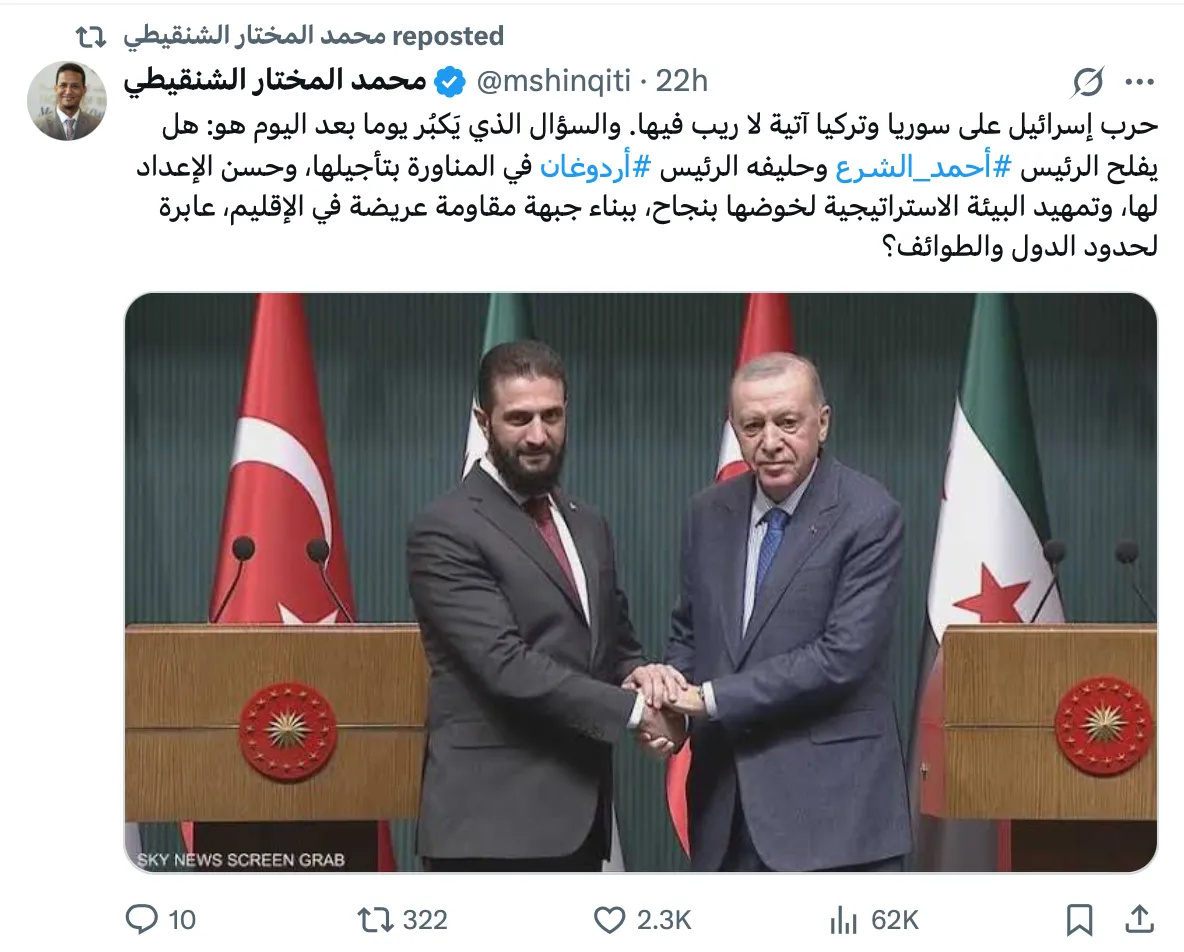
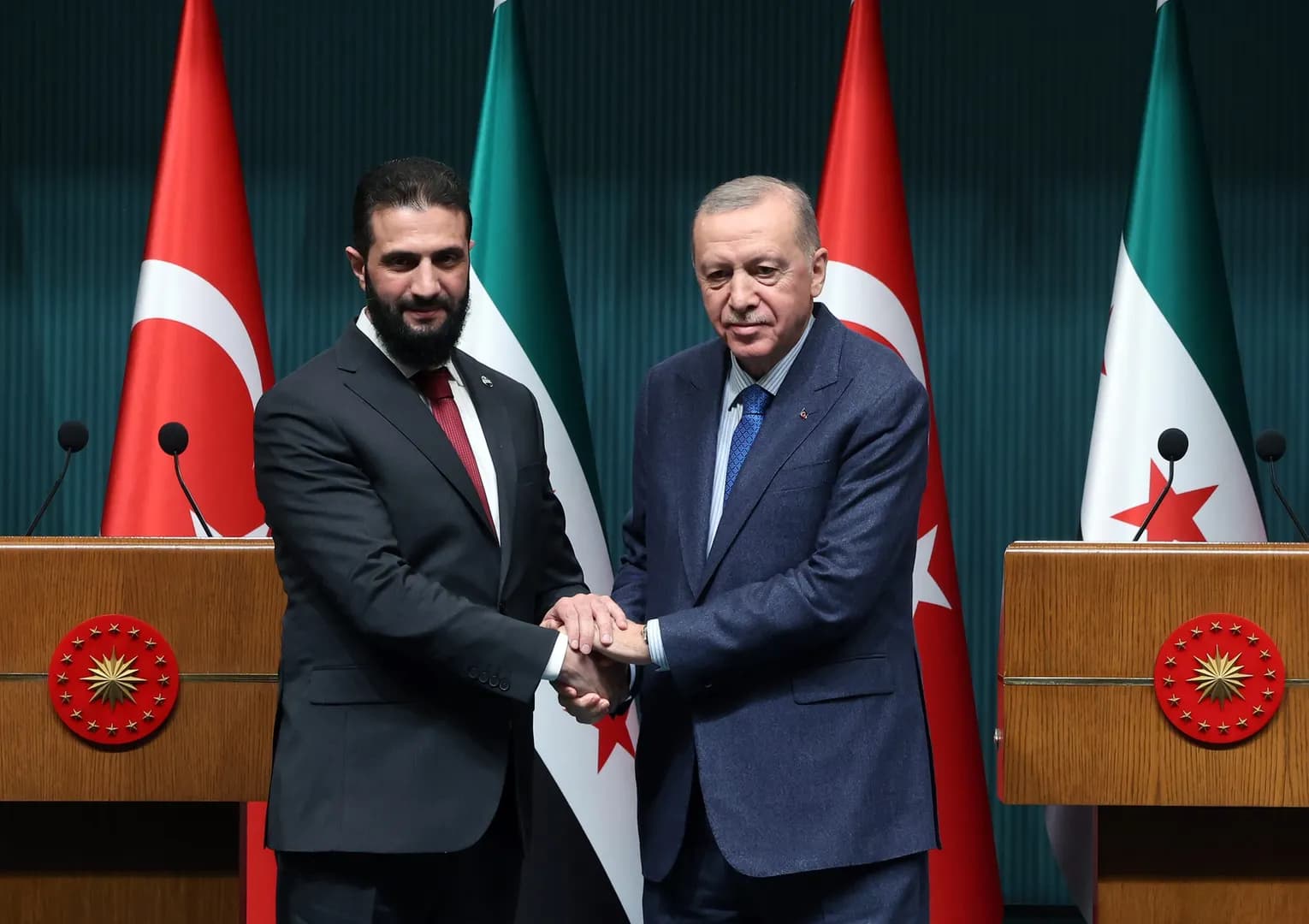
Dr. Shinqiti’s central question can be summarized as follows: “To what extent can President Ahmed Al-Sharaa and his ally President Erdoğan effectively delay this war, adequately prepare for it, and shape the appropriate strategic environment to conduct it successfully? In this context, is it feasible to build a broad-based resistance front that transcends national borders and sectarian divisions?”
This inquiry is grounded not in speculative futurism but in a dispassionate analysis of prevailing military, political, and societal trends in the region. The power vacuum resulting from the Syrian civil war, the limited maneuverability of Iran and Russia, Türkiye’s adoption of a “forward intervention” strategy in its regional defense policies, and Israel’s increasingly heightened security reflexes collectively form the analytical foundation.
Türkiye’s Strategic Choices: Managing the Crisis or Shaping It?
Türkiye’s expanding role in regional affairs presents both significant geopolitical opportunities and grave strategic risks. Notable advances in the defense industry have enabled Türkiye to reconstruct its security architecture; however, a prolonged “crisis postponement” strategy may reduce Türkiye to a passive, reactive actor. Such a stance risks incurring severe costs not only militarily but also diplomatically and socially.
This predicament can be analogized to a game of chess: while every piece holds unique importance, the outcome hinges not solely on their positions but critically on the timing of moves. Even the most powerful pieces lose efficacy if not deployed at the proper moment. If the opponent’s king is threatened and one’s own pieces remain perfectly positioned but fail to act timely, defeat is inevitable. Strategic superiority, therefore, is determined not only by the resources at one’s disposal but also by when and how these resources are mobilized. A power that fails to manage time squanders its advantages and falls behind in the game.
In security literature, it is emphasized that a state’s readiness for war depends not only on military capacity but also on strategic foresight and the coordination abilities of decision-making elites. Given Türkiye’s presence in Syria and its active rhetoric regarding Gaza, its indirect entanglement in a potential Israel-Syria-centered conflict is plausible.
Ankara’s attempt to defer the conflict through diplomacy is an understandable strategy; nevertheless, each year passing without sufficient military and diplomatic preparation increases the risk of facing a heavier toll in the future. Postponing a geopolitical confrontation often facilitates adversarial actors’ preparation while dulling the operational reflexes of the defending party.
The Resistance Front: The Gap Between Theory and Practice
Dr. Shinqiti’s proposal for a “broad resistance front transcending countries and sects and crossing regional boundaries” theoretically rests on principles of solidarity and collective security. However, it encounters multifaceted challenges in practice. The principal obstacle is the sectarian polarization and historical distrust endemic to the region. Yet, the critical focus must remain on the polarization vis-à-vis Israel and the contemporary security environment.
Moreover, such an alliance is directly linked not only to external threat perception but also to internal security dynamics. In multi-ethnic societies, ethnic and sectarian tensions have become fundamental determinants in shaping security policies. Preventing ethnic conflicts in nation-building processes is crucial not only for internal stability but also for enhancing regional resilience.
Accordingly, the professionalization of security forces, their structuring in consideration of ethnic and cultural sensitivities, and the development of conflict-resolution-oriented training models are imperative. Without these measures, resistance strategies executed on the external front may be rendered ineffective due to internal disintegration. Hence, Türkiye’s robust support for Syria’s reconstruction is foreseen as essential.
Groups Wear Down Israel; Only Regular Army Stops It
Asymmetric conflicts in the Middle East have shown, albeit limitedly, the effectiveness of Proxy forces against modern armies. Groups can tactically wear down a state like Israel, which possesses advanced technology and sophisticated weaponry; however, halting or decisively altering Israel’s strategic trajectory without regular army capacity is nearly impossible.
Proxy forces can provide short-term pressure and deterrence through urban warfare, guerrilla tactics, tunnel-based missile launches, and drone attacks. Such attacks undermine Israel’s internal security perception, affect societal psychology, and create temporary economic pressures. However, these methods cannot fundamentally obstruct Israel’s strategic goals because these groups generally lack political unity, are not recognized as state entities under international law, and do not possess long-term conventional warfare capabilities.
Conversely, Israel maintains a highly institutionalized regular army, a powerful air force, and substantial intelligence capacities. Consequently, establishing a sustainable balance against Israel is feasible only through disciplined, state-backed military structures. Limiting the operational capacity of the Israeli military, balancing its airspace, and deterring ground incursions require not only Proxy forces but also state-supported conventional armies.
This reality underscores the critical positions of actors such as Türkiye and Syria. Syria’s military capabilities have been severely diminished due to prolonged civil war. Türkiye, operating within NATO obligations, is simultaneously developing its military doctrine against regional security threats. If Israel’s intervention capacity in the region is to be constrained, this is possible only through state-backed conventional forces.
In this regard, Iran’s proxy warfare model through Proxy forces cannot prevent Israel’s long-term strategic planning. On the contrary, Israel uses these threats to justify military operations and garner support from the West. When confronted with a deterrent, persistent, internationally recognized army that holds societal legitimacy on the ground, Israel’s maneuvering space narrows.
Conclusion: Preparation Is Not Optional But Imperative
Dr. Shinqiti’s warnings are not merely academic cautions. From the perspective of regional geopolitical analysis, such assessments provide early warning mechanisms for policymakers. Türkiye’s stance in this context will be decisive not only for its national security strategy but also for the construction of regional peace.
In conclusion, establishing regional deterrence against Israel is possible only through coordinated regular armies led by politically responsible state actors, not solely Proxy forces. While Proxy forces may create tactical disruptions, they cannot establish strategic equilibrium. Therefore, Türkiye’s reinforcement of its military capacity, alongside supporting the restructuring of regular armies in neighboring countries such as Syria, constitutes not only a defensive imperative but also a cornerstone of a long-term regional balance strategy. Otherwise, Israel’s zone of dominance will expand, and proxy wars will remain a protracted process of attrition without decisive resolution.

İsmail Polat
Ph. D. in International Relations
Follow EUReflect
See more of our reporting on Google
Mark EUReflect as a preferred source and our stories are ranked higher for you in Top Stories, Discover and Google News — and carry a “preferred” badge when they are cited in AI results.
Add EUReflect as a preferred source