Nepal and the European Union: A New Chapter in Investment, Tourism and Strategic Engagement
For decades, Nepal has been known in Europe primarily through the image of the Himalayas, Mount Everest, spiritual heritage, cultural depth and adventure tourism. Today, however, Nepal’s importance to the European Union goes far beyond tourism. Located between India and China, Nepal occupies a strategic position in South Asia and holds strong potential in renewable energy, hydropower, sustainable tourism, agriculture, digital services and climate-resilient development.
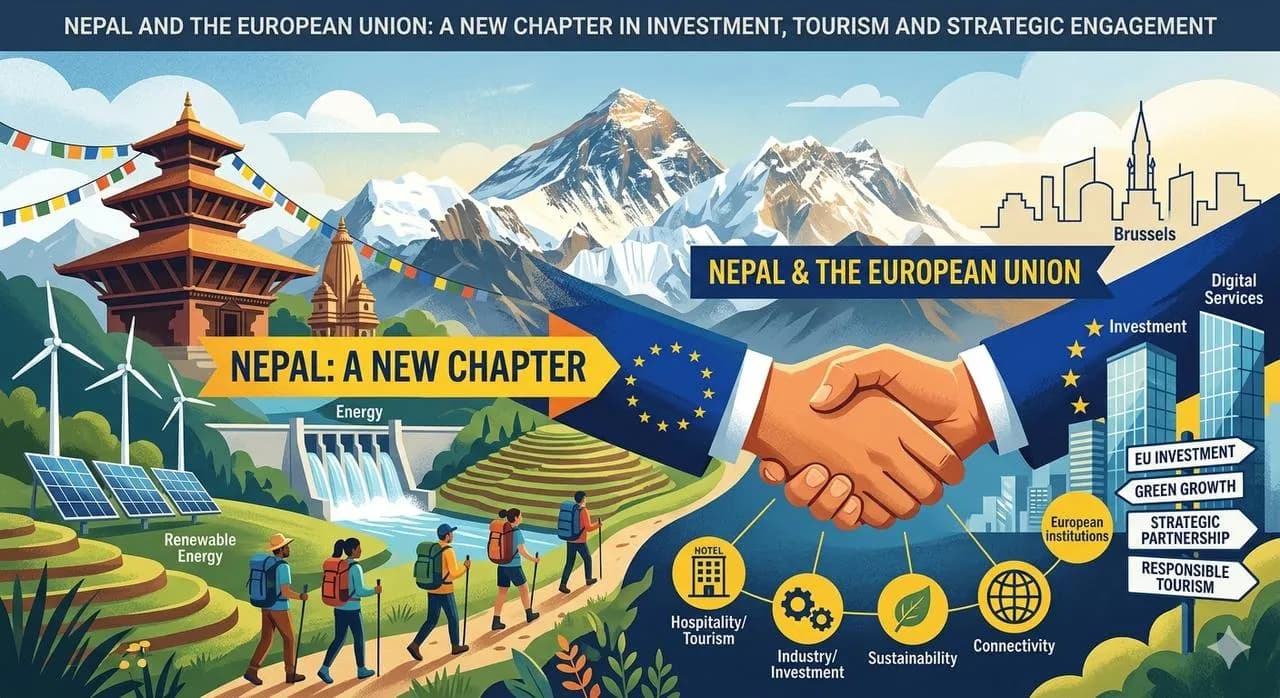
The relationship between Nepal and the European Union is entering a more mature phase. Traditionally, the EU’s engagement with Nepal has focused on development cooperation, democratic governance, human rights, education, resilience, and inclusive growth. Yet the new global environment requires a broader perspective. Nepal is no longer only a country to be supported through development programmes; it can also become a serious partner for sustainable investment, green growth, and responsible tourism.
This shift comes at an important moment. Nepal’s new government is expected to place stronger emphasis on economic reform, investment facilitation, and international partnerships. For Nepal, the main challenge is not a lack of potential. The country has natural beauty, a young population, strategic geography, and a powerful global tourism identity. The real challenge is to convert these advantages into bankable projects, investor confidence, and long-term economic value.
From the European Union’s perspective, Nepal matters for several reasons. First, it is a key country in the climate agenda. As a Himalayan nation, Nepal is directly exposed to the consequences of climate change, including melting glaciers, water security risks, and fragile mountain ecosystems. Supporting Nepal’s green transition is therefore not only a development priority, but also part of Europe’s wider global climate responsibility.
Second, Nepal is strategically located in a sensitive but important region. Situated between two major powers, India and China, Nepal has the potential to act as a balanced partner in South Asia. For the European Union, engagement with Nepal does not need to be framed through geopolitical competition. It can instead be built around sustainable development, connectivity, institutional capacity, investment standards, and people-to-people cooperation.
Third, Nepal represents a meaningful opportunity for European investors. Hydropower, renewable energy, tourism infrastructure, hospitality, agriculture, digital services, and education are all sectors where European expertise can contribute. The EU’s long-standing emphasis on sustainability, governance, and responsible business makes it a natural partner for Nepal’s next stage of growth.
Tourism should be seen as one of the most immediate and effective entry points for this new investment relationship. For a country like Nepal, tourism is not just a soft-power asset. It is one of the fastest ways to attract foreign investment, create employment, improve infrastructure, support small businesses, and promote international visibility. Hotels, resorts, aviation connectivity, destination management, wellness tourism, mountain tourism, cultural routes, gastronomy, and eco-tourism can all become part of a broader investment strategy.
In this context, the visit of Bulut Bağcı, President of the World Tourism Forum Institute, to Nepal this week carries particular significance. His visit should not be viewed only as a tourism-sector engagement. It also reflects Nepal’s growing potential to become more visible within European institutional, investment, and tourism circles.
The Global Tourism Forum brand and the World Tourism Forum Institute have built a strong international reputation through Brussels-based initiatives, high-level public-private dialogue and tourism investment platforms. Over the years, these platforms have brought together governments, investors, tourism leaders, institutions and international media around one central idea: tourism can be a powerful engine for economic development. This is especially relevant for Nepal. If the country wants to attract investment quickly and responsibly, tourism can provide the first visible success story. A well-designed tourism investment strategy can create confidence among international partners and open the door to wider cooperation in infrastructure, energy, aviation, digital services and destination development.
The fact that the World Tourism Forum Institute has strong links with Brussels and has received support and recognition from several European institutional circles gives this visit an additional layer of importance. It suggests that Nepal could increasingly become a destination of interest not only for travellers, but also for European policymakers, investors, and development institutions. In this sense, Nepal may be moving closer to Europe’s “hot spot” agenda — not in a political or controversial way, but as a country with untapped potential, strategic geography, and a strong sustainability story. For the European Union, Nepal offers a constructive partnership opportunity. For Nepal, Europe offers credibility, standards, investment discipline, and global visibility. The new government’s investment strategy should therefore focus on clarity, speed, and confidence. International investors need predictable regulations, transparent approval processes, strong public-private partnership models, and clear sectoral priorities. Nepal does not need to open every sector at once. It can start with carefully selected flagship projects, especially in tourism and renewable energy, and use these projects to build international trust.
A new EU–Nepal investment dialogue could also focus on practical outcomes: sustainable tourism zones, green hotel investment, mountain infrastructure, vocational training, destination branding, digital tourism platforms, aviation partnerships, and climate-resilient infrastructure. These are areas where Nepal’s needs and Europe’s expertise naturally meet. At the same time, the relationship must be handled with balance and sensitivity. Nepal should not be presented as a field of competition between global powers. Its future should be framed around national development, responsible investment, and international partnership. The European Union’s role can be most effective when it supports Nepal’s own priorities rather than imposing external agendas. This is why the tone of the relationship matters. Nepal needs partners who understand its culture, geography, and political sensitivities. Europe needs reliable partners who share a commitment to sustainability, governance, and long-term development. The foundation for such a partnership already exists; what is needed now is a more investment-oriented roadmap.
Bulut Bağcı’s visit comes at a moment when Nepal is searching for exactly this kind of international positioning. As President of the World Tourism Forum Institute, his engagement can help connect Nepal’s tourism potential with European investment networks and global tourism decision-makers. It can also support the idea that Nepal is not merely a destination to admire, but a country to invest in, partner with, and take seriously.
The coming years may define a new era in Nepal–EU relations. If both sides focus on tourism, green investment, digital transformation, and sustainable infrastructure, Nepal can become one of Europe’s most interesting partners in South Asia. The country has the story, the geography, and the potential. What it needs now is structured visibility, investor confidence, and international platforms that can translate opportunity into action.
Nepal is no longer only the land of Everest. It is an emerging investment destination, a climate-sensitive partner, a tourism powerhouse in waiting and a country that could play a more important role in Europe’s engagement with South Asia. For the European Union, Nepal represents a quiet but strategic opportunity. For Nepal, Europe represents trust, credibility and access to a wider investment ecosystem. If this relationship is developed carefully, respectfully, and practically, both sides can benefit from a new chapter of cooperation built around tourism, sustainability, and long-term economic partnership.
EUReflect News
Site Administrator
Follow EUReflect
See more of our reporting on Google
Mark EUReflect as a preferred source and our stories are ranked higher for you in Top Stories, Discover and Google News — and carry a “preferred” badge when they are cited in AI results.
Add EUReflect as a preferred source