Dutch Agriculture Powers Trade
Agricultural exports hit a record €137.5 billion in 2025, up 8.4%, and now account for 20.7% of total Dutch goods exports, the highest share since 2001.
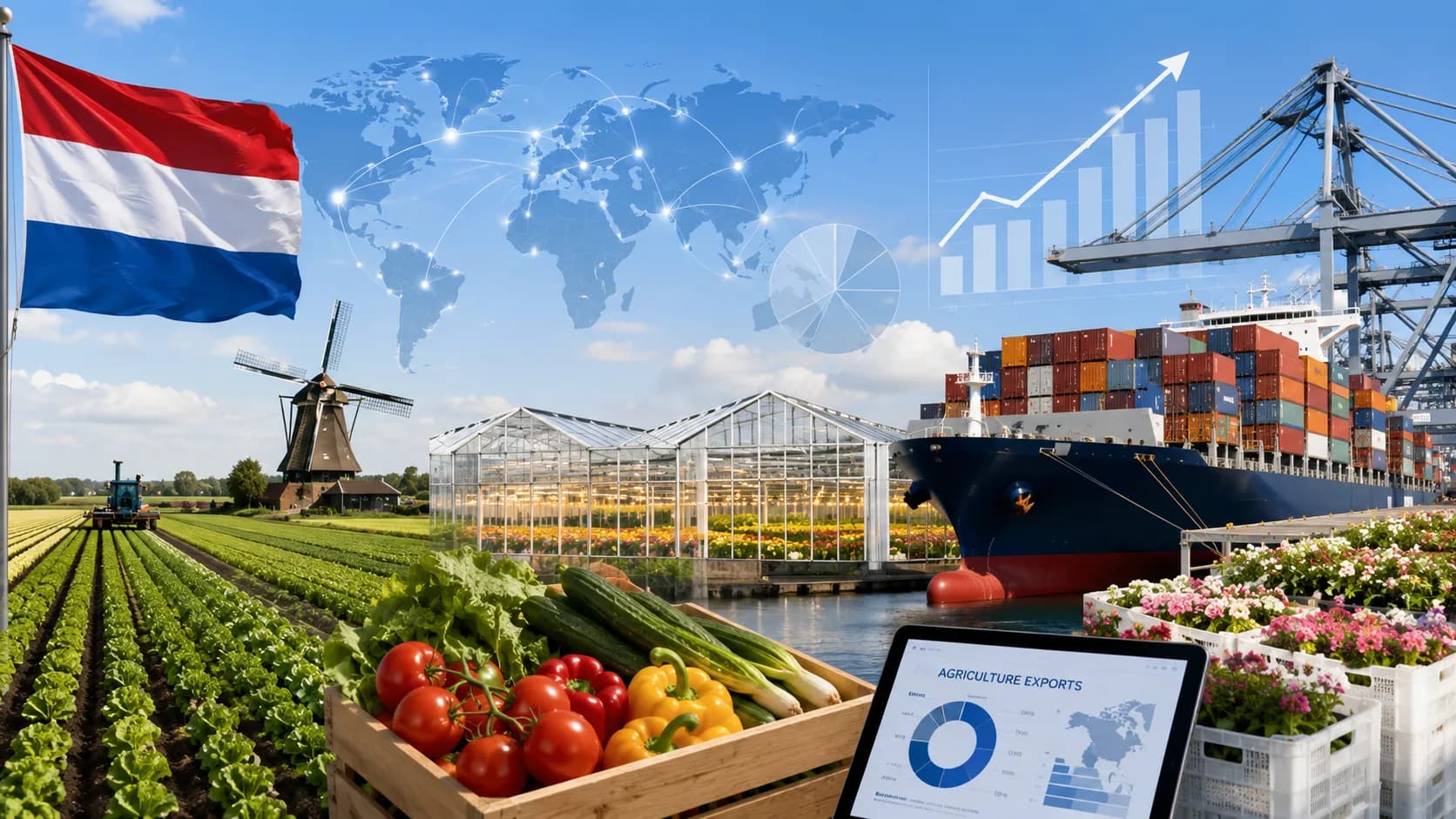
The Netherlands has built one of the world's most commercially successful agricultural systems despite being a relatively small and densely populated country. In 2026, agriculture remains important to the Dutch economy not simply because of farming itself, but because it supports a much larger network of food processing, horticulture, logistics, technology and international trade.
The latest figures underline that importance. Dutch agricultural exports reached an estimated €137.5 billion in 2025, an increase of 8.4% from the previous year. It was the tenth consecutive year in which the value of agricultural exports increased.
Agricultural products accounted for approximately 20.7% of total Dutch goods exports in 2025, the highest share recorded since 2001.
Agriculture Generates Billions for the Economy
The economic importance of Dutch agriculture becomes clearer when export value is separated from actual earnings generated inside the Netherlands.
According to Statistics Netherlands and Wageningen University & Research, the Dutch economy earned more than €49 billion from agricultural goods exports in 2025. Around €43.5 billion came from agricultural goods produced or substantially processed in the Netherlands, while €5.7 billion came from re-exports.
When agriculture-related products such as machinery and greenhouse technology are included, total Dutch earnings from broad agricultural exports are estimated at €54.6 billion.
This demonstrates why Dutch agriculture should not be understood simply as fields, farms and livestock.
It is an integrated economic ecosystem.
Farmers are connected with food processors, research institutions, greenhouse companies, seed producers, agricultural technology firms, ports, logistics operators and international retailers.
Horticulture Is a Strategic Industry
Horticulture remains one of the strongest components of this system.
Dutch exports of horticultural products including flowers, plants, bulbs and nursery products reached approximately €12.3 billion in 2025.
New research released by Wageningen in July 2026 also shows that the wider Dutch horticultural supply chain generated €20.4 billion in added value in 2024, equivalent to approximately 1.8% of Dutch GDP.
The horticultural cluster supported around 208,000 annual work units, representing roughly 2.5% of total Dutch employment.
The Netherlands has therefore transformed horticulture from a traditional agricultural activity into a high-value industrial and technological sector.
Greenhouse production, automation, plant genetics, climate-control systems and advanced logistics allow Dutch producers to generate substantial value from limited land.
Technology Is Part of the Agricultural Export Model
One of the Netherlands' greatest agricultural strengths is that it exports not only food but also the technology required to produce food.
Exports of agriculture-related goods reached an estimated €14 billion in 2025, rising 14% from 2024. Agricultural machinery accounted for €3.6 billion, while greenhouse materials represented another €3.1 billion.
This gives the Netherlands a different position from many traditional agricultural exporters.
Its international competitiveness increasingly comes from knowledge, technology and processing capacity as much as from agricultural land.
Dutch companies can therefore participate in global agriculture even when production itself takes place outside the Netherlands.
Germany Remains the Main Market
European integration is another major advantage.
Almost 73% of Dutch agricultural exports went to other EU countries in 2025. Germany remained by far the largest market, followed by Belgium and France.
This geographic position allows Dutch producers to reach some of Europe's largest consumer markets quickly.
At the same time, Rotterdam and other Dutch logistics infrastructure connect agricultural supply chains with global markets.
The Netherlands also functions as a processing and distribution centre. Around 72% of imported agricultural goods are subsequently processed or re-exported, demonstrating that the country's agricultural economy extends far beyond domestic production.
Agriculture Supports Dutch Economic Growth
The importance of this export model became particularly visible in the latest national economic figures.
The Dutch economy expanded by 1.6% in 2025, with exports of goods and services contributing approximately 0.9 percentage points to that growth. CBS specifically identified increased exports of machinery, food and domestically produced agricultural products among the factors supporting economic expansion.
Agriculture is therefore connected directly to the Netherlands' broader export-driven economic model.
Yet the sector also faces significant challenges.
Environmental regulations, nitrogen emissions, land availability, energy costs, climate change and pressure to reduce pesticide use are forcing Dutch agriculture to become more sustainable while maintaining its international competitiveness.
The future of Dutch agriculture will consequently depend less on simply increasing production and more on producing greater economic value with fewer resources.
That is also the central lesson of the Dutch model.
The Netherlands has demonstrated that agricultural power does not necessarily depend on possessing enormous amounts of farmland. By combining technology, research, intensive production, processing, logistics and access to international markets, the country has turned agriculture into one of the strategic pillars of its export economy.
Zhansaya Nurlanovna
Contributing writer at EUReflect.
Follow EUReflect
See more of our reporting on Google
Mark EUReflect as a preferred source and our stories are ranked higher for you in Top Stories, Discover and Google News — and carry a “preferred” badge when they are cited in AI results.
Add EUReflect as a preferred source