Taliban Rule Tests International Law
Russia is the only state to formally recognize the Taliban, while others engage without full legal recognition, creating a unique legal limbo.
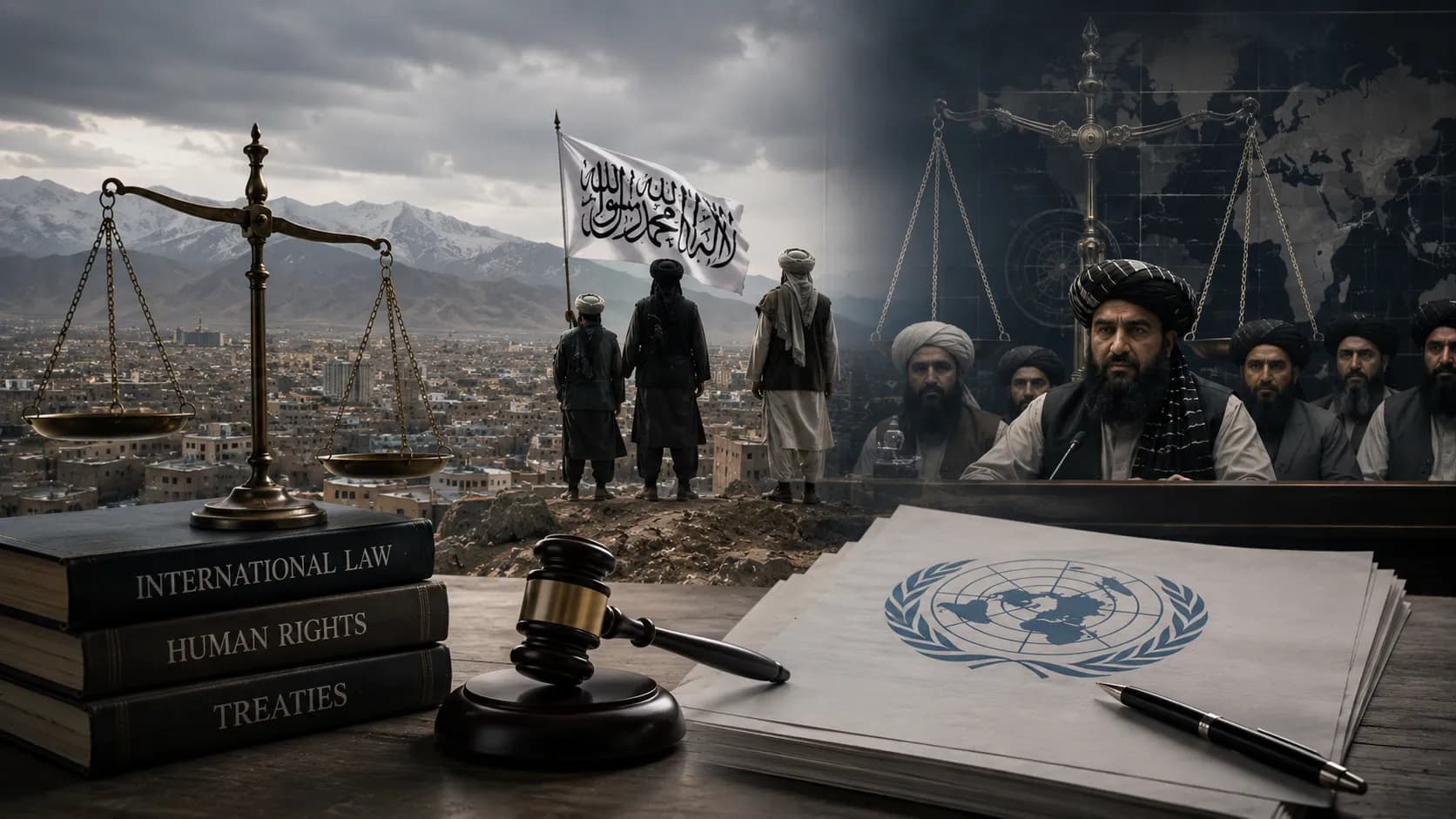
Five years after the Taliban returned to power in Afghanistan, the country's political reality presents one of the most complicated tests for contemporary international law: how should the international community deal with a government that exercises effective control over a state but remains largely without formal international recognition?
The Taliban has controlled Afghanistan since August 2021. Yet as of August 2026, Russia remains the only country to have formally recognized the Taliban government, after doing so in July 2025. Other countries, including China, Iran, Türkiye, Qatar, the UAE and several Central Asian states, maintain varying degrees of diplomatic or economic engagement without extending full legal recognition.
This creates an unusual situation: the Taliban governs Afghanistan in practice, while its international legal legitimacy remains deeply contested.
Control Does Not Remove Legal Obligations
International law makes an important distinction between recognition and responsibility.
A government does not become free from international obligations simply because other countries refuse to recognize it.
The United Nations has emphasized that Afghanistan remains bound by its existing international human-rights obligations and that the Taliban, as the authority exercising effective control over the country, is required to respect those obligations.
This principle has major consequences.
Afghanistan remains party to international treaties covering areas including women's rights, civil and political rights, children's rights and torture.
A change of government does not automatically erase those treaty commitments.
The Taliban's argument that domestic governance should follow its interpretation of Islamic law therefore does not by itself remove Afghanistan's previously assumed international obligations.
Women's Rights Are the Central Legal Dispute
No issue has created a larger conflict between Taliban governance and international law than the treatment of women and girls.
Women remain excluded from many forms of employment and public life, while Afghanistan continues to be the only country where girls are prohibited from attending secondary education because of their gender.
The restrictions have increasingly moved from the political arena into international legal proceedings.
Australia, Canada, Germany and the Netherlands initiated steps under the Convention on the Elimination of All Forms of Discrimination against Women (CEDAW), arguing that Taliban policies constitute systematic violations of Afghanistan's treaty obligations.
This is significant because it reframes the issue.
Women's rights in Afghanistan are no longer being treated simply as a diplomatic disagreement with the Taliban. They are increasingly being approached as a question of state responsibility under international law.
The ICC Has Targeted Taliban Leaders
International criminal law represents an even more serious challenge for the Taliban leadership.
Afghanistan joined the Rome Statute in 2003, meaning the International Criminal Court can exercise jurisdiction over certain international crimes committed on Afghan territory from May 2003 onward.
On July 8, 2025, the ICC issued arrest warrants for Taliban Supreme Leader Haibatullah Akhundzada and Taliban Chief Justice Abdul Hakim Haqqani.
The judges found reasonable grounds to believe that they bear criminal responsibility for the crime against humanity of persecution on gender and political grounds involving women, girls and people considered their supporters.
The Afghanistan investigation has remained active in 2026. Recent developments at the ICC have also placed greater emphasis on the investigation of alleged Taliban persecution of women.
This creates a critical distinction between two branches of international law.
Afghanistan can bear responsibility as a state, while individual Taliban leaders can separately face personal criminal responsibility.
Recognition Remains the Taliban's Diplomatic Problem
International recognition presents another legal and political dilemma.
Russia's decision to recognize the Taliban government demonstrated that recognition is possible even without fundamental changes to Afghanistan's domestic political structure.
Other governments have taken a more cautious approach.
Many have accepted Taliban-appointed diplomats, negotiated trade agreements or conducted direct talks with Taliban officials without formally recognizing the Islamic Emirate.
This has created a system of de facto engagement without de jure recognition.
Countries need to communicate with Kabul over terrorism, refugees, trade, humanitarian assistance and regional infrastructure. But many governments are reluctant to provide formal recognition because they fear that doing so would legitimize Taliban policies.
Even terminology has become politically sensitive at the UN Security Council, where members have disagreed over whether describing the Taliban as Afghanistan's “de facto authorities” could implicitly confer legitimacy.
UN Sanctions Continue
Recognition is further complicated by the fact that international sanctions remain in place against Taliban-linked individuals and entities.
In February 2026, the UN Security Council unanimously adopted Resolution 2816, maintaining the sanctions framework involving asset freezes, travel restrictions and an arms embargo against designated individuals and entities associated with the Taliban that threaten Afghanistan's peace, stability and security.
The Security Council simultaneously extended the mandate of the sanctions monitoring mechanism until February 2027.
This creates another unusual legal reality.
Foreign governments can negotiate with Taliban officials while some individuals within the Taliban structure remain subject to international sanctions.
Engagement and sanctions therefore operate simultaneously.
Security Creates Another International Obligation
The Taliban's responsibilities also extend beyond human rights.
Afghanistan's territory remains relevant to international counter-terrorism concerns, particularly because of ISIS-K and questions surrounding other militant networks operating in or around the country.
The UN Security Council continues to describe the situation in Afghanistan as a threat to international peace and security.
For neighboring states, this issue can sometimes be more important than formal recognition.
China, Russia, Pakistan and Central Asian governments have strong incentives to maintain direct relations with Kabul because instability, terrorism, narcotics trafficking and refugee movements can cross Afghanistan's borders.
This explains why political engagement with the Taliban has expanded even while formal recognition remains extremely limited.
The Humanitarian Dilemma
International law and sanctions also confront a practical problem: pressure intended to influence the Taliban can affect ordinary Afghans.
Afghanistan remains in a severe humanitarian crisis. The UN estimates that approximately 22 million Afghans require humanitarian assistance in 2026, including 10.7 million women and girls.
International organizations therefore face a difficult balance.
Isolating the Taliban too completely can make humanitarian operations and economic stabilization harder.
Engaging too closely can provide political legitimacy without securing improvements in human rights.
This is why the international approach increasingly separates humanitarian engagement from political recognition.
Afghanistan Creates a Legal Paradox
The Taliban case demonstrates an important reality about international law.
Effective power, legal responsibility and international legitimacy are not the same thing.
The Taliban possesses effective control over Afghanistan.
That control creates obligations under international law.
But control alone has not produced widespread international recognition.
At the same time, refusing recognition does not prevent foreign governments from negotiating with Kabul when security, migration, trade or humanitarian interests require cooperation.
Afghanistan has therefore developed into a laboratory for a new form of international engagement:
deal with the authority, preserve the state's international obligations, prosecute alleged international crimes where jurisdiction exists — but withhold full political legitimacy.
Whether this approach can eventually change Taliban policies remains uncertain.
But the larger legal principle is becoming clearer: controlling a country can establish political authority, but it does not automatically establish international legitimacy — and it does not place those exercising that authority outside international law.
Ahmet Balakan
Contributing writer at EUReflect.
Follow EUReflect
See more of our reporting on Google
Mark EUReflect as a preferred source and our stories are ranked higher for you in Top Stories, Discover and Google News — and carry a “preferred” badge when they are cited in AI results.
Add EUReflect as a preferred source