The Akhal-Teke Horse and the Soul of Turkmenistan at Thirty-Five
“These horses are an unearthly breed. Perfection, miracles of miracles. … Gold that came down from heaven.”
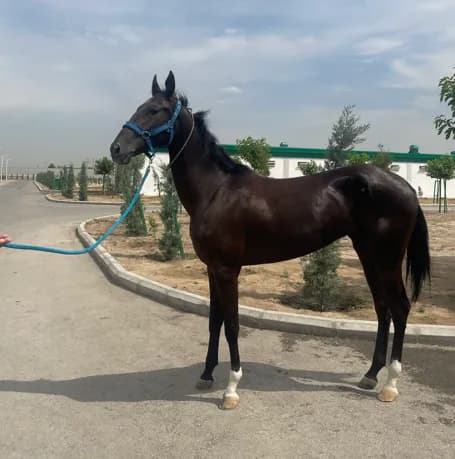
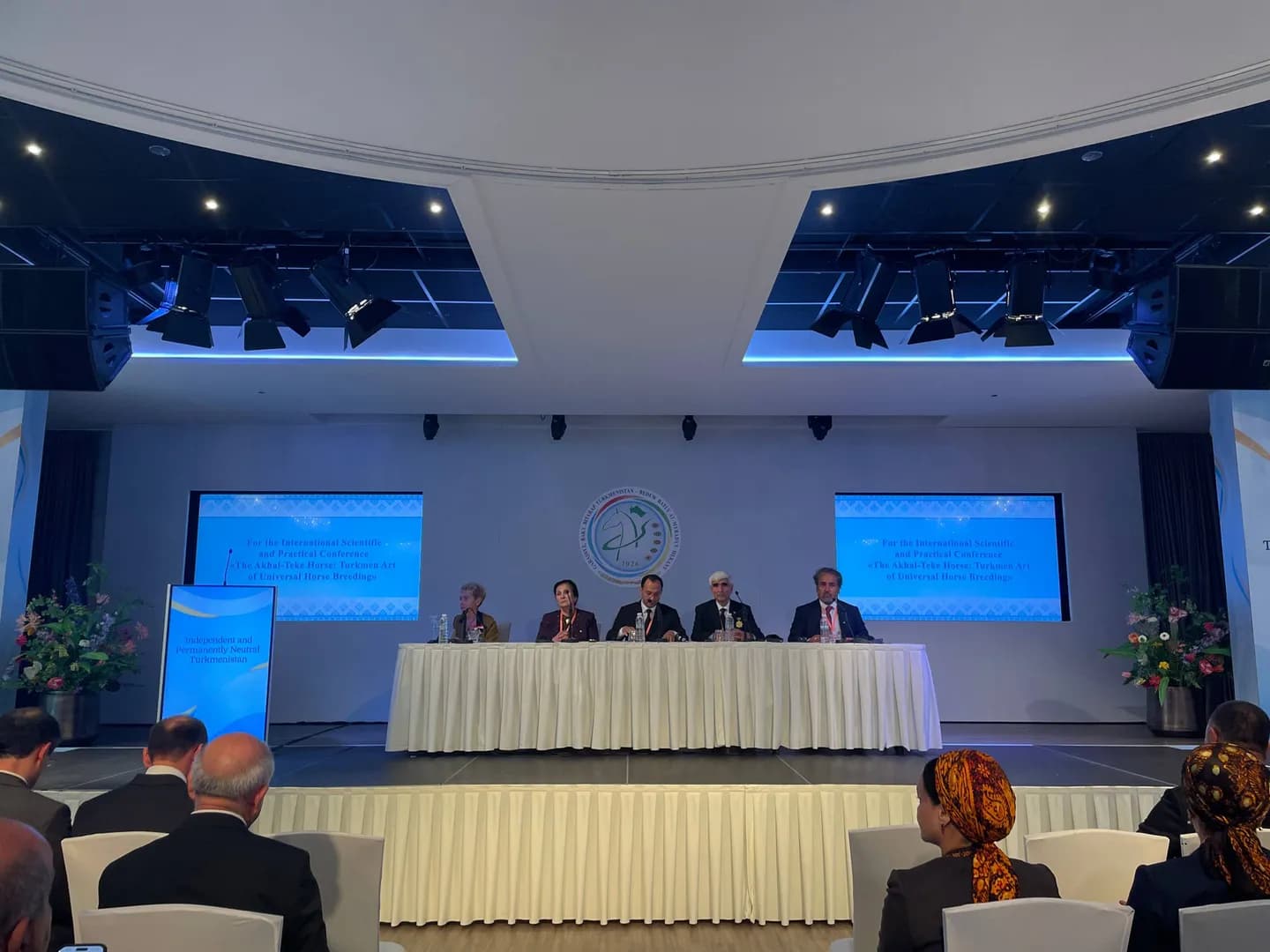
There is a moment, familiar to anyone who has stood on the edge of the Karakum at first light, when the desert seems to mint its own currency. As the sun lifts over the Kopet Dag, the flanks of an Akhal-Teke horse catch the low rays and ignite — not the dull warmth of a chestnut coat, but a genuine metallic blaze, copper and gold and silver poured over living muscle. For three thousand years the Turkmen have watched this happen, and for three thousand years they have understood it as something more than optics. In 2026, as Turkmenistan marks the thirty-fifth anniversary of its independence under the banner “Independent, Permanently Neutral Turkmenistan — the Homeland of Purposeful Heavenly Horses,” that ancient understanding has been raised, once again, to the level of national creed.
This essay is an attempt to explain why a single breed of horse — rare, temperamental, and numbering only some 6,600 animals worldwide — can carry the weight of a nation’s identity at one of the most symbolically charged moments in its modern history. It is a story that runs from Bronze Age oases to UNESCO committee rooms, from the cavalry of Achaemenid kings to the state emblem of a twenty-first-century republic. And it is, above all, a story about how a people chose an animal to stand for everything they hoped to be: enduring, beautiful, loyal, and free.
I. A Horse Older Than History
The Akhal-Teke is widely regarded as one of the oldest domesticated horse breeds still in existence, with a lineage that scholars trace back at least three thousand years, and by some accounts considerably further. Its very name is a map of its origins: “Akhal” denotes the string of oases running along the northern slopes of the Kopet Dag mountains, while “Teke” names the Turkmen tribe that bred and guarded these horses there for centuries. The breed is the direct heir — possibly the last living representative — of the fabled Turkoman horse of antiquity, the mount of Scythians and Parthians whose fast, mobile cavalry terrified the settled empires of the ancient world.
The difficulty of dating the breed precisely is itself instructive. Before roughly 1600 AD, “breeds” in the modern sense did not exist; horses were known instead by local strain or type. What set the Turkmen tribes apart was the extraordinary discipline with which they recorded their horses’ pedigrees — not in writing, but orally, generation after generation, with a precision that modern genetics has since vindicated. When twenty-first-century studies confirmed the Akhal-Teke to be a genetically distinct breed of remarkably low diversity — the signature of a long, closed, carefully managed bloodline — they were merely confirming what the seyis, the master horse-breeders of Turkmenistan, had known and transmitted for millennia.
As Herodotus already noted in the fifth century BC, the Scythians of this region were a people for whom “their country is the back of a horse” (Elmas & Seven). Russian archaeologists later recovered almost perfectly preserved Scythian war-horses from the frozen kurgan tombs of the Altai, animals that resemble the Akhal-Teke in every respect and show that as early as 500 BC the nomads were already selecting tall, “dry,” fast horses. These Central Asian war-horses won great fame in antiquity and were known, according to time and place, as Median, Bactrian, Sogdian, Hyrcanian, Chorasmian or Parthian. The Chinese called them “heavenly horses” or “thousand-li horses,” coveting them so intensely that emperors sent expeditions west to acquire them; Chinese sources record that these animals “sweated blood.” Alexander the Great is said to have ridden one — his beloved Bucephalus traced, at least in part, to the steppes of Central Asia — and Marco Polo, crossing modern Turkmenistan on the Silk Road, praised the “good Turkoman horses” on the opening pages of his Travels.
II. The Anatomy of a Miracle
No account of the Akhal-Teke can avoid the question that every photograph provokes: how does a horse come to look as though it were cast from precious metal? The answer is not pigment but physics. Most horses have hair with a thick, opaque central core. Akhal-Teke hair has a far thinner core — in some coat colours almost none at all — so that the outer layer of each strand behaves like a prism, bending and reflecting light to produce an iridescent, metallic effect. A bay animal takes on a warm copper sheen; a palomino turns to burnished gold; a black horse acquires a bluish, silvered cast; a grey can appear almost white beneath a veil of silver.
This is beauty as a by-product of survival. The same sparse coat and fine, thin skin that scatter light also help the horse shed heat in a desert where daytime temperatures are punishing and nights turn cold. Everything about the Akhal-Teke’s physique — the lean, greyhound-like frame, the long neck and back, the sloping shoulder, the dry, hard legs — was shaped by the pitiless logic of the Karakum: long distances between water sources, extreme heat, and terrain ranging from loose sand to rocky mountain passes. The measured standards of the early studbook capture this precisely: an average height around 154 cm, a long body of roughly 154 cm, a narrow chest (girth circumference about 166 cm) and strong, muscular limbs, with common colours of grey, light bay and chestnut, plus the striking golden shade (Scekin & Gorelov, 1939).
The endurance is not folklore. Historical accounts describe Akhal-Tekes completing rides of extraordinary length, the most famous being the 1935 journey from Ashgabat to Moscow — roughly 4,300 kilometres in some 84 days, including a stretch of nearly 300 desert miles crossed with almost no water. It remains one of the most remarkable feats of equine endurance ever recorded, and Turkmen breeders cite it, rightly, as proof of what their horses can do.
III. A Horse That Chooses Its Rider
If the coat is what first captivates the eye, it is the temperament that captures the heart — and that lies closest to why the Turkmen love this animal as they do. The Akhal-Teke is famous for forming an intense, near-exclusive bond with a single person. Bred for centuries not in vast herds on open range but tethered close to the family tent, hand-fed a carefully managed diet of barley, alfalfa and animal fat, the breed developed a temperament as people-focused as a dog’s. Owners reach instinctively for comparisons to cats: bold, quick-thinking, sensitive, opinionated, and fiercely loyal to the one human it trusts.
The scholarly literature stresses that this character is fiery and passionate, and that it demands a particular psychological approach: because these horses possess exceptional intelligence and intuition and regard themselves as independent individuals, any use of physical force is counter-productive — the Akhal-Teke has an innate sense of honour, and can be brought to obedience only through great patience and respect (Elmas & Seven). A Turkmen proverb captures the depth of the relationship: “to turn a foal into a horse, its owner becomes a dog.” Because the horse’s life could mean its rider’s survival, this loyalty was not a charming quirk but a survival trait — and it became, over time, a moral ideal, embodying the very virtues the Turkmen prize in a human being: fidelity, courage, dignity, and an independence that will not be broken by force but can be won by trust.
IV. From Folklore to National Emblem
The love of the Turkmen people for the Akhal-Teke has been poured, over the centuries, into an immense reservoir of oral heritage — fairy tales, epics, legends, poems and historical accounts in which the horse appears as man’s faithful friend, a companion able to cross great distances swiftly and never to desert its rider in difficulty. To read this folklore is to encounter a being that is at once utterly practical and frankly sacred: a source of livelihood and warfare, but also a creature woven into rituals of birth, marriage and death, and surrounded by beliefs about nobility, protection and good fortune.
At independence in 1991, this cultural inheritance was elevated to the highest register of the state. The Akhal-Teke stands at the very centre of Turkmenistan’s national emblem — represented by the champion stallion Ýanardag — and appears on the country’s banknotes; it even gave its name to the Ahal province itself. The magnificent golden Monument of the Akhal-Teke Horses in Ashgabat, and the Independence Monument crowned with rearing golden steeds, translate the animal into architecture. In 2023, UNESCO inscribed “the art of Akhal-Teke horse breeding and the traditions of horse decoration” on the Representative List of the Intangible Cultural Heritage of Humanity, giving international recognition to what Turkmens had always known: that this is not merely animal husbandry but a living art form, complete with its own aesthetics of ornamentation, its silver-and-carnelian jewellery, its embroidered trappings and its ceremonial codes.
V. Horse Day and the Rituals of Devotion
A national symbol is kept alive not by monuments alone but by repetition, by an annual rhythm of celebration — and here Turkmenistan is unusually rich. On the last Sunday of April, the country observes the National Day of the Turkmen Horse, a festival whose emotional centre is the Akhal-Teke Equestrian Sports Complex in Ashgabat. In 2026, the celebrations included the unveiling of a monument to the celebrated stallion Pyýada, exhibitions of paintings, sculpture, carpets and jewellery depicting the horses, and the climactic final of the international Akhal-Teke beauty contest — a genuine pageant in which the most magnificent representatives of the breed compete before the head of state and thousands of spectators.
These are not empty spectacles. They are the modern, state-scale continuation of an ancient devotional relationship between a people and an animal, and they perform real cultural work: transmitting breeding knowledge to a new generation, sustaining the crafts of saddlery, weaving and jewellery that adorn the horses, and binding national pride to a shared, tangible inheritance. The horse is presented as a gift of the highest honour — offered by labour collectives, regions and institutions to the state, and by Turkmenistan itself to visiting heads of state as the ultimate expression of diplomatic esteem.
VI. Thirty-Five Years of Sovereignty, Ridden on Horseback
Why, then, should the Akhal-Teke be the chosen face of the thirty-fifth anniversary of independence? The answer lies in the remarkable fit between the animal and the national story Turkmenistan tells about itself. When the Soviet Union dissolved in 1991, Turkmenistan — the last of the republics to leave — faced the double task of building a state at home and finding a posture abroad, in a neighbourhood shadowed by the civil war in Afghanistan and the uncertainties of the post-Cold-War world. Its answer was a policy of permanent neutrality, formally recognised by the United Nations, paired with a patient programme of nation-building and, increasingly, of connectivity — the Middle Corridor linking Central Asia across the Caspian to the South Caucasus, Türkiye and Europe.
In declaring 2026 the Year of “Independent, Permanently Neutral Turkmenistan — the Homeland of Purposeful Heavenly Horses,” the Mejlis fused three things that Turkmens regard as inseparable: sovereignty, cultural heritage, and a forward-looking strategy of development. The image of the purposeful, determined horse, straining ahead, was explicitly chosen to reflect the country’s current pace of advancement and to set the direction of its political and cultural life for the year. It is a motto, and an animal, that faces forward.
The symbolic logic is elegant. A breed that survived the near-extinction of the Soviet decades — when the studbook was closed and the population collapsed — and was then deliberately revived as living national heritage becomes a perfect emblem for a state that likewise re-emerged from the Soviet collapse to reclaim its own name and destiny. The endurance the horse showed across the Karakum mirrors the endurance the nation claims across three and a half turbulent decades. The loyalty the horse gives its single rider mirrors the fidelity the citizen is asked to feel for the homeland. And the shining coat — gold that came down from heaven — supplies the note of pride, of beauty raised to the level of the miraculous, that every young nation seeks in its founding symbols.
VII. A Turkmen Legacy
The influence of the Turkmen horse on world equestrian culture is not a matter of national pride alone but of documented pedigree. Two of the three foundation sires of the English Thoroughbred — the entire basis of modern flat racing — were of Turkoman stock: the Byerly Turk and the Darley Arabian (Elmas & Seven; cf. Milyayev, Charyyev & Atabayev, 2024). The Darley Arabian, though purchased at Aleppo in Syria in 1717, had been bred by Turkmen nomads on the Iranian plateau, and several of the mares in the royal stud of Charles II that contributed to the Thoroughbred’s birth were likewise of Turkmen origin. To the rider, the resemblance is unmistakable: with its long neck, high legs, sloping “loose” shoulder and characteristic soft, high-stepping trot, the Akhal-Teke closely recalls the first generations of the early English Thoroughbred — no coincidence, but a direct inheritance.
The breed’s prestige in the modern era was sealed on the world stage. At the end of the Second World War, Marshal Georgy Zhukov rode a white Akhal-Teke stallion at the Moscow Victory Parade; and at the 1960 Rome Olympics the most celebrated horse of the Soviet equestrian team was the Akhal-Teke stallion Absent, who won the first of several Olympic gold medals in dressage (Rottermann, 2009). From Alexander the Great to Olympic gold, the same golden thread runs unbroken.
VIII. A Scholarly Interlude: The Testimony of Henri Moser (1882)
Among the richest scholarly descriptions of the Akhal-Teke in its natural setting is the 1882 memoir of the Swiss traveller Henri Moser, resident in St. Petersburg, who visited Central Asia several times and left an account that modern researchers still treat as a primary source (cited in Elmas & Seven). Moser recorded that Turkmen horses enjoyed the highest reputation far beyond the borders of Central Asia — that already in the time of Alexander the Great the horses of Sogdiana were famous, and that Marco Polo had marvelled that their hooves were so hard they needed no shoes. Even today, Moser noted, the Akhal-Teke is rarely shod. He also observed that over the centuries the line was occasionally refreshed from outside: Timur, for instance, is said to have distributed 5,000 Arabian mares among the Turkmen to improve the blood — yet the Teke remained closer to the English Thoroughbred than to the Arabian in build.
Moser’s ethnographic detail remains invaluable. He observed that among the Teke there were no horse-breeding farms in the European sense: the horse was raised among the tents and dwellings, hand-reared in intimate proximity to the family. Brush and comb were unknown; grooming was reduced to its most elemental form, the Turkmen scraping the coat with his knife along the direction of the hair and then polishing it with the sleeve of his robe or a piece of felt. Foals were kept blanketed in felt day and night, the number of coverings increased with age, so that skin and hair grew thinner than in any other horse — the very mechanism, we now understand, behind the celebrated metallic bronze and old-gold sheen that produces so incredible an effect in sunlight.
The regime of the desert runner was austere by design. “Our horses’ fat must melt,” the Teke insisted; the animals were to be pure muscle. Water was reduced to an almost incredible minimum, oats replaced by barley-flour mixed with tail-fat, hay by chopped dried alfalfa. Tethered by a long rope near the entrance of the owner’s dwelling, wearing a fine snaffle rather than a curb, ridden without spur or whip, the Akhal-Teke covered prodigious distances — Moser describes journeys of eight days at roughly two hundred versts a day, twenty hours out of twenty-four spent in the saddle. Because it was never beaten, the horse was extraordinarily gentle toward people, though ferocious toward its own kind; a loose stallion could provoke terrible and dangerous fights, which only the owner, with a soft “dour, dour” (“slowly, slowly”), could pacify. When a woman married, her dowry had to include a finely embroidered cover for her husband’s saddle — a detail that captures how completely the horse was woven into the social fabric. Because the Akhal-Teke stallion was believed to be a one-owner horse, it was not the custom in Turkmenistan to give, sell or barter it: rider and horse were an inseparable team, parted only by death, the long-lived horse often accompanying its master on his final journey.
IX. The Colours of Gold: A Typology of the Coat
Scholarly treatments of the breed classify its coats with some precision, and the proportions are themselves revealing (Elmas & Seven, drawing on Turkmen breeding data). The bay (doruk), chocolate-bodied with darker legs and black mane and tail, accounts for some 40 percent of Akhal-Tekes; the golden-bay type (doru), golden or yellowish with black points, roughly 20 percent; the true chestnut/reddish (kızıl) about 11 percent. Rarer are the black (kara), fully black including mane and tail, at around 12 percent; the grey (kır) at about 8 percent; and the pale yellow-dun (sarı) at under 5 percent.
Rarest and most celebrated of all is the Isabella (İzabella) — a cream, pearlescent coat occurring in only about 25 of every 1,000 horses. Its milk-white, pinkish or yellowish hair carries an iridescent, mother-of-pearl lustre, with mane and tail slightly darker than the body. Across all colours, the defining trait is the same: a hair structure that throws back a bright golden or silver reflection. This is not merely the outcome of natural selection but of centuries of deliberate breeding by the Turkmen, who selected relentlessly for endurance, speed and intelligence as much as for beauty.
X. The Stalinist Destruction of the Akhal-Teke
No academic account of the breed can omit its darkest chapter — the near-annihilation of the Akhal-Teke under Soviet rule, a history documented in detail by Elmas and Seven and by scholars such as Sébastien Peyrouse, Erika Fatland and David Wolff. After the Second World War, as the campaign of “Zhdanovism” reasserted ideological control over intellectual and cultural life, the traditional epics of resistance to Tsarist colonialism fell under suspicion. In Turkmenistan the scholar Baimuhammed Karryev was accused of “bourgeois nationalism” for his analysis of the Dede Korkut epic, and the authorities moved against the Akhal-Teke horse precisely because it was regarded as the living symbol of the Turkmen nomadic tradition (Peyrouse, 2015).
The mechanics of destruction were brutal. The Soviet regime banned private horse-breeding, forced farmers to slaughter their horses for meat, and — under Marshal Budyonny — crossbred the pure Akhal-Teke with Don horses, diluting the ancient line. Noble breeds were branded a symbol of the bourgeoisie and declared unsuitable for the army. At one point only some 1,250 Akhal-Tekes remained in the entire Soviet Union; by the late Soviet period, studbook-registered Akhal-Tekes in Turkmenistan itself had fallen below a thousand — a staggering collapse for a breed of which, in Alexander’s day, the Parthian herds alone had numbered 50,000 to 100,000. It was against this backdrop that the legendary 1935 ride from Ashgabat to Moscow acquired its full meaning: not a mere sporting feat but a desperate act of advocacy, a demonstration to the authorities of the breed’s unique worth in a bid to halt the killing.
The sources record that Stalin regarded the magnificent Akhal-Teke as an emblem of Turkmen “backwardness” and is said to have ordered horses sent to the sausage factories, offering tractors and apartment blocks in the name of modernisation — which the nomads detested. It is alleged that during and after the war some 80,000 Akhal-Teke horses were destroyed on orders connected to the suppression of Turkmen resistance (Hutmacher, 2024). Tellingly, when Russian forces first conquered Turkmenistan around 1880, General Grodekov had already grasped the political logic, remarking that if only the best stallions and mares could be taken from the Teke, “they would no longer pose a danger to us.” In Turkmen memory it is often Khrushchev whose name is cursed for ordering the slaughter of the desert horses (Fatland, 2019; Wolff, 2010).
Yet the Akhal-Teke survived — and how it survived is itself the moral of the story. Rather than see their horses butchered, Turkmen breeders released their beloved animals into the Karakum, the desert homeland from which the breed could later be recovered and revived. The old nomadic traditions, as Wolff observes, proved more durable than the USSR itself. When the Soviet Union withdrew from the stage of history and Turkmenistan regained its independence in 1991, increasing the breed’s numbers became official state policy: new private stud farms were established, export restrictions imposed to safeguard the line, and the population climbed once more into the thousands. The horse that Stalin tried to erase now stands, quite literally, at the centre of the sovereign state’s emblem.
Conclusion
To ask why the Akhal-Teke matters so much to Turkmenistan at thirty-five is, in the end, to ask what a nation chooses to see when it looks in the mirror. Turkmenistan has chosen to see a horse: an animal three thousand years old and unmistakably its own, forged by the desert into something enduring, loyal, beautiful and free. In the golden flank of the Akhal-Teke the country reads its past and projects its future — the memory of the seyis and the oral pedigrees, the survival through Soviet neglect and outright destruction, the revival as sovereign heritage, and the ambition to be, once more, a homeland of purposeful heavenly horses.
On the thirty-fifth anniversary of its independence, then, Turkmenistan does not merely celebrate a milestone of statehood. It celebrates a relationship — between a people and an animal, between endurance and beauty, between the deep past and the intended future — that it has decided is the truest expression of who the Turkmen are. When the horses run at Ashgabat this year, their coats alight in the desert sun, they will be carrying not just their riders but the whole self-image of a nation: gold that came down from heaven, and refused, across every century, to be tamed by anything but love.
References
Elmas, A. & Seven, Ö. (2024). Bozkırın Altın Parıltısı: Ahal Teke Atlarının Tarihi ve Soykırımı Üzerine Bir İnceleme [The Golden Gleam of the Steppe: A Study on the History and Genocide of the Akhal-Teke Horses]. (pp. 1035–1049).
Fatland, E. (2019). Sovietistan: A Journey Through Turkmenistan, Kazakhstan, Tajikistan, Kyrgyzstan and Uzbekistan. MacLehose Press. — Hutmacher, H. (2024). Auf den Spuren des Achal-Tekkiners. — Milyayev, I., Charyyev, M. & Atabayev, M. (2024). Ahal-Teke Horses: The Majestic Breed of Turkmenistan. Akademicheskaya Publitsistika.
Peyrouse, S. (2015). Turkmenistan: Strategies of Power, Dilemmas of Development. Routledge. — Rottermann, S. (2009). “Absent: An Akhal-Teke on the Olympic Stage,” EuroDressage. — Scekin, V. A. & Gorelov, K. I. (1939). The Akhal-Teke Horse. Moscow: Lenin Academy of Agricultural Sciences. — Wolff, D. (2010). Tibet Unconquered. Palgrave Macmillan.
Additional sources: UNESCO Intangible Cultural Heritage (Art of Akhal-Teke horse breeding, 2023); Akhal-Teke Association of America; Turkmenistan Altyn Asyr / turkmenistan.gov.tm; Eurasia Review (D. Soysal, “Turkmenistan: 35 Years of Sovereignty,” 2026); Visit Turkmenistan; chevauxdumonde.com.
Related Topics
Derya Soysal
Contributing writer at EUReflect.
Follow EUReflect
See more of our reporting on Google
Mark EUReflect as a preferred source and our stories are ranked higher for you in Top Stories, Discover and Google News — and carry a “preferred” badge when they are cited in AI results.
Add EUReflect as a preferred source