Europe’s New Energy Frontier: Connecting with Emerging Clean Energy Markets
Europe’s new energy frontier: how the Caspian–Black Sea–Europe corridor could reshape the EU’s clean-energy security.
Analysis of the Conference “Connecting Europe with Emerging Clean Energy Markets”
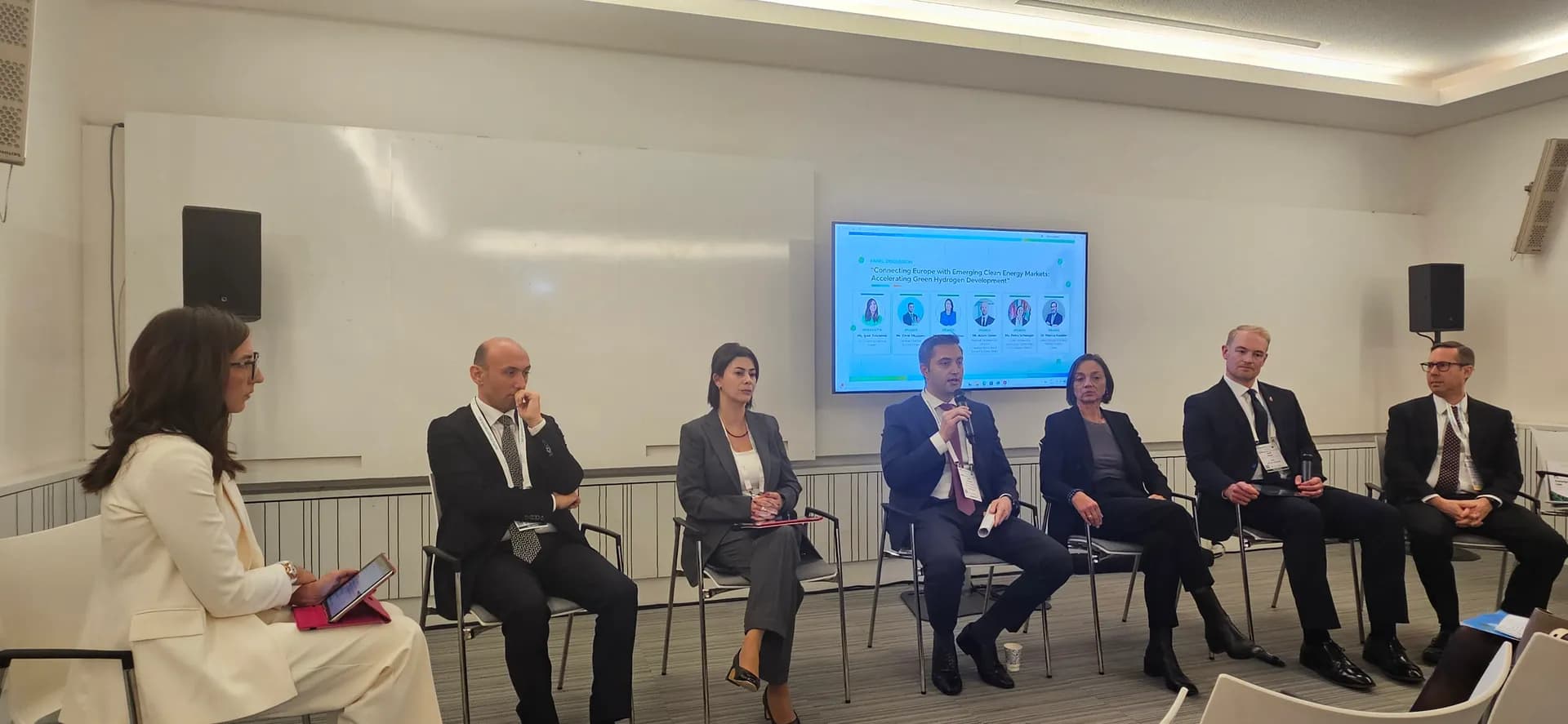
European Hydrogen Week 2026, Brussels, 28 October 2026
The future of Europe’s clean-energy relationship with the Caspian region is increasingly being written through infrastructure. The proposed Caspian–Black Sea–Europe Green Energy Corridor aims to connect renewable generation in Azerbaijan, Kazakhstan and Uzbekistan with European markets through the Black Sea, with a final investment decision targeted for 2029. Yet the project’s success will depend not only on cables, converters and financing, but also on the political geography through which it must pass. Recent debates in Türkiye over the possibility of being bypassed by the Black Sea route have shown that green-energy corridors can redistribute influence, transit revenues and strategic leverage among partners.
The challenge ahead is therefore twofold: to turn an ambitious connectivity vision into a bankable project, while ensuring that it strengthens rather than strains regional cooperation. If Europe, Azerbaijan and its neighbours can align regulation, financing and political expectations, the corridor could become a major pillar of Europe’s post-2029 clean-energy security architecture. If they cannot, it may remain an expensive and politically fragile promise.
A conference on connection
On the sidelines of European Hydrogen Week 2026, the side event Connecting Europe with Emerging Clean Energy Markets, co-organised by the Clean Energy Center of the Economic Cooperation Organization (CECECO), SOCAR Green and Hydrogen Europe, brought together public, private and institutional actors around a deceptively simple question: how to connect Europe’s growing demand for hydrogen and renewable electricity with the resources and ambitions of emerging clean-energy markets in the Caspian region, Türkiye and Central Asia.
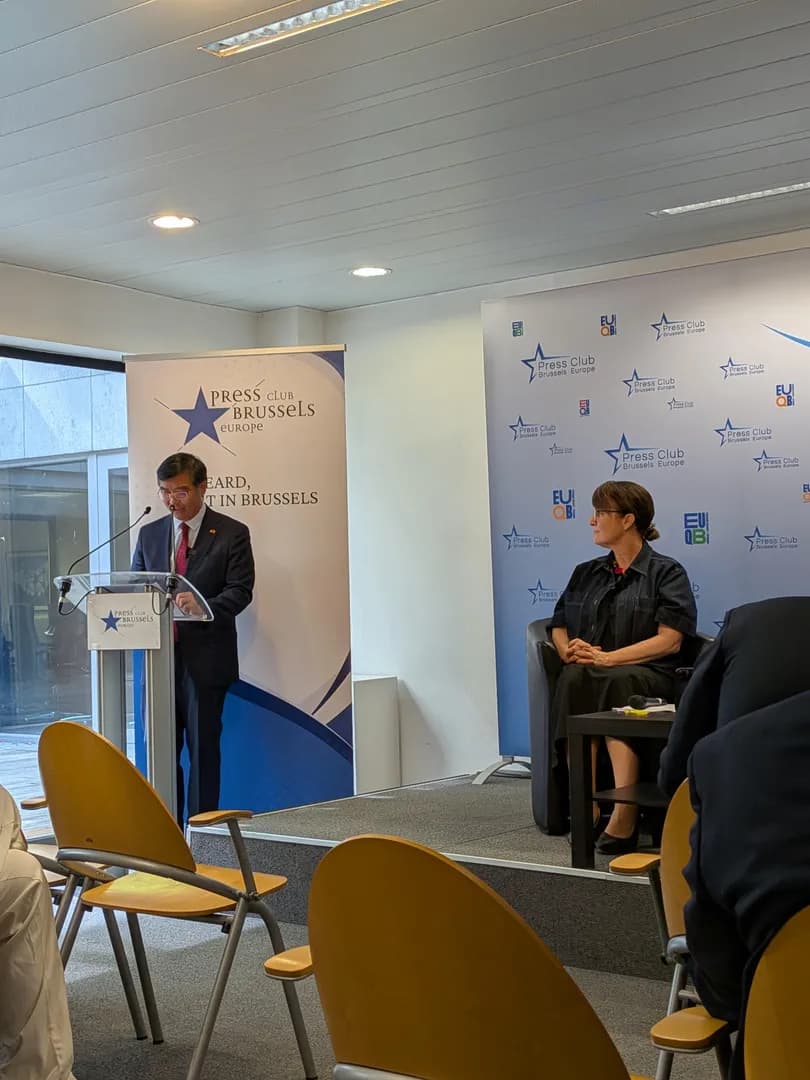
Azerbaijan’s Ambassador to Belgium, Mammad Ahmadzada, opened the discussion by stressing that Baku sees itself not only as a potential producer of hydrogen and its derivatives, but also as a transit country. According to the ambassador, the experience gained through the Southern Gas Corridor provides a credible foundation for this ambition. Ongoing work on green electricity corridors, particularly the route across the Black Sea, follows the same logic of continuity.
The timing is significant. The feasibility study for the Caspian–Black Sea–Europe Green Energy Corridor, linking Azerbaijan, Georgia, Romania and Hungary, was completed in July 2026 and found the project technically feasible and economically attractive. The project is estimated to require around €22.1 billion in investment, including €14.3 billion for transmission infrastructure and €7.8 billion for associated renewable generation. It is designed to develop at least 8 GW of renewable capacity in the region and to transmit approximately 20 billion kilowatt-hours of electricity annually to Europe by 2040.minenergy.
The corridor is expected to be commissioned in phases from 2032, reaching its full 4 GW transmission capacity by 2040. The European Investment Bank has expressed interest in the project, while underlining the need to clarify the allocation of costs, benefits and risks before any financing decision. A possible hydrogen pipeline along the same axis was also mentioned as a longer-term possibility.
From gas to green power
Moderator Ipek Tekdemir focused the debate on the practical conditions for this connection. Europe has ambitious decarbonisation targets and an evolving hydrogen market. On the other side, Türkiye adopted its first climate law in 2025 and is developing its hydrogen policy framework, while Kazakhstan and Uzbekistan are expanding renewable generation and regional electricity cooperation.
The Caspian Green Energy Corridor, involving Azerbaijan, Kazakhstan and Uzbekistan, illustrates the ambition to link renewable sources across borders. According to Azerbaijan’s Ministry of Energy, the feasibility study for the Central Asia–Azerbaijan Green Energy Corridor is expected to be completed in May 2027, with the corridor planned for phased commissioning from 2032.
In July 2026, the European Union and Azerbaijan launched an EU–Azerbaijan Connectivity Partnership, alongside a High-Level Connectivity Dialogue covering transport, energy and digital connectivity. The partnership explicitly identifies clean energy, electricity interconnections and regional energy networks as areas for deeper cooperation.
UNIDO’s bridging role
Petra Schwager, from UNIDO’s Climate and Technology Partnerships Division, outlined the organisation’s role as adviser, connector and facilitator. According to Schwager, the Global Programme for Hydrogen in Industry, launched five years ago, now emphasises aligning hydrogen development with national industrial strategies, including derivatives such as ammonia and methanol.
UNIDO works with around fifteen developing countries and runs working groups on policy, with the OECD, and on finance, with the World Bank. It also hosts the secretariat of the Southern Hydrogen Corridor, linking Algeria, Tunisia, Italy, Austria and Germany. The organisation presents itself as a neutral broker between exporting and importing countries—an approach repeatedly highlighted in discussions on North–South partnerships.
Azerbaijan’s green transition
From the Azerbaijani side, Elmir Musayev, Director General of SOCAR Green, detailed the national trajectory. Established in March 2024 as a dedicated subsidiary, SOCAR Green aims to become the country’s renewable-energy champion. According to Musayev, Azerbaijan has raised its ambitions: the share of renewables in the energy mix is now expected to exceed the original 30 per cent goal for 2030.
The priorities are clear: decarbonise a still heavily gas-dependent domestic mix, strengthen the national grid to manage intermittency, and position the country as a regional hub through several corridors, including the Black Sea, Türkiye, Nakhchivan and the Caspian. The offshore wind potential in the Caspian Sea is presented as particularly suitable for large-scale green hydrogen, despite higher installation costs.
The competitive price of Azerbaijani electricity is seen as a dual advantage—either for export or for attracting energy-intensive industries. SOCAR Green is already advancing concrete projects, including large solar plants with Masdar, and is designing schemes to be EU-regulation compliant from the outset in order to facilitate future offtake.
A regional approach
Aysel Yagubova, Executive Director of CECECO, stressed the regional dimension. Based in Baku and part of UNIDO’s Global Network of Sustainable Energy Centres, the organisation covers the ECO member states. Its work on hydrogen and renewables rests on three pillars: building institutional and human capacity, including the launch of a Clean Energy Academy in Azerbaijan; strengthening policy and regulatory frameworks through a regional legislative compendium and a model law; and moving from knowledge to bankable projects through multi-stakeholder cooperation.
Adam Green of Xlinks recalled that the technology for long-distance, low-loss electricity transmission already exists. According to Green, the real bottleneck is multi-country regulation and the creation of a sufficiently stable governmental framework to make projects bankable. Corridors such as the planned 4 GW link into Central Europe require alignment between EU and non-EU states, including on sensitive maritime transit issues.
Demand remains decisive
Finally, Marcus Kappler, representing a German energy company, brought the discussion back to demand. According to Kappler, without clear and binding obligations, the market does not take shape. Germany’s transposition of the RFNBO targets under RED III—progressive quotas, clearly identified obligated parties and high penalties—has already generated real willingness to pay, with available volumes being absorbed quickly.
Maintaining and extending these mechanisms in the run-up to the 2040 target revision was presented as essential if export projects from the Caucasus and Central Asia are to find reliable offtakers. The underlying message was clear: infrastructure alone does not create a market; predictable demand does.
Geopolitical implications
The clean-energy agenda discussed at the event should not be read solely as a climate or industrial-policy initiative. For Azerbaijan, it is also part of a broader strategy to consolidate its position as a connectivity and energy hub between Central Asia, Türkiye, the Black Sea and the European Union. The Middle Corridor, which links China and Central Asia to European markets through the South Caucasus, has gained strategic importance as alternative routes have been disrupted by the war in Ukraine and instability in the Middle East.
In this context, green electricity and hydrogen corridors would extend the logic of the Southern Gas Corridor. Azerbaijan already supplies gas to ten EU member states, and the EU–Azerbaijan Strategic Partnership in the field of energy, signed in July 2022, provides an institutional basis for deepening cooperation. The EU–Azerbaijan Connectivity Partnership, launched in July 2026, further strengthens this framework by supporting renewable energy, electricity interconnections and regional energy networks.
Green energy would therefore allow Baku to preserve its role as a reliable supplier to Europe while adapting it to the EU’s decarbonisation agenda.
Azerbaijan’s multi-vector strategy
The proposed infrastructure should also be understood through Azerbaijan’s “multi-vector” foreign policy. Rather than aligning exclusively with either the West or Russia, Baku seeks to maintain working relationships with the European Union, Türkiye, Russia, China, the United States and Iran, while avoiding dependence on any single external partner.
This approach matters for Europe. Increased EU–Azerbaijan energy cooperation may strengthen interdependence, but it does not necessarily imply a broader geopolitical realignment of Azerbaijan with the European Union. Azerbaijan’s relationship with Russia remains pragmatic rather than confrontational: the country seeks autonomy and balance, not a definitive rupture with Moscow.
A corridor shaped by regional security
The feasibility of a Caspian–Black Sea–Europe corridor depends on more than engineering, financing and market demand. It is embedded in a volatile regional environment shaped by the Russia–Ukraine war, instability in the Middle East, Iran’s proximity and the unfinished normalisation process between Azerbaijan and Armenia.
The normalisation process between Azerbaijan and Armenia offers a potential opening, although its implementation remains incomplete. A durable peace would require not only political agreements, but also practical cooperation on trade, transit, border delimitation and outstanding legal and political issues.
The prospective cross-border transport link through the Syunik region—often referred to by Azerbaijan as the “Zangezur corridor”—is particularly significant in this respect. If realised, it would connect mainland Azerbaijan to Nakhchivan and onward to Türkiye, the Balkans and the European Union, reinforcing Azerbaijan’s role as a transit state between Europe and Asia. Yet its political sensitivity means that European policymakers should treat it not simply as an infrastructure project, but as part of a wider regional peace and security equation.
Türkiye and the transit question
The project has also exposed a potential source of regional friction. Although Azerbaijan and Türkiye are close strategic partners, the proposed Caspian–Black Sea–Europe Green Energy Corridor would bypass Turkish territory and the Turkish Straits, relying instead on a submarine cable route across the Black Sea to Romania and Hungary. This has raised concerns in Ankara that Türkiye could be marginalised as an energy transit route to Europe.
The issue is politically significant because Türkiye has historically been central to Azerbaijan’s westward energy exports through the Southern Gas Corridor, TANAP and TAP. Recent diplomatic tensions between Baku and Ankara have reinforced questions about whether future energy cooperation, capacity expansion and financing arrangements could be affected by political disagreement.
For Europe, this illustrates a broader geopolitical dilemma. A corridor designed to diversify European energy supplies may itself create new tensions among partners if it appears to redistribute transit revenues, influence and strategic leverage unevenly. Azerbaijan’s authorities have sought to reassure Ankara by presenting the Black Sea route and the Azerbaijan–Georgia–Türkiye–Bulgaria route as complementary rather than competing projects. Nevertheless, the episode shows that clean-energy corridors will need to manage not only technical and financial risks, but also the political expectations of transit states.
What Europe should watch
For the European Union, the central question is whether green-energy cooperation with Azerbaijan and Central Asia can deliver diversification without creating new forms of dependency. Replacing fossil-fuel imports with renewable electricity or hydrogen imports may reduce carbon emissions, but it would not automatically reduce Europe’s strategic exposure if supply remains concentrated along a limited number of routes and suppliers.
The EU therefore has an interest in supporting transparent governance, diversified transit options, credible risk-sharing mechanisms and meaningful regional cooperation. Infrastructure alone cannot guarantee resilience: political stability, regulatory predictability and durable peace between regional actors will determine whether the Caspian–Black Sea–Europe corridor becomes a genuine strategic asset or remains an ambitious but fragile concept.
Follow EUReflect
See more of our reporting on Google
Mark EUReflect as a preferred source and our stories are ranked higher for you in Top Stories, Discover and Google News — and carry a “preferred” badge when they are cited in AI results.
Add EUReflect as a preferred source