The Beijing Summit and the Future of Global Power Politics
The Xi-Putin summit highlighted growing China-Russia cooperation against Western influence, yet the relationship is driven more by shared opposition than a common vision. Power asymmetry, economic dependence, and differing geopolitical priorities continue to raise questions about its long-term durability.
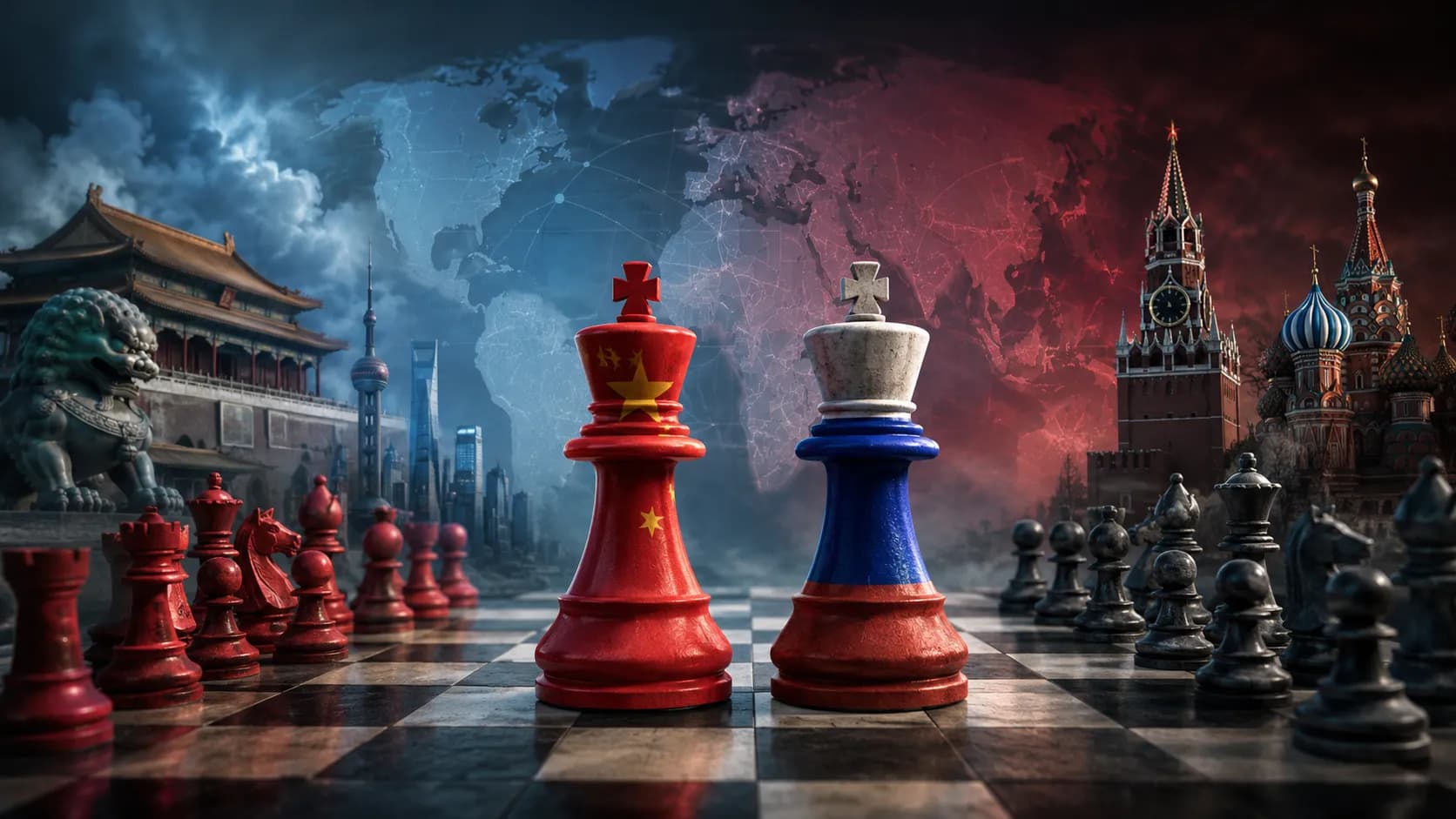
The back-to-back visits of Donald Trump and Vladimir Putin to Beijing placed China firmly at the center of global diplomacy and strategic competition. Within this context, the Xi-Putin summit carried major geopolitical symbolism. Both leaders projected unity, reaffirmed their so-called “no-limits” partnership, and promoted the idea of a multipolar world order designed to reduce Western dominance. Joint declarations, economic agreements, and political messaging all sought to portray China and Russia as architects of an emerging global balance of power. Yet beneath the carefully staged image of solidarity lies a far more complicated reality. The summit revealed not only cooperation, but also the deep insecurities, contradictions, and strategic limitations shaping the Sino-Russian relationship.
At first glance, the summit appeared to demonstrate that China and Russia are moving steadily closer together politically, economically, and strategically. However, a closer examination suggests that their partnership is driven less by genuine strategic convergence and more by shared opposition to the United States and the Western-led international order. In essence, the relationship is largely reactive rather than transformative. Moscow and Beijing are united by what they oppose, not necessarily by a common long-term vision of global governance.
Russia’s priorities differ sharply from China’s Moscow seeks to restore its great-power status through military power, territorial revisionism, and direct confrontation with the West. The Ukraine war reflects this aggressive and security-driven worldview. China, on the other hand, prefers a gradual expansion of influence through trade, technology, investment, and international institutions such as BRICS and the Belt and Road Initiative. Beijing aims to weaken American influence without triggering direct military confrontation. These contrasting approaches expose the limits of the so-called “no-limits” partnership.
The imbalance of power between the two countries is becoming increasingly visible. China’s economy is many times larger than Russia’s, and Beijing possesses far greater technological and financial capabilities. Since the outbreak of the Ukraine war, Russia has become heavily dependent on Chinese markets, technology, and financial lifelines. Yet China has carefully avoided crossing certain Western red lines. Beijing has refused to officially recognize Russia’s annexation of Ukrainian territories beyond Crimea and has remained cautious about supplying direct military assistance that could trigger secondary sanctions.
This asymmetry has transformed Russia into the junior partner in the relationship, a reality that many within the Russian political establishment are uncomfortable accepting. Historically, Russia viewed itself as a global superpower equal to the United States and China. Today, however, it risks becoming overly dependent on Beijing for energy exports, investment, and trade. Such dependency may eventually fuel nationalist resentment inside Russia, especially if Chinese influence over Siberian development and Central Asian connectivity continues to grow.
The summit also carried significance because it followed Trump’s visit to Beijing. Some observers interpreted Trump’s diplomacy as an attempt to create divisions between Moscow and Beijing. While such efforts may not have succeeded immediately, Trump’s unpredictable and transactional approach exposed the limits of China’s balancing strategy. Beijing ideally prefers stable economic relations with the United States while maintaining strategic coordination with Russia. However, trade wars, tariffs, technological restrictions, and growing US-China rivalry have increasingly forced China to choose sides. In many ways, the Xi-Putin summit was not an offensive declaration of strength, but a defensive response to mounting geopolitical pressure.
Economically, the summit reinforced discussions about de-dollarization and the creation of alternative financial systems independent of Western institutions. China and Russia have expanded bilateral trade in yuan and rubles and continue exploring alternatives to SWIFT. However, claims of a rapidly emerging anti-dollar financial order remain exaggerated. The US dollar still dominates global finance, energy markets, and reserve holdings. The Chinese yuan is not fully convertible, and Beijing maintains strict capital controls. Even Russia, despite sanctions, still relies indirectly on dollar-based systems through intermediaries in countries such as Turkey, the UAE, and Kazakhstan.
In reality, the global financial system remains deeply interconnected with Western institutions. Building a credible alternative requires trust, liquidity, transparency, and stable capital markets, areas where neither China nor Russia currently provides a complete substitute. Therefore, while de-dollarization may advance incrementally, it is unlikely to fundamentally overturn the dollar-dominated system in the near future.
The broader geopolitical implications of the summit also deserve careful consideration. The emerging world order is unlikely to evolve into a neat bipolar or bloc-based structure similar to the Cold War. Instead, the global system is becoming increasingly fragmented and unpredictable. Countries such as India, Turkey, Saudi Arabia, and even some European states are pursuing flexible, interest-based foreign policies rather than rigid alliances.
This fluid environment creates potential tensions within the China-Russia partnership itself. India, for example, is simultaneously a BRICS member, a strategic partner of Russia, and an increasingly important security partner for the United States in the Indo-Pacific. Turkey cooperates with Moscow on energy and regional diplomacy while remaining a NATO member. Iran’s nuclear ambitions create different strategic calculations for Beijing and Moscow. Such overlapping relationships demonstrate that the emerging multipolar order is far more complex than simple anti-Western alignment.
Future crises may expose the practical limits of Sino-Russian unity even further. If tensions escalate in the Taiwan Strait, Russia would likely provide diplomatic support to China but avoid direct military involvement against the United States and its allies. Similarly, if Russia were to intensify confrontation with NATO in Eastern Europe, China would probably call for restraint rather than risk its own economic interests by openly supporting military escalation. These realities suggest that the partnership remains highly transactional and based on selective cooperation rather than binding alliance commitments.
Ultimately, the Xi-Putin summit was significant not because it established a revolutionary new world order, but because it reflected the anxieties and ambitions of two powers navigating an uncertain global transition. Both Beijing and Moscow understand that the international system is changing, yet both also recognize their own vulnerabilities. Russia faces economic isolation, demographic decline, and strategic overdependence on China. China confronts slowing economic growth, technological containment, and increasing regional resistance to its rise.
Despite the symbolism of unity, the summit revealed a relationship built more on necessity than trust. It is a partnership shaped by circumstance rather than deep ideological or institutional integration. While China and Russia will likely continue coordinating against Western pressure in the coming years, their diverging interests, unequal power dynamics, and competing regional ambitions will continue to test the durability of their alignment.
The Xi-Putin meeting demonstrates more than just opposition to the West; it highlights a growing strategic partnership between China and Russia that could play an important role in shaping a more balanced global order. If managed with pragmatism, their cooperation in trade, energy, and institutions like BRICS and SCO may help strengthen multipolarity and give emerging powers a greater voice in global affairs. Rather than a fragile alliance, it can be seen as a developing framework for long-term stability and influence in an evolving world system. Similarly, one thing is certain that history will not be defined by single powers, but by the ability of nations to build balance through partnership.
Uroosa Khan
Contributing writer at EUReflect.
Follow EUReflect
See more of our reporting on Google
Mark EUReflect as a preferred source and our stories are ranked higher for you in Top Stories, Discover and Google News — and carry a “preferred” badge when they are cited in AI results.
Add EUReflect as a preferred source