The Donroe Doctrine: Rise of American Power and the Return of Expansionism
The Donroe Doctrine revives U.S. expansionism under Trump, prioritizing unilateral power, military force, and economic coercion over diplomacy and international law.
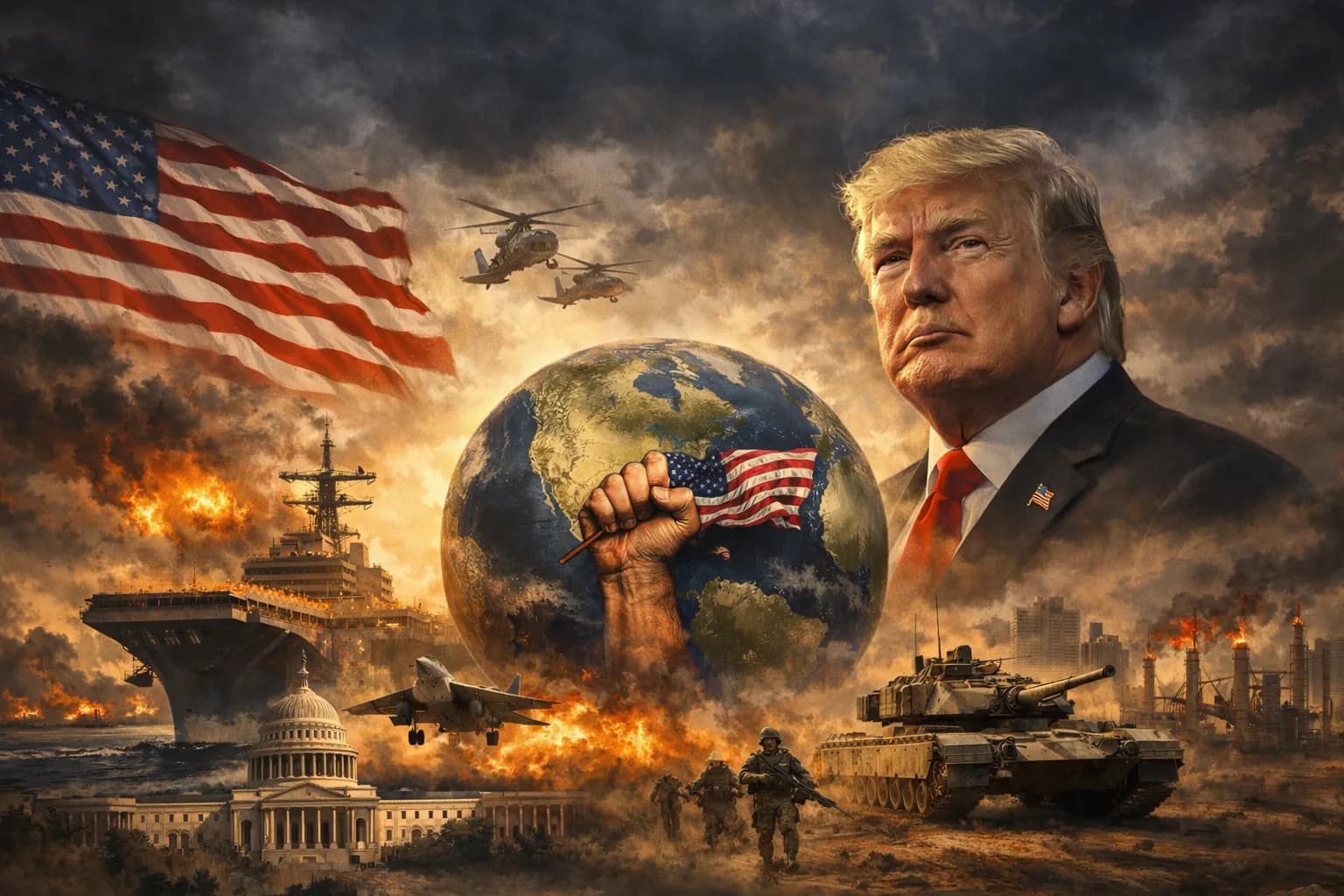
The Donroe Doctrine is a new version of the old Monroe Doctrine, revived under Donald Trump’s second presidency. Unlike previous U.S. policies that valued diplomacy and working with other nations, the Donroe Doctrine is unilateral, forceful, and openly dismissive of international law. Trump himself said that he does not believe in international laws, showing that the United States will act solely in its own interest, without worrying about treaties, agreements, or global consensus. This approach marks a shift from the post-World War II world order and reflects a power-focused strategy, where America’s influence is maintained through military, economic, and strategic control.
At its heart, the doctrine aims to reassert U.S. dominance in the Western Hemisphere. While the Monroe Doctrine of 1823 focused on keeping European powers out of the Americas, the Donroe Doctrine goes further by excluding China, Russia, and other emerging powers from the region. It does this through interventions, coercion, and territorial ambitions. The doctrine is closely tied to Trump’s “America First” agenda, putting national interests above global cooperation and reshaping the balance of power in the Americas.
The doctrine is being applied through military actions, economic sanctions, and territorial plans. For example, Operation Absolute Resolve, where Venezuelan President Nicolás Maduro was detained by U.S. forces, shows the doctrine’s willingness to use force to protect American interests. Economic measures, like tariffs on Mexico and Canada in the 2025 U.S. trade war, show that the doctrine also relies on economic pressure to achieve political goals. Ambitions like acquiring Greenland or influencing Canada reflect a return of expansionism and imperialism, as the U.S. seeks resources, strategic locations, and stronger control over the region.
Economically, the Donroe Doctrine represents a geoeconomic strategy, where controlling critical resources and trade routes becomes central to national power. Greenland’s rare-earth minerals, the Panama Canal, and the Gulf of Mexico (renamed the Gulf of America) are examples of such resources. Tariffs and sanctions are not just economic tools, they are political instruments, designed to enforce U.S. interests and reshape the global economic landscape. In this way, the doctrine emphasizes economic dominance as a form of power.
The doctrine also shows a strong military assertiveness. U.S. naval deployments in the Caribbean to intercept alleged drug trafficking are a modern form of gunboat diplomacy, showing power without going to full war. This is similar to the imperial strategies of the 19th and early 20th centuries but updated for today’s world. By showing military strength, the U.S. sends a message that it prefers coercion over negotiation, reviving a form of imperialism adapted to modern conditions.
A major concern is the return of expansionism and imperialism. Unlike old colonialism, today’s expansionism is pragmatic, focusing on strategic resources, trade routes, and geostrategic control. Plans to acquire Greenland or Canada reflect imperial ambitions under a modern strategy. In Latin America, interventions in countries like Venezuela and potential actions against Colombia show a coercive approach to influence, combining military, political, and economic pressure.
The doctrine increases rivalries between the U.S. and other global powers, particularly China and Russia. By controlling the Americas and keeping other powers out, the U.S. creates a new sphere of influence. This could lead to counteractions by rival nations, raising global tensions and creating a world where power is measured by military and economic strength rather than cooperation or negotiation.
The doctrine’s disregard for international law could also weaken global governance. If the U.S. openly rejects international rules, other nations might follow suit, undermining organizations like the United Nations, the World Trade Organization, and the Organization of American States. This could lead to a more fragmented and unstable world, where coercion replaces legal and diplomatic processes.
The doctrine positions the U.S. as the central power controlling critical resources, trade routes, and industrial assets. This could push other countries to form alliances or trade partnerships to bypass American influence. In effect, the Donroe Doctrine encourages global competition based on power and coercion, rather than collaboration.
Looking ahead, the Donroe Doctrine may reshape the global order. It favors unilateral action, military power, economic leverage, and expansionist ambitions, moving the world toward a power-centered system. Regional spheres of influence may become more common, and smaller nations may be pressured to align with major powers or face intervention. This represents a modern return of imperialism, where control over resources and trade defines strength.
While the doctrine may provide short-term benefits, like securing resources and regional control, it carries risks. Military interventions could lead to rebellions or instability. Economic coercion may provoke counter-alliances, and ignoring international law could encourage global chaos. The long-term consequences could be destabilizing for the entire world system.
The Donroe Doctrine is more than just a regional policy, it is a blueprint for a new global order. It promotes American dominance, expansionism, and modern imperial influence, challenging international norms and shifting the global balance toward coercion and power. By combining military force, economic control, and territorial ambition, the doctrine signals a return of expansionism and imperialism in the 21st century. The future of global politics under this doctrine may see increased competition, fragmented alliances, and a world where strength, not law, dictates hierarchy. The Donroe Doctrine is reshaping international relations and the global order, leaving the world at a crossroads between American primacy and potential instability.
Uroosa Khan
Contributing writer at EUReflect.
Follow EUReflect
See more of our reporting on Google
Mark EUReflect as a preferred source and our stories are ranked higher for you in Top Stories, Discover and Google News — and carry a “preferred” badge when they are cited in AI results.
Add EUReflect as a preferred source