The EU's "Made in EU" Era: The Industrial Accelerator Act
The proposal targets manufacturing at 20% of EU GDP by 2035, up from 14.3% in 2024.
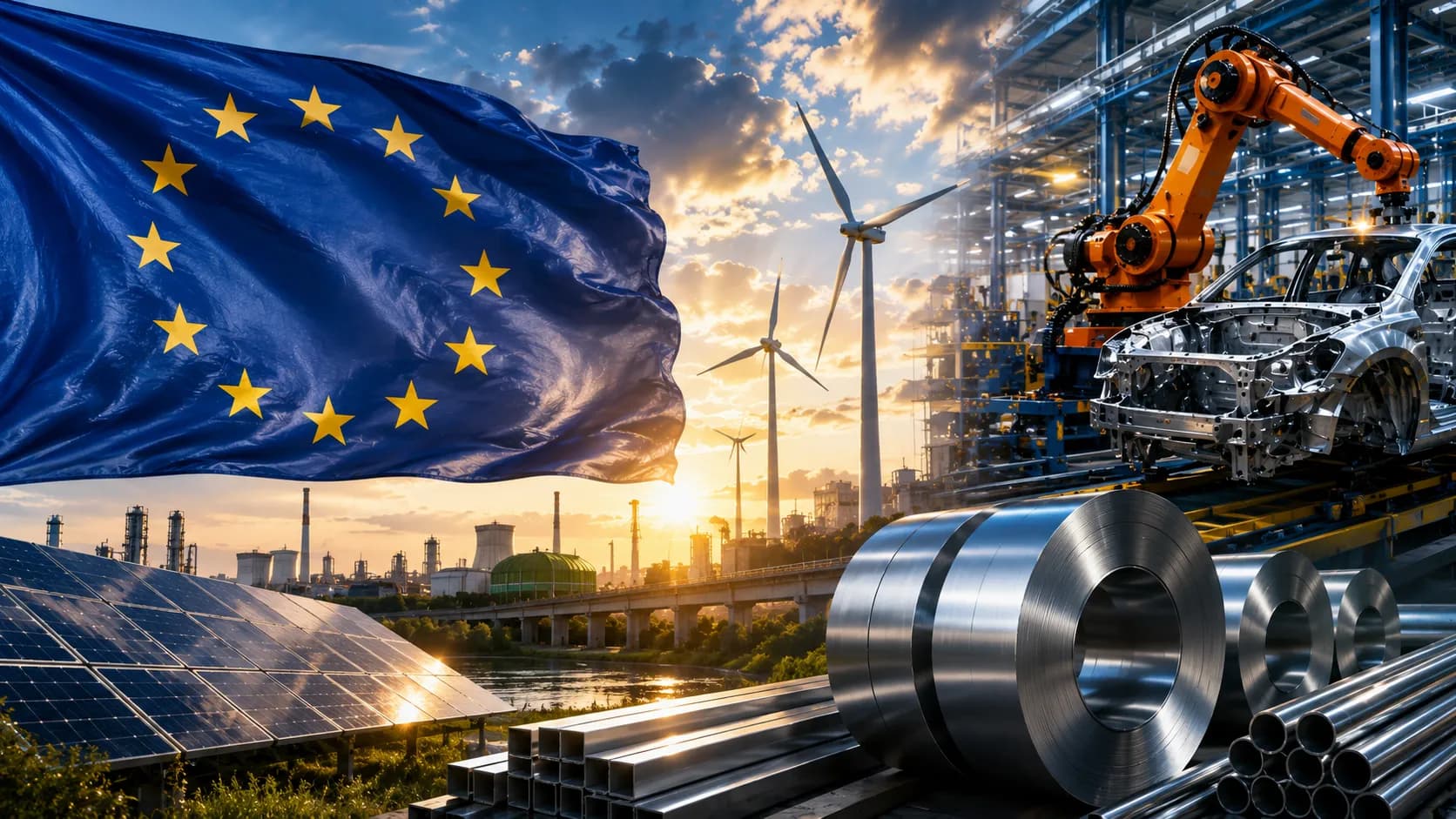
The European Union has taken its most ambitious step in industrial policy in years. The Industrial Accelerator Act (IAA), proposed by the European Commission on 4 March 2026, aims to boost manufacturing, grow businesses and create jobs in the EU, while supporting industry's adoption of cleaner, future-ready technologies (Commission). Announced in the Clean Industrial Deal and in the Joint Communication on strengthening EU economic security, the proposal delivers on the Draghi report by creating EU demand for clean and EU-made products and key technologies through public procurement and support schemes (DG-EMPL).
The target: Manufacturing at 20 per cent of the EU economy by 2035
At the core of the act lies a measurable goal. According to the Commission, manufacturing represented 14.3 per cent of EU gross domestic product in 2024 and plays a vital role in Europe's economic resilience, innovation lifecycle and social fabric; the act sets the goal of raising this share to 20 per cent by 2035 (Commission). According to the European Parliament's research service, the key sectors covered are energy-intensive industries, net-zero technologies and the automotive industry (Parliament).
Executive Vice-President for Prosperity and Industrial Strategy Stéphane Séjourné presented the proposal in these terms: the act will create jobs by directing taxpayers' money to European production, decreasing dependencies and enhancing the EU's economic security and sovereignty (Commission).
"Made in EU": Lead markets backed by public money
The proposal's most talked-about innovation is the creation of "lead markets" for clean and European-made products wherever public money is involved. The act leverages the strengths of the Single Market by supporting lead markets for "Made in EU" and low-carbon products, ensuring that foreign direct investments bring value to the EU, and simplifying permitting procedures for industrial projects (DG-EMPL). The Commission stresses that the EU remains one of the world's most open markets and, in line with the Draghi report, encourages greater reciprocity in public procurement: equal treatment is envisaged for countries that offer EU companies access to their own markets (Commission).
Acceleration areas and "one project – one procedure"
The act regulates not only the demand side but also the conditions of production. Industrial manufacturing projects will benefit from a streamlined and digital "one project – one procedure" approach through a single access point; for projects in energy-intensive industries and clean technologies, permitting procedures should not exceed 18 months. Member states will also designate industrial acceleration areas, where site-level permitting is already completed and enabling conditions are in place, allowing project promoters to focus only on activity-specific permits (Commission).
A value condition on foreign investment
The proposal's third pillar concerns foreign direct investment in strategic sectors. According to the Commission, such investments must create high-quality jobs, drive innovation and growth, and generate real value in the EU through technology and knowledge transfer as well as compliance with local content requirements. Investors must also guarantee a 50 per cent minimum level of European employment, ensuring that businesses and citizens benefit alongside investors from access to the Single Market (DG-EMPL).
The legislative process
The proposal was published as draft Regulation COM(2026)100, accompanied by its impact assessment (DG-GROW). The regulation will be negotiated by the European Parliament and the Council of the European Union before its adoption and entry into force (DG-EMPL). In Parliament, the file has been allocated jointly to the Industry (ITRE), Internal Market (IMCO) and International Trade (INTA) committees; the next step is the appointment of rapporteurs and preparation of the joint report (Parliament).
Why it matters
The Industrial Accelerator Act is the EU's most comprehensive answer to global industrial competition: steering public money toward European-made, low-carbon products, capping permits at 18 months and tying investment to a value condition, all in a single package. If enacted, "Made in EU" will cease to be a marketing slogan and become a legal standard — changing the rules of the game for every company manufacturing in Europe, exporting to the EU market or planning to invest in the EU. The negotiations in Parliament and the Council will determine how broad the label's scope and how strict its conditions will be.
Botakoz Unbayeva
Contributing writer at EUReflect.
Follow EUReflect
See more of our reporting on Google
Mark EUReflect as a preferred source and our stories are ranked higher for you in Top Stories, Discover and Google News — and carry a “preferred” badge when they are cited in AI results.
Add EUReflect as a preferred source