The Mecca Defence Agreement: Defence Diplomacy and Deterrence
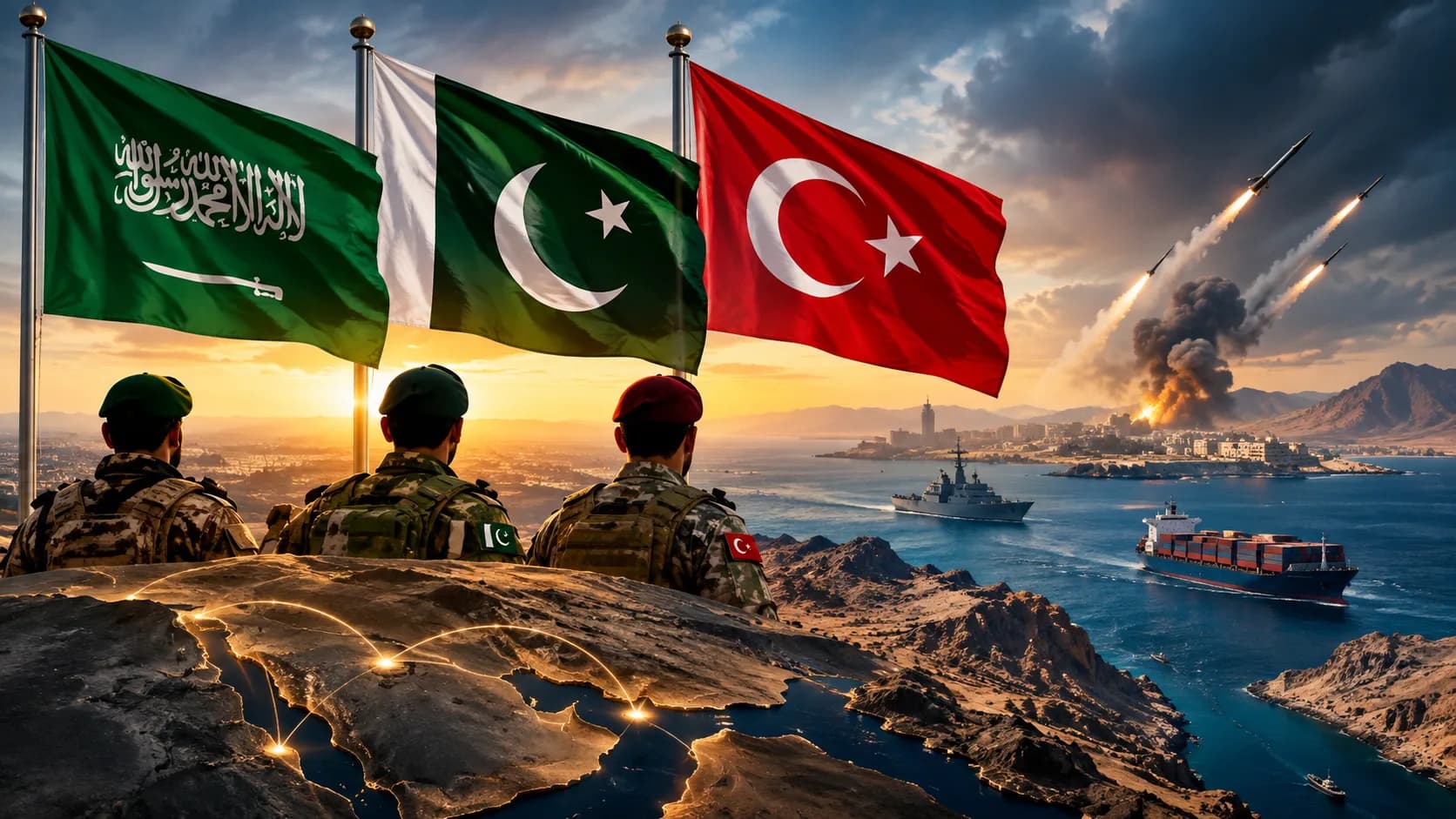
The Mecca Joint Defence Agreement strengthens defence diplomacy and collective deterrence among Türkiye, Saudi Arabia, and Pakistan by combining their military, industrial, economic, and strategic capabilities. Its effectiveness depends on credible commitments and institutional cooperation.
1. Introduction
The transformation of the international security environment in recent years has made it increasingly difficult for states to conduct their defence policies exclusively on the basis of national military capabilities. Regional conflicts, non-state armed actors, the proliferation of missile and unmanned systems, energy security concerns, the protection of critical infrastructure, and the security of maritime trade routes have contributed to an environment in which security increasingly requires multilateral cooperation.
Within this context, defence diplomacy has become one of the principal instruments through which states integrate their military capabilities with broader foreign policy objectives. Defence diplomacy encompasses not only wartime military coordination but also the development of security relations during peacetime through military education and training, defence-industrial cooperation, joint exercises, high-level military contacts, strategic dialogue, and confidence-building mechanisms.
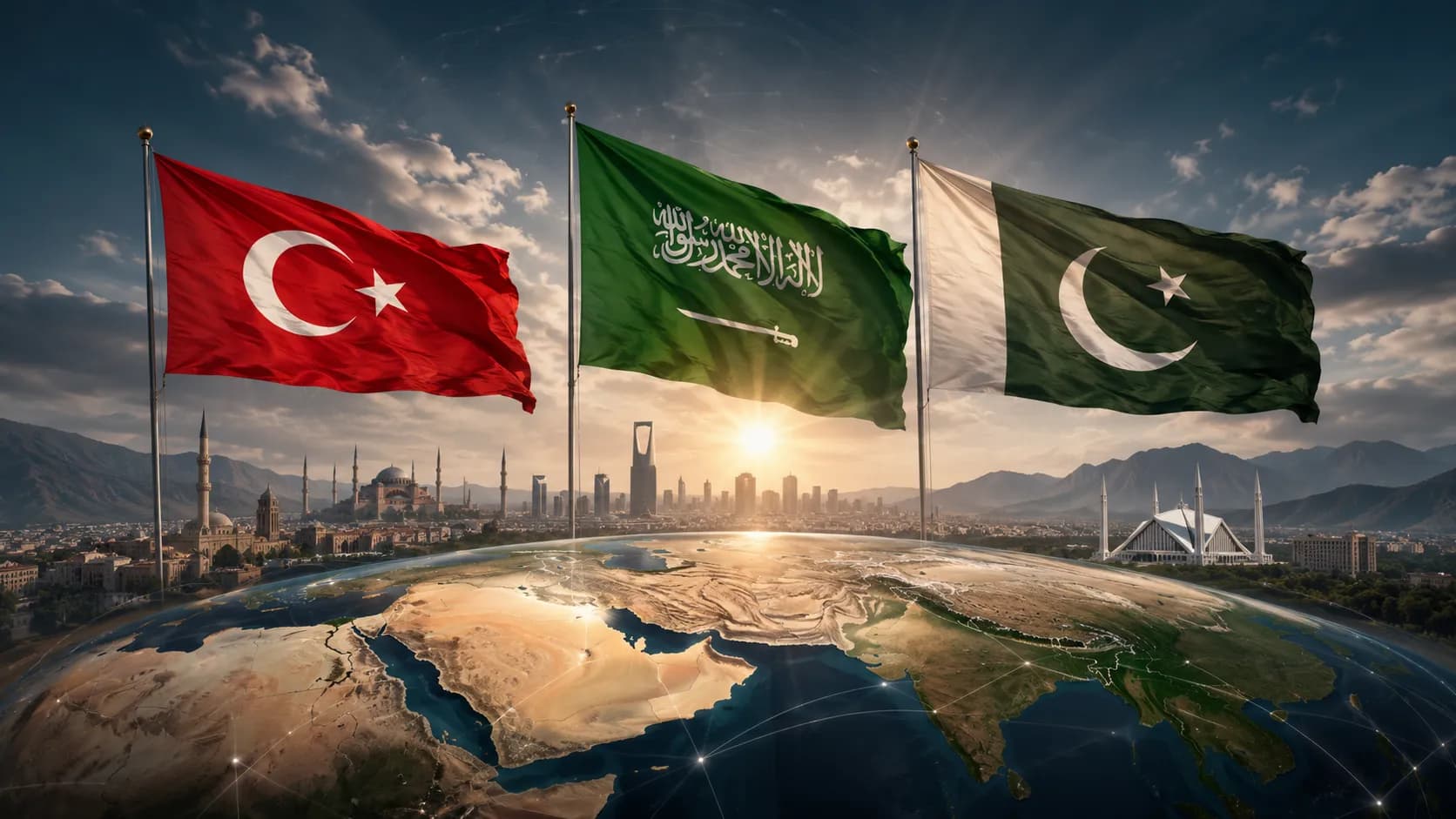
The Mecca Joint Defence Agreement, signed by Türkiye, Saudi Arabia, and Pakistan on 7 August 2026, should be examined within this broader strategic context. One of the Agreement's most significant provisions is the principle of collective defence, according to which an armed attack against any of the three countries is considered an attack against the other parties as well. This provision gives the Agreement a considerably stronger strategic character than conventional defence cooperation arrangements.
The Mecca Agreement did not, however, emerge in a strategic vacuum. The Strategic Mutual Defence Agreement signed between Pakistan and Saudi Arabia on 17 September 2025 elevated bilateral defence relations to the level of collective deterrence by establishing that an attack against either country would be regarded as an attack against both. The subsequent participation of Türkiye in the emerging trilateral framework is therefore significant insofar as it potentially transforms the existing Pakistan–Saudi Arabia defence axis into a broader regional security mechanism.
The principal objective of this article is not to examine the operational military dimensions of the Mecca Agreement, but rather to assess how the Agreement may generate deterrence through defence diplomacy. In doing so, the study situates the trilateral arrangement within the broader theoretical literature on deterrence, alliance credibility, strategic signalling, and defence diplomacy.
2. Conceptual Framework: Defence Diplomacy and Deterrence
Defence diplomacy can broadly be defined as the peaceful utilisation of defence institutions and military capabilities in support of foreign policy objectives. According to Cottey and Forster (2004), defence diplomacy may contribute to the establishment of long-term security relationships among states through military cooperation, training activities, institutional contacts between defence establishments, and confidence-building measures.
From this perspective, defence diplomacy functions primarily as an instrument of conflict prevention rather than as a mechanism for the conduct of war. Military power does not disappear from international relations; instead, it remains present in the background as a credible capability reinforcing diplomatic communication and political commitments.
This relationship directly intersects with deterrence theory. Schelling (1966) conceptualises deterrence not primarily as the actual use of military power but as the ability to influence an adversary's decision-making by credibly communicating the potential consequences of hostile action. Deterrence is therefore not solely a question of material capability. Rather, it depends on the relationship between capability, resolve, and communication.
Morgan (2003) similarly conceptualises deterrence as an attempt by one actor to persuade another that a particular course of action would generate unacceptable costs. From this perspective, the deterrent effect of alliances cannot be understood simply as the mathematical aggregation of the military capabilities of participating states. What matters is the expectation that an aggressor would confront not merely the targeted state but also its security partners.
The strategic significance of the Mecca Agreement becomes particularly evident within this theoretical framework. By establishing a common security commitment among three states, the Agreement potentially alters the cost-benefit calculations of prospective adversaries. An actor contemplating hostile action against one member would theoretically have to incorporate the possible responses of all three states into its strategic calculations.
Consequently, the Mecca Agreement may be interpreted as an attempt to transform separate national capabilities into a broader framework of collective deterrence.
3. The Strategic Context Leading to the Mecca Agreement
The growing strategic alignment among Türkiye, Pakistan, and Saudi Arabia cannot be understood solely through the Agreement signed on 7 August 2026. The three countries entered this arrangement against the background of previously expanding bilateral and multilateral defence relationships.
Pakistan and Saudi Arabia have maintained military and security relations for decades. These relations were elevated to a more institutionalised strategic level through the Strategic Mutual Defence Agreement of 17 September 2025. According to official Saudi and Pakistani statements, the agreement sought to strengthen defence cooperation and reinforce joint deterrence against aggression directed at either state.
Türkiye–Pakistan relations constitute another important component of this emerging strategic architecture. Bilateral relations have expanded considerably in the fields of defence industry cooperation, military training, defence technology, and broader strategic coordination. The two countries have developed an increasingly institutionalised security partnership, creating an important foundation for a trilateral mechanism.
Türkiye–Saudi Arabia relations have likewise undergone significant development, particularly in the defence and security domains. The expansion of defence-industrial contacts and strategic dialogue between Ankara and Riyadh has facilitated the emergence of a broader framework capable of incorporating Pakistan.
Furthermore, cooperation among the three states has not been confined to strictly military affairs. Diplomatic coordination has also intensified through regional consultation mechanisms. During 2026, Türkiye, Pakistan, and Saudi Arabia participated in several diplomatic initiatives concerning regional security and stability. For example, at the fourth R4 consultative meeting held on 21 June 2026, the foreign ministers of Türkiye, Pakistan, Saudi Arabia, and Egypt emphasised the importance of sustained consultation and coordination for regional peace, security, and stability.
The Mecca Agreement should therefore be understood not as the sudden creation of a new military bloc, but rather as the institutionalisation of progressively intensifying diplomatic and defence relationships.
4. The Mecca Agreement from the Perspective of Defence Diplomacy
The first major strategic function of the Mecca Agreement is its potential to transform existing bilateral defence relationships into a trilateral defence diplomacy framework.
Bilateral defence relations can remain limited to specific fields of cooperation. A trilateral mechanism, by contrast, may enable security challenges to be evaluated through a shared strategic framework. Such an arrangement can potentially facilitate more regular coordination among ministries of defence, ministries of foreign affairs, military establishments, security institutions, and defence-industrial organisations.
The second dimension concerns strategic signalling. One of the principal functions of defence diplomacy is to communicate to external actors the extent of solidarity and strategic coordination among participating states. The collective defence commitment contained in the Mecca Agreement constitutes a particularly strong diplomatic signal in this respect.
The Agreement communicates that the security of Türkiye, Saudi Arabia, and Pakistan can no longer necessarily be evaluated as three entirely separate strategic questions. Instead, a hostile action against one party may create consequences involving the broader trilateral framework. This increases uncertainty for potential adversaries and may consequently raise the anticipated costs of aggression.
A third dimension is defence-industrial diplomacy. Türkiye's rapidly developing defence-industrial capabilities, Pakistan's extensive military experience and defence infrastructure, and Saudi Arabia's substantial financial resources and investment capacity create potentially complementary strategic assets.
Türkiye's defence industry can contribute technological and industrial capacity; Pakistan can provide military experience, human capital, and strategic depth; while Saudi Arabia can contribute investment resources, economic leverage, and geopolitical influence. The combination of these assets could allow defence diplomacy to extend beyond political declarations into technological cooperation, military education, institutional capacity building, and potentially joint defence-industrial initiatives.
Defence-industrial cooperation is particularly important because it creates long-term interdependence. Unlike short-term diplomatic agreements, defence projects typically involve training, maintenance, technology transfer, logistics, supply chains, and institutional interaction over extended periods. Consequently, defence-industrial cooperation may function as a mechanism for consolidating political trust among the three states.
5. Assessing the Deterrence Capacity of the Agreement
The most important feature of the Mecca Agreement from a deterrence perspective is its capacity to bring three distinct categories of strategic power within a common security framework.
Türkiye contributes a rapidly developing defence industry, extensive institutional military experience acquired within NATO, significant conventional military capabilities, and a geostrategic position connecting Europe, the Black Sea, the Caucasus, the Middle East, the Eastern Mediterranean, and adjacent regions.
Pakistan's contribution has a different strategic character. Pakistan possesses large and experienced armed forces and occupies a distinctive position in international deterrence literature as a nuclear-armed South Asian state. Nevertheless, publicly available information concerning the nuclear dimension of the Mecca Agreement remains limited. It would therefore be analytically inappropriate to assume that the Agreement automatically establishes a Pakistani "nuclear umbrella" over Türkiye or Saudi Arabia.
What is strategically relevant is not necessarily an explicit extension of nuclear deterrence, but the effect of Pakistan's overall strategic capabilities on the perceived credibility of the trilateral arrangement. Pakistan's status inevitably affects how external actors may calculate the potential consequences of escalation involving the three-country framework.
Saudi Arabia represents the third pillar. Its contribution derives from its considerable economic capacity, central position within global energy markets, geopolitical influence in the Gulf and Red Sea regions, and wider diplomatic significance across the Islamic world.
When combined, these three components may produce what can be described as multilayered deterrence.
Deterrence does not consist exclusively of the threat of direct military retaliation. Diplomatic isolation, economic costs, defence-industrial mobilisation, political pressure, and the expectation that an attacked state will not remain strategically isolated can also affect an adversary's calculations.
For analytical purposes, the deterrent potential of the Mecca Agreement can therefore be conceptualised as follows:
Deterrence = Capability + Credibility + Solidarity + Strategic Communication
The first component, capability, concerns whether the participating states possess sufficient material resources to impose costs upon an aggressor.
The second, credibility, concerns whether adversaries believe that these capabilities would actually be employed if required.
The third, solidarity, concerns the political cohesion of the three states and their willingness to accept costs in defence of one another.
Finally, strategic communication concerns whether the collective commitment is clearly communicated to potential adversaries without simultaneously generating unnecessary escalation.
The possession of substantial capabilities by Türkiye, Pakistan, and Saudi Arabia is therefore insufficient by itself. For the Agreement to function as an effective deterrent, the mutual defence commitment must also be perceived as credible.
6. Collective Defence and Strategic Ambiguity
The provision defining an attack against one party as an attack against the others naturally invites comparisons with NATO's collective defence principle. Indeed, some international commentary has characterised the arrangement as a "NATO-style" defence pact.
Such comparisons should nevertheless be approached cautiously.
NATO is a highly institutionalised alliance supported by decades of integrated command structures, joint defence planning, standardisation mechanisms, military exercises, interoperability arrangements, and permanent political and military bodies. Whether the Mecca Agreement will develop comparable institutional mechanisms remains uncertain.
This distinction is particularly important because political declarations of collective defence and operationally credible collective defence mechanisms are not necessarily identical.
The concept of strategic ambiguity is relevant in this regard. Even if a prospective aggressor does not know precisely how Türkiye, Saudi Arabia, or Pakistan would respond to an attack against one of the other parties, the possibility of broader intervention must nevertheless be incorporated into its calculations.
A certain degree of uncertainty can strengthen deterrence because the aggressor cannot confidently limit the scope of a potential conflict.
However, excessive ambiguity may produce the opposite result. If external actors conclude that the parties themselves do not know under what circumstances they would assist one another, the credibility of the collective defence commitment could weaken.
The long-term deterrent value of the Agreement will therefore depend on the ability of the three states to balance strategic ambiguity with institutional credibility.
7. Strategic Implications for Türkiye
For Türkiye, one of the most significant implications of the Mecca Agreement is the geographical expansion of its defence diplomacy.
Türkiye remains a member of NATO and possesses longstanding institutional connections with the Euro-Atlantic security architecture. The Mecca Agreement need not necessarily be interpreted as replacing or directly challenging these relationships. Rather, it can be understood as establishing an additional channel of defence diplomacy extending towards the Middle East, the Gulf, and South Asia.
This development is consistent with Türkiye's broader tendency towards multidimensional strategic engagement.
A second implication concerns the diplomatic role of Türkiye's defence industry. Defence technologies are not merely commercial export products. Because defence cooperation typically requires training, maintenance, technical assistance, technology transfer, logistical coordination, and long-term institutional relationships, defence exports can also function as instruments of foreign policy.
Türkiye's defence-industrial capabilities could therefore become one of the principal mechanisms through which the trilateral framework is institutionalised.
Third, the Agreement could strengthen Türkiye's position as a strategic actor linking Gulf security with South Asian security. Such a role may increase Ankara's diplomatic relevance in regional crises and reinforce its ability to operate across multiple geopolitical environments.
Nevertheless, the Agreement also raises an important strategic question for Türkiye: how obligations arising from NATO membership and commitments under the new trilateral defence framework would be coordinated during a major regional crisis.
The sustainability of the Mecca framework may therefore depend partly on Ankara's ability to manage these security relationships as complementary mechanisms operating across different geographical and political contexts rather than as competing alliance structures.
8. Risks and Limitations
Despite its strategic potential, the Mecca Agreement also faces several important limitations.
First, the threat perceptions of Türkiye, Pakistan, and Saudi Arabia are not identical. South Asian security dynamics remain central to Pakistan's strategic calculations, whereas Saudi Arabia prioritises security challenges in the Gulf, the Red Sea, and the wider Middle East. Türkiye, meanwhile, operates within an exceptionally broad security environment extending from the Black Sea and the Caucasus to the Eastern Mediterranean and the Middle East.
The central challenge will therefore be transforming different national threat perceptions into a sufficiently coherent common security framework.
The second issue concerns the risk of alliance entrapment. One party's involvement in a regional confrontation could potentially create expectations of support from the other parties. Determining which types of attacks activate collective defence obligations and what forms of assistance are required will therefore be essential for managing escalation risks.
The third challenge is institutionalisation. Political commitments become effective deterrence mechanisms only when supported by credible structures. Regular consultation mechanisms, strategic assessments, crisis communication channels, defence planning, and institutional coordination will therefore be crucial to the long-term effectiveness of the Agreement.
The fourth issue concerns external perceptions. If the Mecca Agreement is interpreted as an offensive bloc directed against a specific state or group of states, its stabilising function as an instrument of defence diplomacy could be weakened. The parties must therefore communicate the defensive character of the arrangement clearly.
Defence diplomacy is most effective when it simultaneously strengthens the security of participating states and reduces uncertainty concerning their intentions. Strategic communication will consequently constitute a critical component of the Agreement's long-term credibility.
9. Conclusion
The Mecca Joint Defence Agreement represents an important attempt to institutionalise the defence diplomacy relationship among Türkiye, Saudi Arabia, and Pakistan. Its strategic significance derives not merely from the aggregation of the military capabilities of the three states, but more importantly from the possibility of linking these capabilities through a common political commitment and mutual security framework.
From the perspective of deterrence theory, the principal effect of the Agreement is its potential to alter the calculations of prospective adversaries. If an attack against one party creates a credible possibility of involvement by the other two, the anticipated political, military, economic, and strategic costs of aggression increase considerably.
From the perspective of defence diplomacy, meanwhile, the Agreement should be understood as a security instrument designed to operate before military force becomes necessary. The effectiveness of defence diplomacy is not measured primarily by the ability to wage war, but by the ability to reduce the probability of war through credible capability, institutional cooperation, and political solidarity.
Türkiye's defence-industrial capabilities and institutional military experience, Pakistan's military-strategic capacity, and Saudi Arabia's economic and geopolitical weight theoretically constitute complementary strategic assets. Accordingly, the most significant potential contribution of the Mecca Agreement lies not simply in the aggregation of national capabilities, but in the creation of a combined strategic capability.
The long-term significance of the Agreement, however, will ultimately be determined by implementation rather than by the language of the document alone. The extent to which the three states harmonise their threat perceptions, clarify the political meaning of their mutual commitments, develop crisis-management mechanisms, and institutionalise defence diplomacy will determine whether the Agreement becomes an enduring component of the regional security architecture.
It is therefore premature to characterise the Mecca Agreement as the establishment of a new military bloc comparable to NATO. A more analytically precise interpretation is to conceptualise it as an emerging multilayered mechanism of defence diplomacy and collective deterrence connecting Türkiye, Saudi Arabia, and Pakistan.
If political commitments are successfully transformed into sustainable institutional cooperation, the Mecca Agreement could ultimately influence not only bilateral and trilateral relations among the participating states but also the broader security architecture connecting the Middle East, the Gulf, and South Asia. In this sense, its strategic significance may lie in the emergence of a security framework in which defence diplomacy serves as the institutional bridge between national military capabilities and collective deterrence.
References
Cottey, A., & Forster, A. (2004). Reshaping Defence Diplomacy: New Roles for Military Cooperation and Assistance. Oxford University Press for the International Institute for Strategic Studies.
Freedman, L. (2004). Deterrence. Polity Press.
George, A. L., & Smoke, R. (1974). Deterrence in American Foreign Policy: Theory and Practice. Columbia University Press.
Jervis, R. (1976). Perception and Misperception in International Politics. Princeton University Press.
Morgan, P. M. (2003). Deterrence Now. Cambridge University Press.
Schelling, T. C. (1966). Arms and Influence. Yale University Press.
Saudi Press Agency. (2025, September 17). HRH the Crown Prince, Pakistan Prime Minister Hold Official Talks, Sign Strategic Mutual Defense Agreement.
Pakistan Broadcasting Corporation. (2025, September 17). Pakistan, Saudi Arabia Sign Strategic Mutual Defense Agreement.
Republic of Türkiye Ministry of Foreign Affairs. (2026, June 21). Joint Statement of the R4 Following the Fourth Consultative Meeting of the Foreign Ministers.
Republic of Türkiye Ministry of Foreign Affairs. (2026, July 23). Joint Statement by the Foreign Ministers of Türkiye, Egypt, Indonesia, Jordan, Pakistan, Qatar, Saudi Arabia, and the United Arab Emirates.
Associated Press. (2026, August 7). Saudi Arabia, Turkey and Pakistan Have Signed a Key Defense Agreement.
The Guardian. (2026, August 7). Saudi Arabia, Pakistan and Turkey Sign NATO-style Defence Pact.

İsmail Polat
Ph. D. in International Relations
Follow EUReflect
See more of our reporting on Google
Mark EUReflect as a preferred source and our stories are ranked higher for you in Top Stories, Discover and Google News — and carry a “preferred” badge when they are cited in AI results.
Add EUReflect as a preferred source