The New Arms Race: UAVs, AI, and Electronic Warfare Integration
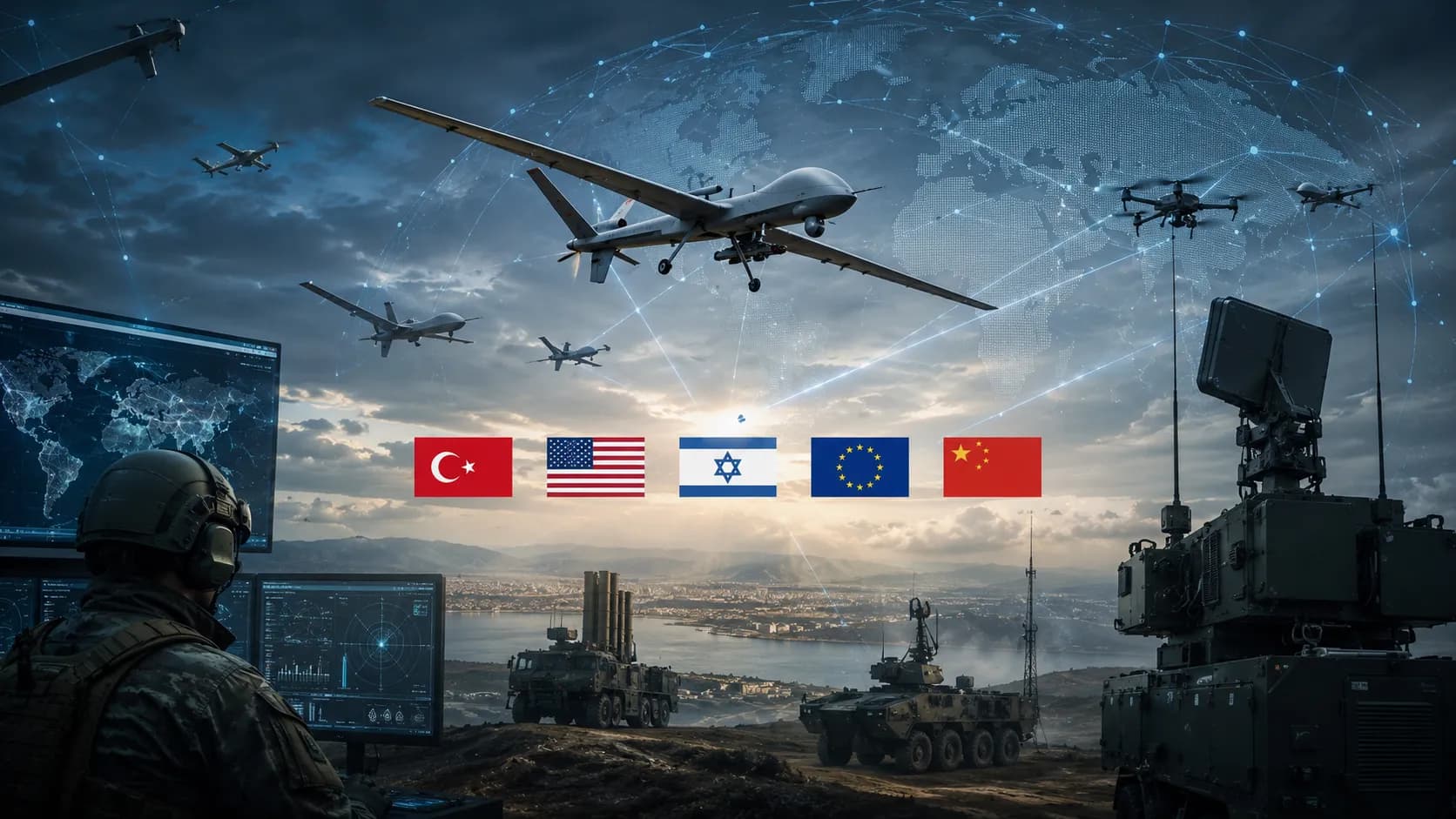
Türkiye has become a major disruptive force in global UAV warfare with Baykar, TAI, ASELSAN, and Roketsan. The US leads high-end autonomous systems, Israel dominates ISR technologies, Europe focuses on integrated defense networks, and China controls mass production. Drone warfare is shifting toward AI-driven, scalable ecosystems.
Introduction
The global unmanned aerial vehicle (UAV) and counter-unmanned aerial system (C-UAS) industry has evolved into one of the most decisive pillars of modern military power projection. What was once a niche segment of aerospace engineering focused primarily on reconnaissance has now transformed into a multi-domain warfare ecosystem integrating precision strike capability, electronic warfare, artificial intelligence, autonomous navigation, swarm coordination, and real-time battlefield data fusion. In contemporary conflicts, UAV systems are no longer auxiliary assets; they are central components of operational doctrine, shaping tactical outcomes, strategic deterrence, and geopolitical influence.
Within this rapidly evolving environment, competition is no longer defined solely by hardware superiority. Instead, it is determined by the ability to integrate software-defined warfare architectures, scalable production models, resilient communication networks, and adaptive AI-driven autonomy. The result is a fragmented but highly competitive global market dominated by a small number of states and defense corporations that control both technological standards and export flows. Among these actors, Türkiye has emerged as one of the most significant disruptive forces, fundamentally altering traditional hierarchies in UAV warfare through its emphasis on combat-proven systems, rapid iteration cycles, and cost-efficient scalability.
Türkiye: The Emerging Center of Gravity in Drone Warfare
Türkiye’s rise in the UAV sector represents one of the most rapid industrial transformations in modern defense history. Unlike legacy defense powers that developed UAV capabilities gradually over decades, Türkiye accelerated its position through an integrated ecosystem combining private-sector agility, state-backed defense coordination, and operational battlefield feedback loops. The country has established a vertically integrated drone production architecture where airframe design, avionics, mission systems, sensors, and munitions integration are increasingly developed within a domestic supply chain.
At the core of this ecosystem is Baykar, which has become globally recognized for platforms such as the Bayraktar TB2, TB3, and the Akinci class of medium-altitude long-endurance (MALE) strike UAVs. These systems have been deployed extensively in multiple operational theaters, establishing a reputation for reliability, precision strike capability, and cost-effectiveness. Complementing Baykar’s platform-centric approach, Turkish Aerospace Industries contributes high-endurance ISR and strike platforms such as the Anka and Aksungur systems, which extend Türkiye’s operational depth into longer-range and higher-payload missions.
The effectiveness of these platforms is significantly enhanced by subsystem integration from ASELSAN and Roketsan. ASELSAN provides advanced electro-optical targeting systems, radar solutions, electronic warfare suites, and counter-UAS detection capabilities, while Roketsan ensures precision-guided munitions compatibility and air-to-ground strike effectiveness. This synergy between airframes, sensors, and weapons systems creates a self-reinforcing ecosystem that enhances battlefield adaptability.
Türkiye’s strategic advantage is not limited to technological production alone. Its UAV doctrine is shaped by continuous operational feedback, enabling rapid iteration cycles that shorten development timelines significantly compared to Western procurement models. Moreover, the export-oriented structure of the industry has turned UAV systems into geopolitical instruments, extending Türkiye’s influence across regions such as the Middle East, North Africa, Eastern Europe, and parts of Central Asia. As a result, Türkiye has transitioned from an emerging player to a central reference point in discussions of modern drone warfare economics and asymmetric military capability.
United States: High-End Autonomous Warfare Architecture
The United States continues to dominate the upper tier of UAV technology, particularly in high-altitude long-endurance systems, stealth integration, and network-centric warfare frameworks. The American UAV ecosystem is characterized by deep integration between defense primes, intelligence agencies, and satellite-based command infrastructures. This enables the deployment of UAV systems not merely as independent platforms but as nodes within a global surveillance and strike network.
Key actors such as General Atomics have defined the global standard for armed UAV operations through platforms like the MQ-9 Reaper. Meanwhile, Northrop Grumman specializes in high-altitude reconnaissance systems such as the RQ-4 Global Hawk, which provide persistent surveillance over strategic regions. Lockheed Martin contributes advanced autonomous systems and stealth-integrated UAV concepts that align with next-generation multi-domain operations.
In parallel, RTX Corporation provides critical counter-UAS capabilities, missile interception systems, radar networks, and sensor fusion technologies that form the backbone of layered air defense architectures. Boeing develops carrier-based UAV systems such as the MQ-25 Stingray, extending unmanned capabilities into naval aviation. Additionally, Kratos Defense & Security Solutions focuses on tactical unmanned combat systems and loyal wingman concepts, while Anduril Industries represents a new generation of AI-driven autonomous defense systems emphasizing real-time situational awareness and distributed sensor networks.
The American model is defined by technological depth, high R&D investment, and integration with satellite and cyber warfare infrastructure, making it the most advanced ecosystem in terms of strategic UAV deployment capability.
Israel and Europe: Precision Warfare and Intelligence Dominance
Israel and Europe occupy a distinct position within the global UAV landscape, focusing primarily on intelligence, surveillance, reconnaissance (ISR), precision targeting, and electronic warfare integration. Rather than pursuing mass-scale production, these regions emphasize battlefield-tested reliability, sensor accuracy, and interoperability with NATO and allied defense systems.
In Israel, Israel Aerospace Industries has developed widely deployed platforms such as the Heron series, which are recognized for endurance and strategic reconnaissance capabilities. Similarly, Elbit Systems produces the Hermes UAV family, which integrates advanced ISR payloads and real-time battlefield intelligence systems that are extensively exported and operationally proven.
In Europe, companies such as Thales Group, BAE Systems, Saab AB, and Leonardo S.p.A. collectively form a technologically sophisticated ecosystem focused on radar systems, sensor fusion, electronic warfare integration, and reconnaissance UAV platforms. These systems are typically embedded within broader NATO command and control structures, prioritizing interoperability and strategic intelligence gathering over standalone strike capability.
Emerging Disruptors and Dual-Use UAV Ecosystems
Beyond traditional defense contractors, the UAV industry is increasingly influenced by dual-use technology providers and emerging defense innovators, particularly in China and hybrid commercial-defense ecosystems. The most prominent example is DJI, which dominates the global civilian drone market and indirectly influences military applications through its mass production capabilities and technological accessibility.
The convergence of commercial and military drone technologies has significantly lowered entry barriers for UAV deployment, enabling a broader range of actors to access aerial surveillance and strike capabilities. This shift has intensified the importance of counter-UAS systems and electronic warfare measures designed to neutralize inexpensive but effective drone swarms. Companies such as Dedrone and similar firms have emerged to address this new threat environment by focusing on detection, classification, and neutralization of hostile UAV activity.
Global Market Structure and Strategic Outlook
The global UAV and counter-UAS market is increasingly characterized by asymmetric specialization rather than uniform competition. The United States leads in high-end autonomous systems and integrated battlefield networks, Israel and Europe dominate precision ISR and sensor-based warfare, China drives mass-market dual-use production, while Türkiye represents the most dynamic disruptive force in scalable combat-proven UAV systems.
The emerging strategic trajectory of the sector suggests that future dominance will depend less on individual platform superiority and more on ecosystem integration, including artificial intelligence, autonomous decision-making systems, electronic warfare resilience, and production scalability under conflict conditions. As warfare continues to evolve toward network-centric and algorithm-driven models, UAV systems will remain central to both offensive and defensive military doctrines across all major global powers.
Alvara Merrick
Contributing writer at EUReflect.
Follow EUReflect
See more of our reporting on Google
Mark EUReflect as a preferred source and our stories are ranked higher for you in Top Stories, Discover and Google News — and carry a “preferred” badge when they are cited in AI results.
Add EUReflect as a preferred source