The Hidden Risk in America’s AI Strategy
The new strategy may deepen reliance on large AI models and computing infrastructure, conflicting with diverse defense ecosystem goals.
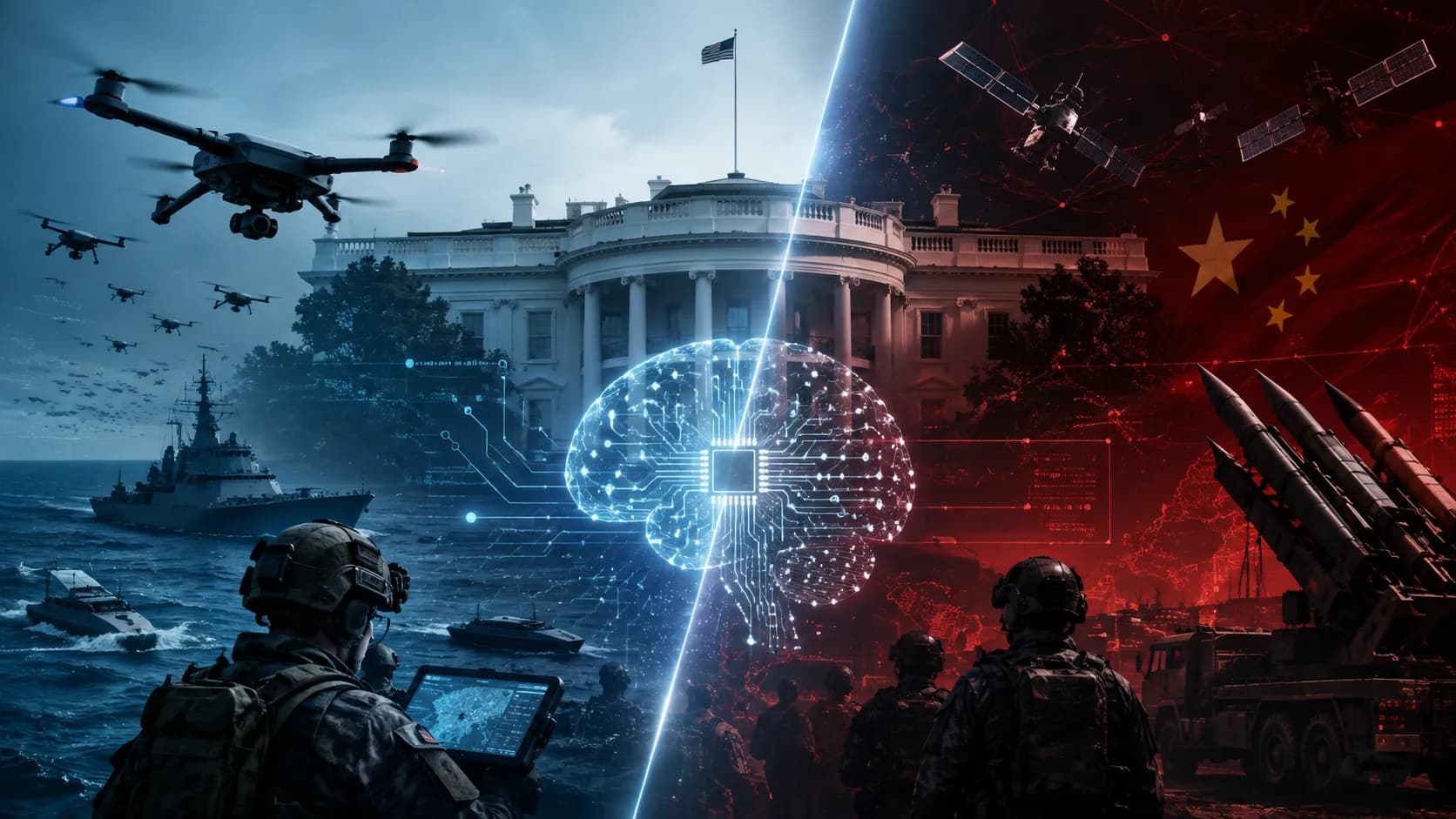
The United States is preparing to accelerate the way it develops, buys, and deploys military technology. Washington’s new National Security Science and Technology Strategy places artificial intelligence, autonomous systems, space, undersea capabilities, and faster defense procurement near the center of America’s effort to preserve its technological advantage.
For defense startups, the message is broadly encouraging. The federal government wants shorter development cycles, greater tolerance for technological risk, more experimentation with nontraditional companies, and easier pathways for commercial technologies to enter national-security missions.
Yet the strategy also reveals a potential contradiction.
While Washington wants a more diverse defense-industrial ecosystem, its approach to artificial intelligence could reinforce dependence on large foundation models and the computing infrastructure required to operate them. The strategy explicitly identifies foundation models—including large-language, multimodal and world models—as critical technologies. At the same time, it does not explicitly identify open-weight AI as a separate priority.
That distinction could become increasingly important as military AI moves from laboratories and cloud infrastructure to ships, aircraft, drones and units operating in communications-degraded environments.
The battlefield is moving toward autonomy
One of the clearest messages in the strategy is that future American military power will not depend exclusively on increasingly sophisticated—and increasingly expensive—individual weapons platforms.
Washington wants a combination of high-end systems and larger numbers of cheaper assets.
The document says the United States should pursue combinations of lower-cost and, in some circumstances, attritable platforms operating alongside smaller numbers of sophisticated systems. The objective is not simply to produce cheaper weapons. It is to create a force structure capable of imposing difficult economic and operational choices on an adversary.
That logic strongly favors autonomous aircraft, unmanned maritime systems, distributed sensors and coordinated groups of robotic platforms.
The strategy identifies undersea capabilities, space, and AI and autonomy as three major areas tied to battlefield dominance and power projection. Its updated critical-technologies list goes further, identifying multi-agent systems, swarm intelligence, autonomous command and control, robotics, embodied intelligence, sensor fusion and autonomous systems across air, surface, maritime, space and cyber domains as important technologies.
This is particularly relevant to the Indo-Pacific.
A conflict fought across enormous distances would put extraordinary pressure on logistics, communications and inventories of expensive precision weapons. Large numbers of comparatively inexpensive autonomous platforms could complicate an adversary’s targeting problem while allowing the United States to distribute sensors, weapons and decision-making across a wider battlespace.
In that sense, Washington appears to be moving beyond the assumption that technological superiority always means building a smaller number of increasingly sophisticated platforms.
Sometimes superiority may instead come from scale.
A potentially important shift in Pentagon procurement
Technology alone, however, has rarely been the Pentagon’s only problem.
The United States has an enormous commercial technology sector and a rapidly expanding defense-startup ecosystem. Turning promising prototypes into military capabilities at scale has often proved considerably harder.
The new strategy explicitly targets that gap.
Federal agencies are encouraged to use Other Transaction Authorities where appropriate and to experiment with milestone-based fixed-cost contracts, competitive development and performance-based selection. More broadly, the document endorses combining conventional acquisition mechanisms with faster nontraditional approaches capable of accepting greater risk in exchange for potentially greater technological rewards.
That matters for startups.
Traditional defense contractors are structured to navigate lengthy procurement processes, extensive compliance requirements and programs that may continue for decades. Young technology companies operate under very different financial pressures. A startup can possess an impressive technology and still fail if the government takes years to become a meaningful customer.
Faster contracting therefore represents more than administrative reform. It could determine which technologies—and which companies—survive long enough to reach military scale.
The strategy also calls for streamlined access to Cooperative Research and Development Agreements and Agreements for Commercializing Technology, while encouraging greater access to federal research infrastructure for small and nontraditional companies. It additionally proposes mechanisms to facilitate private capital investment in technologies relevant to national security.
Together, these measures could widen the entrance to the American defense market.
Washington also wants a larger market for U.S. defense technology
There is another important element: allies.
A defense startup cannot necessarily build a sustainable business around one experimental Pentagon contract. Access to allied markets can dramatically increase the potential customer base and make private investment easier to justify.
The strategy acknowledges the tension between protecting sensitive American technology and allowing allies to acquire capabilities they need.
It therefore calls for a more balanced approach to export controls and foreign military sales—protecting advanced capabilities from potential adversaries without unnecessarily restricting allies and partners seeking to strengthen their own defenses.
If implementation follows the rhetoric, the consequences could extend beyond established defense primes.
A larger international market could give emerging American defense companies something they frequently need as much as Pentagon funding: multiple customers.
But Washington’s AI strategy raises a different question
The strategy becomes more complicated when it turns to artificial intelligence.
Its critical-technologies appendix explicitly includes foundation models, including large-language, multimodal and world models. It also highlights distributed machine learning, continual learning, AI security, interpretability, autonomous agents and tactical edge computing.
What it does not explicitly elevate as its own category is open-weight AI.
That omission does not mean the U.S. government opposes open models. In fact, a separate June national-security AI memorandum specifically directs agencies to adapt both commercial and open-source AI technologies and obtain capabilities from suppliers large and small.
Nevertheless, the difference in emphasis matters.
The dominant frontier-AI model in the United States has increasingly depended on massive computing clusters, sophisticated accelerators, enormous datasets and substantial capital investment. This has produced remarkably capable general-purpose systems.
It has also created an AI ecosystem in which only a relatively small number of companies can afford to compete at the frontier.
For commercial AI, that concentration may primarily be an economic and competition issue.
For military AI, it could become an operational issue.
The battlefield does not look like a data center
Military forces cannot assume permanent access to hyperscale cloud infrastructure.
Ships operate thousands of kilometers from major computing facilities. Aircraft may enter heavily contested electromagnetic environments. Ground forces may lose communications. Satellites can be disrupted. Networks can become congested, degraded or deliberately attacked.
An AI system that performs extraordinarily well while connected to enormous computing infrastructure may therefore be less useful when deployed at the tactical edge.
The White House strategy appears to recognize part of this challenge. Its future-computing priorities specifically include “edge computing and devices for tactical environments,” alongside high-performance computing and next-generation computing architectures.
That creates an important technological question for the Pentagon:
Should the objective be to bring the largest possible AI models closer to the battlefield—or to develop smaller systems specifically optimized for battlefield constraints?
The answer may ultimately be both.
But if federal funding and procurement incentives become excessively concentrated around frontier foundation models, smaller and more specialized approaches could struggle for attention even when they are better suited to particular missions.
Small AI could become strategically important
For many military applications, the most capable general-purpose model may not be necessary.
A drone identifying objects, a vehicle analyzing sensor information, a submarine processing acoustic signatures or a command post prioritizing battlefield data may benefit more from specialized models designed around specific tasks.
Such systems can potentially operate with lower computing requirements, reduced energy consumption and less dependence on continuous connectivity.
Open-weight models add another dimension.
Because model parameters can be inspected, adapted and deployed on infrastructure controlled by the user, open-weight systems may provide governments and military organizations with greater flexibility to modify models for specialized missions.
They can also potentially reduce dependence on individual commercial providers.
That does not automatically make open-weight AI superior. Security, reliability, provenance, adversarial manipulation and model integrity remain serious concerns—particularly in national-security environments.
But the ability to experiment with these systems could itself become strategically valuable.
China changes the calculation
The debate becomes more consequential because the United States is not developing AI in isolation.
China is simultaneously investing in foundation models, open models, autonomous systems, robotics, semiconductors and military applications of artificial intelligence.
The traditional American technology-control strategy has relied partly on restricting Chinese access to advanced chips, manufacturing equipment and sensitive U.S. technologies.
But software ecosystems complicate that approach.
If capable AI models become easier to modify, compress and distribute, technological advantage may depend increasingly on how effectively countries adapt models to real-world applications—not simply on who possesses the largest computing cluster.
That could favor ecosystems capable of rapidly experimenting with open models and specialized architectures.
Washington therefore faces a strategic balancing act.
It wants to preserve the advantages of America’s frontier AI companies while preventing the national-security establishment from becoming dependent on a small number of providers or a single technological architecture.
The White House’s June AI memorandum already contains some safeguards against that outcome. It calls for onboarding advanced models from multiple vendors and explicitly says the government should draw from commercial and open-source technologies while ensuring that no commercial provider can unilaterally disable or materially alter mission-critical AI systems.
The August science-and-technology strategy, however, places foundation models prominently inside its critical technology framework without giving open-weight models comparable explicit visibility.
That may prove to be an important gap.
The real AI race may be about deployment
For years, discussion of U.S.-China competition in artificial intelligence has centered on model benchmarks, semiconductor performance, computing capacity and the race to build increasingly powerful general-purpose systems.
Military competition introduces another metric: usefulness under battlefield conditions.
A model that achieves exceptional benchmark performance but requires enormous computing resources and reliable network access may not always outperform a smaller system that can run locally inside an aircraft, unmanned vehicle or tactical command post.
The most strategically valuable AI ecosystem may therefore not be the one producing only the largest models.
It may be the ecosystem capable of producing the widest range of models—and rapidly adapting them to radically different operational environments.
That is where the White House strategy contains both its greatest strength and its most significant unresolved question.
Its defense-technology agenda clearly favors experimentation, autonomous systems, new suppliers and faster procurement. It recognizes that future American forces will need cheaper platforms operating at greater scale and that military innovation cannot remain trapped inside traditional acquisition structures.
Yet AI policy will have to follow the same philosophy.
If Washington genuinely wants a defense ecosystem built around competition and experimentation, it may eventually need to treat AI the same way: encouraging frontier models where they provide decisive advantages, while simultaneously supporting open-weight, specialized, distributed and edge-deployed alternatives.
America’s technological advantage may ultimately depend less on possessing a single dominant form of artificial intelligence than on ensuring its military has many different forms of AI available when—and where—they are needed.
In a competition with China, that diversity could become a strategic advantage of its own.

İsmail Polat
Ph. D. in International Relations
Follow EUReflect
See more of our reporting on Google
Mark EUReflect as a preferred source and our stories are ranked higher for you in Top Stories, Discover and Google News — and carry a “preferred” badge when they are cited in AI results.
Add EUReflect as a preferred source