Is the Post-American Middle East Beginning to Take Shape?
Unlike NATO, the Mecca Pact lacks an integrated command structure and joint military planning, raising doubts about its effectiveness as a deterrent.
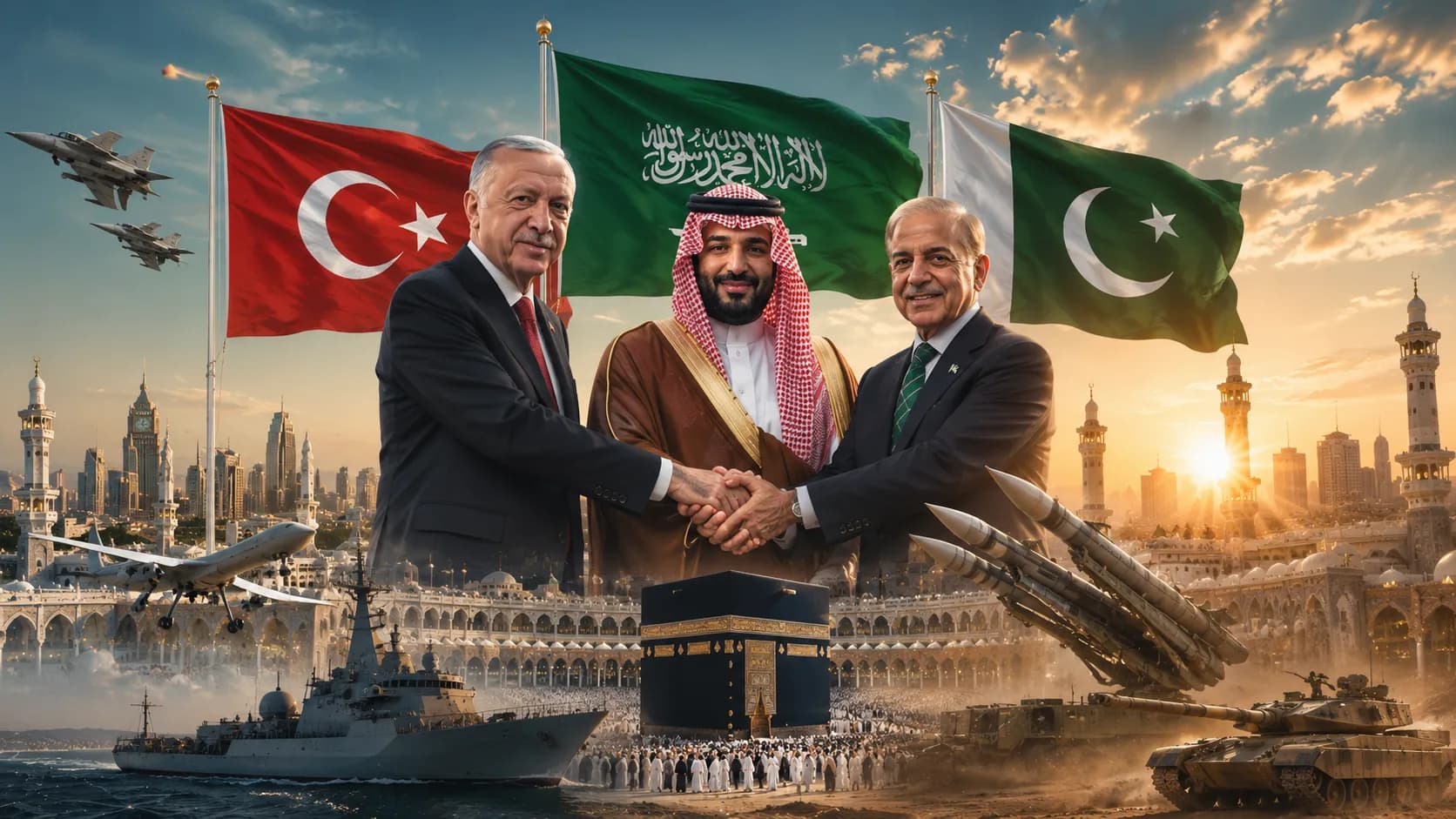
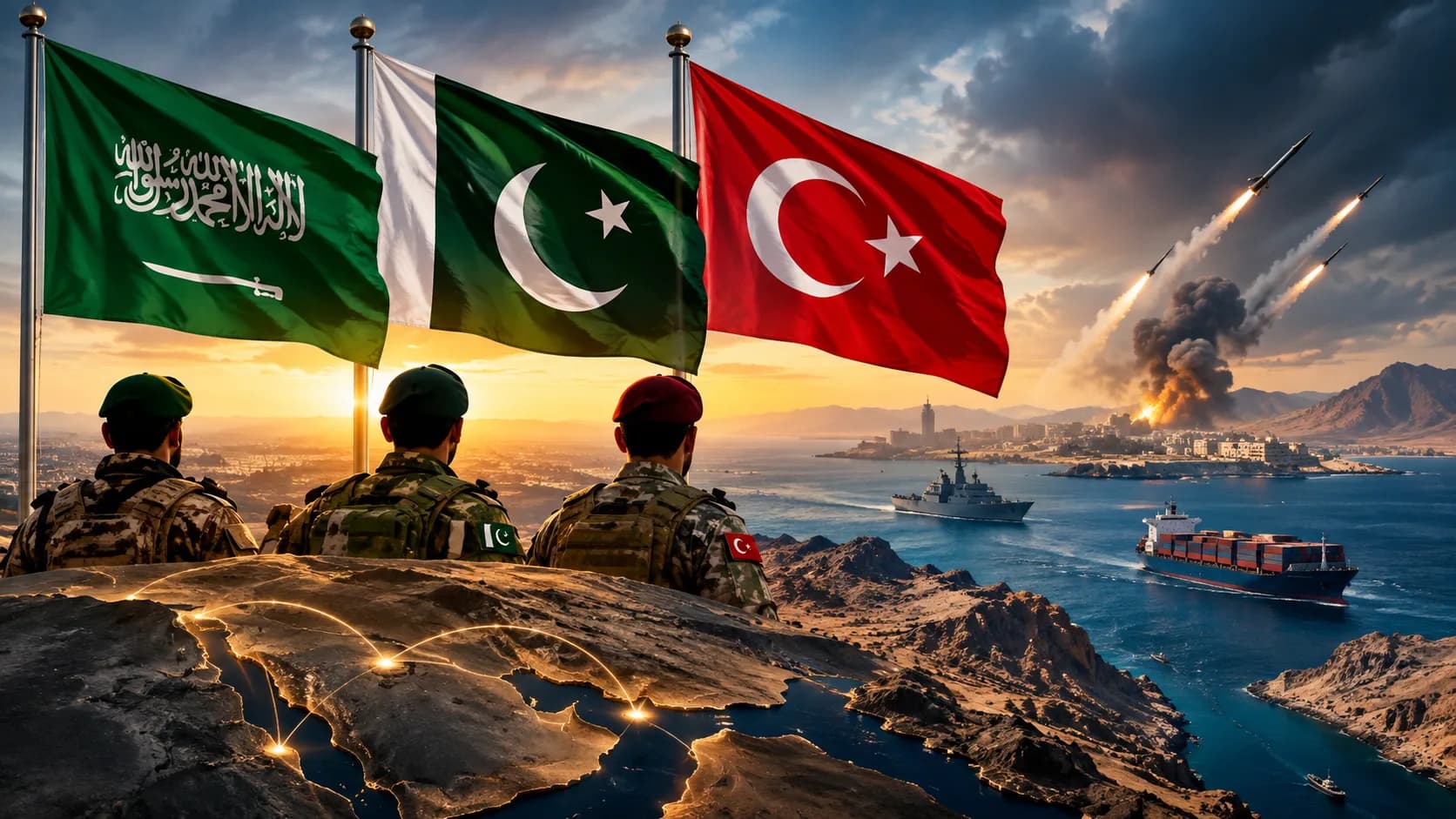
On August 7, 2026, Saudi Crown Prince Mohammed bin Salman, Turkish President Recep Tayyip Erdogan, and Pakistani Prime Minister Shehbaz Sharif signed the Mecca Joint Defense Agreement. The document declares that an armed attack against any one of the three states shall be regarded as an attack against all. Turkish Foreign Minister Hakan Fidan confirmed that the arrangement is technically equivalent to NATO's Article 5, prompting Western observers to christen it a Muslim NATO.
The catalyst for the pact
The pact emerged from a specific catalyst. On February 28, 2026, the United States and Israel launched strikes against Iran that killed Supreme Leader Ali Khamenei. Iran's retaliation extended beyond Israel to Saudi Arabia, Kuwait, Bahrain, Qatar, the UAE, Oman, and Jordan. Tehran's effective closure of the Strait of Hormuz cut crude and LNG shipments through the waterway by roughly nine tenths, a disruption so severe that Gulf officials do not expect full flows to resume before 2027. Riyadh absorbed direct fire while watching its economic diversification plans fall into jeopardy.
This sustained exposure, arriving despite decades of American security guarantees, catalyzed the Mecca Pact more than any single event. The trilateral agreement built upon a bilateral Pakistan-Saudi defense understanding signed in September 2025. It represents the latest and most formal step in a gradual process of Gulf states hedging against the possibility that Washington's protection may prove selective or slow.
The pact's structural weaknesses
Yet the very logic that makes the pact necessary exposes its fundamental weakness. Unlike NATO, it lacks a publicly disclosed equivalent to NATO's integrated command structure, joint military planning, or mechanisms for coordinating a collective response. Intelligence assessments point to a major gap between the political commitment and the military architecture needed to implement it. A secret alliance is, by definition, an ineffective deterrent.
The pact nevertheless brings together three powers with genuinely complementary assets. Turkey contributes NATO's second largest standing army and a defense industrial base that has made it a significant drone and missile producer. Saudi Arabia provides financial depth, custodianship of Islam's holiest sites, and one of the best equipped air forces in the region. Pakistan brings the only nuclear arsenal in the Muslim world, along with a large army long involved in training and defending Gulf forces. On paper, this is a formidable combination.
The gap between capability and commitment is the pact's central vulnerability. When Fidan was asked how the mechanism would work, he offered a revealingly vague answer: assistance could range from intelligence sharing to logistic support or military deployment depending on the threat. This is not the language of a binding military commitment. It is the language of discretion, of options preserved, of commitments deliberately left ambiguous. The pact is less a finished alliance and more a strategic hedge, three states insuring against uncertainty by pooling reputational and military weight without yet building the institutional scaffolding that would make the guarantee credible.
The most visible test of a collective security pact's credibility is when its member states actually face attack. Until that moment arrives, the agreement remains an untested promise, and untested promises in geopolitics are worth considerably less than the paper they are written on.
What the pact signifies
What then does the Mecca Pact actually signify for post-American Middle East security?
It signifies the erosion of trust in the American security umbrella, but not its collapse. Regional states have harbored growing doubts about the reliability of the US security partnership for more than a decade. Both the decision to begin military operations against Iran and the subsequent conduct of the war have intensified those concerns and accelerated efforts to diversify security and defense relations. But building new defense pacts is likely not intended to replace the US, but to provide additional strategic options. America is not disappearing from the Middle East. Its intelligence relationships, military power, technology, and economic influence will remain formidable for the foreseeable future.
The agreement also reveals the limits of Islamic solidarity as a basis for strategic alignment. The three signatories have divergent interests that no amount of rhetorical brotherhood can paper over. Turkey's ambitions in the eastern Mediterranean sit uneasily with Saudi Arabia's cautious approach to regional confrontation. Pakistan's primary strategic preoccupation remains India, not Iran. Each signatory joined for its own reasons. These are not the foundations of a durable alliance. They are the foundations of a transactional arrangement that will hold only as long as it serves each party's interests.
Potential expansion of the pact
Turkish officials have explicitly stated that the pact is open to other nations. Fidan has described Egypt as a natural partner and expects it to participate at the next stage, while also noting that Qatar, Kuwait, and the UAE have shown preliminary interest. A working group has already been established to vet potential candidates. Expansion would add military weight, but it would also multiply the divergent interests that already strain the pact's coherence. Egypt's strategic calculus will be shaped by its own regional priorities, not by abstract commitments to Islamic solidarity. Cairo's primary security concerns revolve around Libya, Ethiopia's Nile dam, and its own fragile economy. Incorporating such diverse actors would transform the pact from a focused deterrent against Iran into a sprawling forum for managing dozens of bilateral grievances, a task for which it has no institutional capacity.
If expansion proceeds, the Mecca Pact could eventually evolve into a genuine regional security framework, but that evolution would require precisely the kind of integrated command, joint exercises, intelligence sharing protocols, and burden sharing formulas that are currently absent. Without these, adding more members would dilute rather than strengthen the collective deterrent. The post-American Middle East security order will not be built by a single treaty. It will be built by a patchwork of bilateral and minilateral arrangements, overlapping and sometimes conflicting, with the Mecca Pact serving as one pillar among many.
The post-American Middle East is indeed taking shape, and the Mecca Pact stands as its most significant institutional expression to date. For all its NATO-like language and dramatic symbolism, the agreement represents something far more consequential than a mere insurance policy against uncertainty. It is a collective assertion of strategic independence from three major powers that have recognized with considerable clarity that the security guarantees they once took for granted are no longer reliable. This recognition, far from being a source of anxiety, is the foundation upon which a durable regional order can be built. The pact's openness to expansion is not an admission of weakness but a demonstration of strategic foresight, an acknowledgment that no three states can secure an entire region alone and that the architecture of tomorrow must be inclusive to be effective.
Expansion, when paired with the institutional deepening that the signatories have already committed to pursuing, will transform this trilateral declaration into a genuine multilateral framework capable of managing the full spectrum of regional threats. The working group established to vet potential candidates, the ongoing discussions with Egypt, Qatar, Kuwait, and the UAE, and the commitment to developing joint command structures all point toward an organization that is evolving. The Mecca Pact is not merely a promise. It is a signal of change that is already becoming substance, a first draft of a post-American security order that places the responsibility for regional stability squarely where it belongs: in the hands of regional powers themselves. The Middle East is no longer waiting for outside powers to define its security. It is defining it for itself, and the Mecca Pact is the charter of that new era.
Uroosa Khan
Contributing writer at EUReflect.
Follow EUReflect
See more of our reporting on Google
Mark EUReflect as a preferred source and our stories are ranked higher for you in Top Stories, Discover and Google News — and carry a “preferred” badge when they are cited in AI results.
Add EUReflect as a preferred source