The Soul of the Steppe: Literature and Song Culture of Karakalpakstan
Karakalpak literature is a mirror and a flame. It remembers what history forgets. It sings when voices are silenced. From Berdaq’s battle cries to Toleubike’s tears, from the zhyrau’s ballads to the whispers of modern poets, Karakalpak cultural expression is not merely survival—it is resistance, identity, and beauty distilled through centuries.
Karakalpak literature is one of the most unique but, unfortunately, least studied segments of the Turkic literary space. Karakalpakstan has its own writing system, folklore base, and rich heroic mythology. Its literature and music are not merely art forms—they are cries of identity, resistance, love, and memory, echoing from yurt to city. Literature of karakalpaks serves not only an aesthetic purpose but also an ideological and historical function, allowing them to preserve the identity of a people who have gone through a nomadic lifestyle, numerous migrations, natural disasters and sieges, first by the Mongol Khanate and then, by the 19th century, by the Russian Empire, and has managed to preserve its literature.
The Historical and Cultural Evolution of Poetry: Transition from Oral to Written Tradition For centuries, Karakalpak culture has been preserved and transmitted primarily through oral traditions, including songs, legends, and epic narratives passed down across generations. Among these forms, epic poetry—encompassing such genres as dastan, zhy, terme, and aitys—has exerted a profound influence on the development of Karakalpak literature. These terms denote distinct poetic genres within the Karakalpak oral tradition. Of particular prominence is the genre of aitys, which may be translated as “debate.” Historically, aitys served as a powerful rhetorical medium through which eloquent and insightful individuals voiced the concerns and grievances of the people, often in opposition to oppressive rulers and members of the aristocracy. According to legend, the renowned Karakalpak poet Berdak, through his sharp wit and compelling arguments, was able to publicly challenge and humble a wealthy oppressor, thereby asserting the moral authority of the common people.
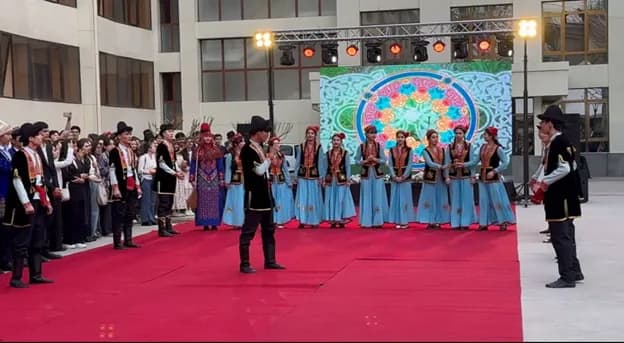
However, in modern days citizen of Karakalpaks, utilize this type of genre on national events or during wedding ceremonies. That is, before the groom takes his bride from her parents’ home, the bride’s friends and sisters and the groom’s friends and brothers ask each other pointed questions in the form of poems and songs accompanied by the national musical instrument, the dutar. Only when both sides find the right answer and reach a compromise do they continue the wedding ceremony with merriment and dancing.
Pioneers of Karakalpak Literature
Berdaq (1827–1900): The Voice of the Nation. Berdaq (Бердақ Қарымойынұлы), a legendary poet and zhyrau, is often considered the father of Karakalpak written literature. Born into a time of social inequality and colonial pressure, his poetry fiercely criticized feudal lords and expressed empathy for the oppressed. His poem “Zulmát kóterilmes” (“Oppression Cannot Stand”) became a rallying cry for justice. He wrote in rich metaphors, blending folklore with sharp social commentary. His works are notable not only for their artistic strength but for giving birth to a national consciousness.
«If the tyrant laughs, let the dombra cry» — Berdaq
Ajiniyaz (1824–1878): The Warrior Poet
Another towering figure is Ajiniyaz Kosybayuly, a poet and freedom fighter. He participated in the famous Kungrad uprising against the Khivan Khanate. His poems fuse heroism with philosophical depth. His famous work “Elim dep yurgan” (“For My People I Roam”) is a reflection on sacrifice, exile, and identity. Unlike many contemporaries, Ajiniyaz used poetry as a political weapon—a means to awaken pride and courage among his people.
Ibash Ibrayimov (1902–1965): The Modern Realist With Sovietization came new challenges—and new themes. Ibash Ibrayimov, one of the first Soviet-era Karakalpak novelists, turned his focus to everyday people, industrialization, and collectivization. His novel “Bozataw” portrays the life of Karakalpaks during the 1930s: hardship, collectivist dreams, and the loss of traditional ways. Yet his prose is not propaganda—it is laced with melancholy and humanity.
The period following independence and the collapse of the USSR in 1991 was characterized by the decolonization of the cultural sphere. Karakalpak culture was freed from ideological pressure and returned to themes of spirituality, connection with the desert and water, and, most importantly, the image of the Aral Sea after it dried up and the life of the people. Writers like Ybyrayym Ykylas, Dauletmurat Tazhimurat, and Saltanat Berdimuratova blend poetry with activism, chronicling the slow vanishing of the Aral Sea, migration, and identity crisis.
Women’s Voices and Literary Struggles
Women’s voices in Karakalpak literature faced marginalization. Toleubike Turgunbaeva, a 20th-century poet, defied expectations with her emotionally raw and symbolist poems. In a male-dominated cultural space, she dared to write about feminine desire, maternal pain, and environmental destruction.
“Menin oǵil balam Aral boldı—taslanǵan…”
(“My son became the Aral—abandoned…”)
Her environmental metaphors referenced the Aral Sea tragedy—a recurring theme in post-Soviet Karakalpak writing.
Conclusion: Memory written in sand
Karakalpak literature is a mirror and a flame. It remembers what history forgets. It sings when voices are silenced. From Berdaq’s battle cries to Toleubike’s tears, from the zhyrau’s ballads to the whispers of modern poets, Karakalpak cultural expression is not merely survival—it is resistance, identity, and beauty distilled through centuries. These masterpieces worth the worldwide recognition which can help to popularize the unique country.
Sources of information and literature
The Oral Epic Traditions of Central Asia” – ed. Karl Reichl
1 • A scholarly study of epic singing traditions, including Karakalpak bards (zhyrau)
• Publisher: Routledge, 2000
• ISBN: 978-0415230863
2. WorldCat.org
• Global catalog of library collections — search for “Karakalpak literature” or “Berdaq”
3. “The Karakalpaks of the Aral Delta” – by David and Sue Richardson
• Rich cultural and ethnographic overview with discussion on literature and oral poetry
4. Encyclopedia of Islam and the Muslim World – Gale Group
• Entries on Central Asian Turkic peoples and literary history
• Section: “Karakalpaks – Language and Culture”
• Available via university libraries and online databases (e.g., Gale Academic)
Aydana Xiyatova
Contributing writer at EUReflect.
Follow EUReflect
See more of our reporting on Google
Mark EUReflect as a preferred source and our stories are ranked higher for you in Top Stories, Discover and Google News — and carry a “preferred” badge when they are cited in AI results.
Add EUReflect as a preferred source