The U.S. Army's Next-Generation Tank: M1E3 Abrams
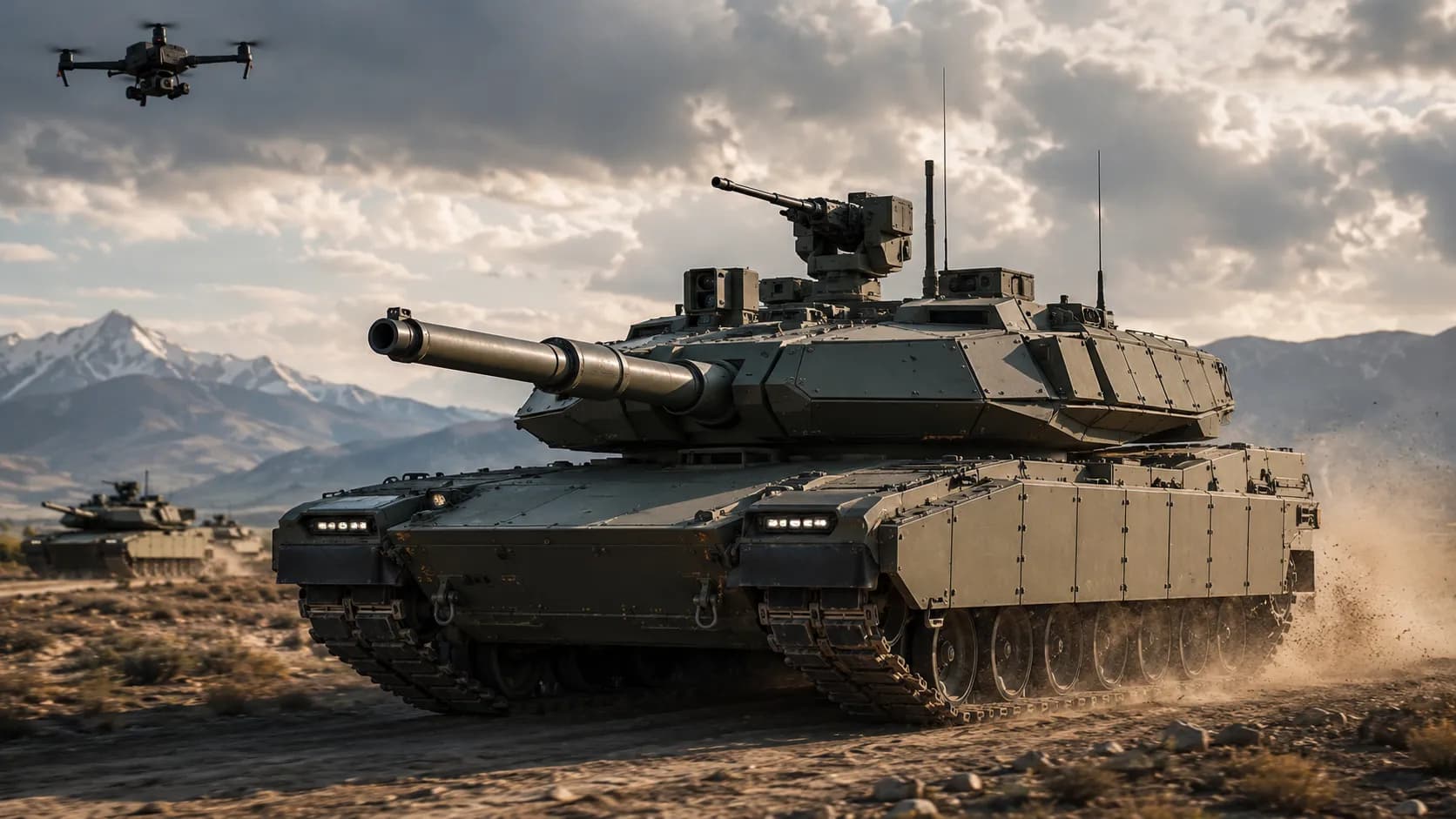
The U.S. Army has publicly unveiled new details about the M1E3 Abrams, its next-generation main battle tank, at the NDIA MDEX 2026 and Michigan Defense Expo 2026 conferences. Designed to replace the current M1A2 SEPv3, the M1E3 represents the most ambitious redesign of the Abrams platform since the original M1 entered service in 1980. The tank's most defining feature is its fully unmanned turret, which eliminates the loader from the crew and reduces the total crew to three personnel seated in an armored hull compartment. A secondary 30 mm Northrop Grumman M230LF cannon mounted atop the main turret provides dedicated counter-drone capability, while the XM251 active protection system — an Americanized derivative of Israel's Iron Fist — guards against incoming anti-tank threats. The drivetrain has been fundamentally redesigned: replacing the legacy gas turbine with a hybrid diesel-electric system is projected to improve fuel efficiency significantly and reduce combat weight from 73 to approximately 60 tons, easing logistical demands across the force. Structurally, the M1E3 is built on a Modular Open Systems Architecture, enabling rapid integration of software updates, new sensors, and upgraded fire control systems without requiring wholesale hardware redesigns. The program's pace is itself newsworthy: prototypes are expected in soldiers' hands by summer 2026, five years ahead of the original schedule. Full Initial Operational Capability is targeted for 2030. Underlying this urgency are the lessons drawn from the war in Ukraine, where drones, loitering munitions, and precision top-attack fires have exposed critical vulnerabilities in conventional armor. The M1E3 is the U.S. Army's direct response — a platform engineered not merely to survive the modern battlefield, but to dominate it.
Introduction
For more than four decades, the M1 Abrams has stood as the unchallenged centerpiece of American armored warfare. Yet the tank that first rolled off General Dynamics' assembly line in 1980 was engineered for a world that no longer exists. Threats have multiplied, battlefields have been transformed, and incremental upgrades have reached their limit. After years of iterative improvements, the United States Army has concluded that the Abrams needs more than a refresh — it needs a revolution. That revolution is the M1E3. According to information presented at the NDIA MDEX 2026 conference by U.S. Army Program Manager Abrams officials, the M1E3 modernization effort is designed to replace the M1A2 SEPv3 through a fundamentally different, modernized technical approach while delivering overmatch capabilities against emerging threats. The most recent concept renderings and technical disclosures from the Michigan Defense Expo 2026 in Detroit have now brought the program's full ambitions into sharper focus. Military MachineArmy Recognition
1. Unmanned Turret, Secondary Cannon, and Counter-Drone Architecture
The most striking departure from previous Abrams variants lies in the wholesale removal of the crew from the turret. The M1E3 prototype features a redesigned hull, an unmanned turret, an autoloader bustle, a three-person crew layout, new external cameras and sensors, a modular remote weapon station, and simplified digital controls. Army Recognition
Beyond the unmanned turret itself, the main armament is supplemented by a light secondary turret mounted on the roof of the main turret, carrying a 30 mm Northrop Grumman M230LF cannon chambered for 30×113 mm ammunition — a weapon well suited to engaging unmanned aerial vehicles. This configuration would, in effect, make the vehicle a two-turret tank. Additionally, a structure visible in a basket behind the turret bustle may serve as a container for a reconnaissance unmanned aerial vehicle. Defence Industry EuropeDefence Industry Europe
On the active protection front, the vehicle is expected to carry the XM251 — later designated M251 — system, an Americanized version of Israel's Elbit Systems Iron Fist. The same system is planned for integration onto Stryker and Bradley vehicles around 2028, signaling a unified protection architecture across multiple U.S. Army vehicle families. Defence Industry Europe
2. Hybrid-Electric Drivetrain, Weight Reduction, and the Lessons of Ukraine
The M1E3's technical backbone rests on the elimination of the gas turbine engine — a notoriously fuel-hungry system that has long strained operational logistics. A central feature of the M1E3 program is the adoption of a hybrid diesel-electric propulsion system combined with a high-efficiency transmission. One of the Army's primary objectives is to reduce the tank's combat weight to approximately 60 tons, down from the current 73 tons. This reduction is expected to improve bridge compatibility, reduce airlift and sealift demands, and ease the overall logistical burden on armored brigade combat teams in sustained operations. DefenseULU Savunma
The urgency behind these design choices is rooted in hard-won battlefield evidence. Since Russia's full-scale invasion of Ukraine in February 2022, the conflict has provided the most intensive test environment for modern armor since the Gulf War, and the lessons have been sobering. First-person view drones, loitering munitions, and top-attack precision fires have emerged as decisive threats against conventional armor — realities that have directly shaped every design priority of the M1E3. Military Machine
3. Accelerated Acquisition, Software-Driven Modularity, and the Road to 2030
The Chief of Staff of the Army stated that the new tanks will be completely software-driven, require a smaller crew, be modular, and be equipped with an active protection system — with soldiers expected to evaluate the platforms upon delivery and determine what further capabilities they need. Congress.gov
Built on a Modular Open Systems Architecture (MOSA), the M1E3 is designed to allow the rapid integration of new subsystems, fire control upgrades, and C4ISR enhancements. This architecture ensures that emerging threats can be countered through software updates rather than costly hardware redesigns, extending the platform's operational relevance well into the 2040s. The revised acquisition timeline targets prototype delivery to soldiers by summer 2026 — approximately five years ahead of the original schedule — reflecting the urgency Army leadership places on modernizing the armored force. Army RecognitionMilitary Machine
Conclusion
The M1E3 Abrams is not merely a new tank; it is the most concrete expression yet of a fundamental shift in how the United States Army conceives of heavy armored warfare. The convergence of an unmanned turret, a dedicated counter-drone weapon system, a hybrid drivetrain, and a software-native open architecture represents a departure from decades of evolutionary thinking. Initial Operational Capability is targeted for 2030, at which point the M1E3 is intended to serve as the backbone of U.S. armored formations across future joint and multi-domain operations. In a battlefield increasingly shaped by autonomous systems and precision-guided munitions, the M1E3 stands as America's most ambitious answer to the question of whether heavy armor can not only survive, but dominate. Army Recognition

İsmail Polat
Ph. D. in International Relations
Follow EUReflect
See more of our reporting on Google
Mark EUReflect as a preferred source and our stories are ranked higher for you in Top Stories, Discover and Google News — and carry a “preferred” badge when they are cited in AI results.
Add EUReflect as a preferred source