The Strait of Hormuz Crisis: How a 39-Kilometre Chokepoint Is Reshaping Global Energy Governance?
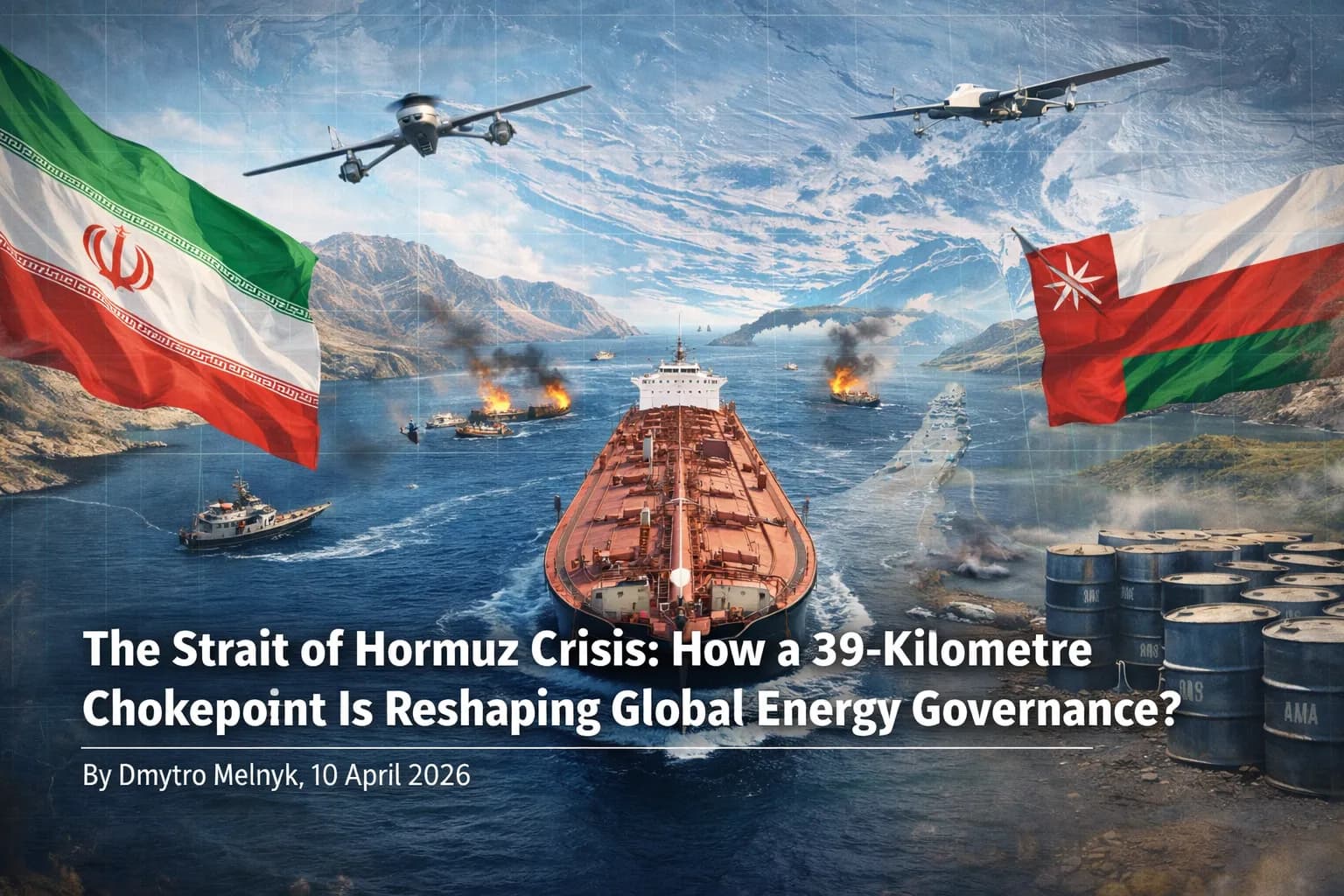
By Dmytro Melnyk. 10 April 2026. Few waterways carry the weight of the world’s economic lifeline quite like the Strait of Hormuz. At its narrowest, just 39 kilometres wide, this passage between Iran and Oman connects the Persian Gulf to the Gulf of Oman and, ultimately, to global energy markets. Today, the strait has become the defining flashpoint of the 2026 Middle East conflict and potentially the catalyst for a fund
The Chokepoint That Powers the World
Before the war, approximately 20 million barrels per day of petroleum liquids passed through Hormuz, representing roughly one fifth of global petroleum consumption and more than one quarter of total seaborne oil trade. The disruption extends beyond crude oil: one fifth of global liquefied natural gas trade also transits Hormuz, including 93 percent of Qatar’s LNG exports. Before the war, 84 percent of crude flowing through the strait was destined for Asian markets, with China, India, Japan, and South Korea collectively receiving 69 percent of the total. Europe is also heavily exposed. The Persian Gulf is a major hub for global fertilizer production, with the region accounting for roughly 30 to 35 percent of global urea exports and around 20 to 30 percent of ammonia exports, while up to 30 percent of internationally traded fertilizers normally transit the Strait of Hormuz.
Alternative pipeline routes exist, but they cannot absorb the shock. Saudi Arabia’s East West Pipeline, also known as the Petroline, runs from Abqaiq in the Eastern Province to Yanbu on the Red Sea coast and has been operating at its maximum capacity of 7 million barrels per day since the blockade began, still leaving a gap of more than 10 million barrels daily.
How the Crisis Unfolded
Shipping traffic through the Strait of Hormuz has been largely blocked by Iran since 28 February 2026, when the United States and Israel launched coordinated airstrikes on Iran, killing its Supreme Leader Ali Khamenei. In retaliation, Iran launched missile and drone attacks on Israel, US military bases, and US allied Gulf states. Iran’s Islamic Revolutionary Guard Corps issued warnings forbidding passage through the strait, launched 21 confirmed attacks on merchant ships, and reportedly laid sea mines in the channel.
The human cost has been severe. According to the International Transport Workers’ Union, there are currently 20,000 seafarers stuck near the Strait of Hormuz, a situation union officials describe as unprecedented in scale and duration. Those stranded face the constant threat of attacks and must navigate in a fog of electronic warfare, including GPS jamming, which leaves them blind to the positions of other vessels. The IMO has confirmed 21 attacks on international shipping in the region, with 10 seafarer fatalities and several others injured.
In normal times, around 135 ships cross the strait daily. More than 800 freighters have been stuck inside the Gulf, mostly waiting to leave.
Iran’s Selective Blockade and the New Vetting System
Rather than a total closure, Iran has implemented a discriminatory system of passage control. Iran’s Islamic Revolutionary Guard Corps is developing a vetting and registration system for ships transiting the Strait of Hormuz. Ships hoping to use a pre approved route are expected to have communicated extensive details regarding both the ownership of the vessel and the destination of the cargo to the IRGC in advance.
On 26 March, Iranian Foreign Minister Abbas Araghchi announced that ships owned by five nations, China, Russia, India, Iraq, and Pakistan, would be allowed to transit the strait. Malaysian and Thai vessels were subsequently granted access, and on 2 April, Iran said it would allow Philippine flagged vessels and Filipino seafarers to cross following diplomatic talks.
The cost of passage has also emerged as a deeply contentious issue. Iranian media have reported that Iran is considering a plan to charge up to 2 million dollars per vessel, to be shared with Oman on the opposite side of the strait, with revenues earmarked to rebuild military and civilian infrastructure damaged by US Israeli strikes. Oman has rejected the idea, with its transport minister stating that Oman had previously signed all international maritime transport agreements which bar the levying of transit fees.
The Legal Battleground
Iran’s claim to govern the strait runs directly into international maritime law. The legal framework governing the strait is set out in the United Nations Convention on the Law of the Sea, which guarantees the right of transit passage through straits used for international navigation. Under Articles 37 to 44, ships and aircraft are entitled to continuous and expeditious passage that cannot be impeded or suspended. Article 26 prohibits states from levying charges on vessels merely for passage.
There is, however, a significant complication. The United States, Israel, and Iran are not parties to UNCLOS. While many of its navigational rules are regarded as customary international law, Iran has explicitly rejected the transit passage regime, with Deputy Foreign Minister Kazem Gharibabadi asserting that we are now in a state of war, and wartime conditions cannot be governed by peacetime rules.
The Strait of Hormuz suffers from a legal anomaly, as it remains one of the few critical maritime arteries of its kind lacking a dedicated international regulatory treaty. Unlike Turkey, whose sovereign control is anchored in the Montreux Convention regulating the Bosphorus and Dardanelles, Hormuz operates without a codified maritime framework, which has made it uniquely vulnerable to the current crisis.
The Push for a New Regional Order
The crisis has accelerated a debate that was already simmering before the war broke out: who should govern the Strait of Hormuz, and under what framework? The GCC and Iran can come up with a new security architecture for the Strait of Hormuz, according to analysts writing in Al Jazeera. The proposed framework would see GCC member states, including Saudi Arabia, the UAE, Kuwait, Qatar, Bahrain, and Oman, and Iran engage in dialogue and joint efforts to ensure unimpeded maritime traffic flow, encompassing enhanced communication protocols, joint patrols, confidence building exercises, and shared intelligence on maritime threats.
Iran is expected to offer Oman a specific role in any new transit mechanism, modeled on the authorities governing the Panama or Suez canals. For Gulf states, the choice may ultimately be between negotiating a place in Iran’s emerging order or watching it take shape without them.
If an Iran Oman protocol is signed before hostilities end, the negotiating dynamics shift in ways that are difficult to undo. Iran would enter ceasefire negotiations not as a country claiming sovereignty over Hormuz, but as a country already exercising governance through an implemented bilateral agreement. The burden shifts from Tehran proving its right to the strait to everyone else explaining why a signed arrangement between two neighbours should be torn up.
The International Response
The response from Western powers has combined military positioning with diplomatic urgency. On 9 March, French President Emmanuel Macron announced that France and several other states were setting up a purely defensive, purely support escort mission for merchant ships transiting the strait under Operation Aspides, sending a dozen ships to the wider Middle East. Britain, Germany, and Italy have also been working to support commercial shipping through the strait.
The UN’s International Maritime Organization has stated it is already working with relevant parties to implement an appropriate mechanism to ensure the safe transit of ships. The IMO’s Maritime Safety Division Director emphasized that the priority now is to ensure the safety of navigation to guarantee an evacuation, warning against any return to escalation.
The fragile US Iran ceasefire agreed on 8 April has provided a brief window, but the strait remains far from normal. Traffic through the Strait was at a virtual standstill in the first 24 hours after the ceasefire deal, with only five bulk carriers transiting the waterway compared with the pre war average of more than 100 vessels sailing through daily. Oil prices rose again above 100 dollars a barrel as initial optimism gave way to uncertainty.
Conclusion
The Strait of Hormuz crisis is not simply a consequence of the 2026 war. It is a stress test for the architecture of global trade and energy governance that has underpinned the world economy for decades. Iran has demonstrated, with devastating effectiveness, that a determined regional power can hold the global economy hostage using inexpensive drones and strategic geography. Whether the outcome is a multilateral treaty, a bilateral Iran Oman arrangement, or an imposed Iranian order, the pre war status quo is gone. The path that offers the least catastrophic outcome is one rooted in regional diplomacy: a shared governance framework that gives Iran a legitimate institutional role, guarantees transit rights for all non hostile shipping under international law, and provides the Gulf states with the security predictability their economies demand. Getting there will require the kind of sustained, good faith diplomacy that the region has rarely managed. The cost of failure, measured in oil prices, stranded sailors, and stunted growth across Asia and Europe alike, is too high to contemplate. References Hale, E. (2026, March 20). Iran developing a “vetting system” for Strait of Hormuz transit. Al Jazeera. https://www.aljazeera.com/news/2026/3/20/iran-developing-a-vetting-system-forstrait-of-hormuz-transit-report United Nations News. (2026, April 8–9). Iran ceasefire raises hopes for reopening key Strait of Hormuz. UN News. https://news.un.org/en/story/2026/04/1167270 Bloomberg. (2026). Strait of Hormuz siege leaves sailors dodging missiles and GPS jamming. Bloomberg. https://www.bloomberg.com/graphics/2026-strait-hormuz-iran-blockade-shipsstranded-gps-jamming/ TRT World. (2026, April 5). Who controls the Strait of Hormuz? Iran’s toll plan could reshape global maritime order. TRT World. https://www.trtworld.com/article/a632f8f6753c Al Jazeera. (2026, April 9). What is Iran’s Strait of Hormuz protocol and will other nations accept it?. Al Jazeera. https://www.aljazeera.com/economy/2026/4/9/what-is-irans-strait-of-hormuzprotocol-and-will-other-nations-accept-it Responsible Statecraft. (2026). Iran-Oman Hormuz protocol: From blockade to governance. Responsible Statecraft. https://houseofsaud.com/iran-oman-hormuz-protocol/ Sina Emami. (2026, April 6). A new regional order for the Strait of Hormuz. Al Jazeera. https://www.aljazeera.com/opinions/2026/4/6/a-new-regional-order-for-the-straitof-hormuz
Dmytro Melnyk
Contributing writer at EUReflect.
Follow EUReflect
See more of our reporting on Google
Mark EUReflect as a preferred source and our stories are ranked higher for you in Top Stories, Discover and Google News — and carry a “preferred” badge when they are cited in AI results.
Add EUReflect as a preferred source