Tokayev’s Strategic Signals for SCO
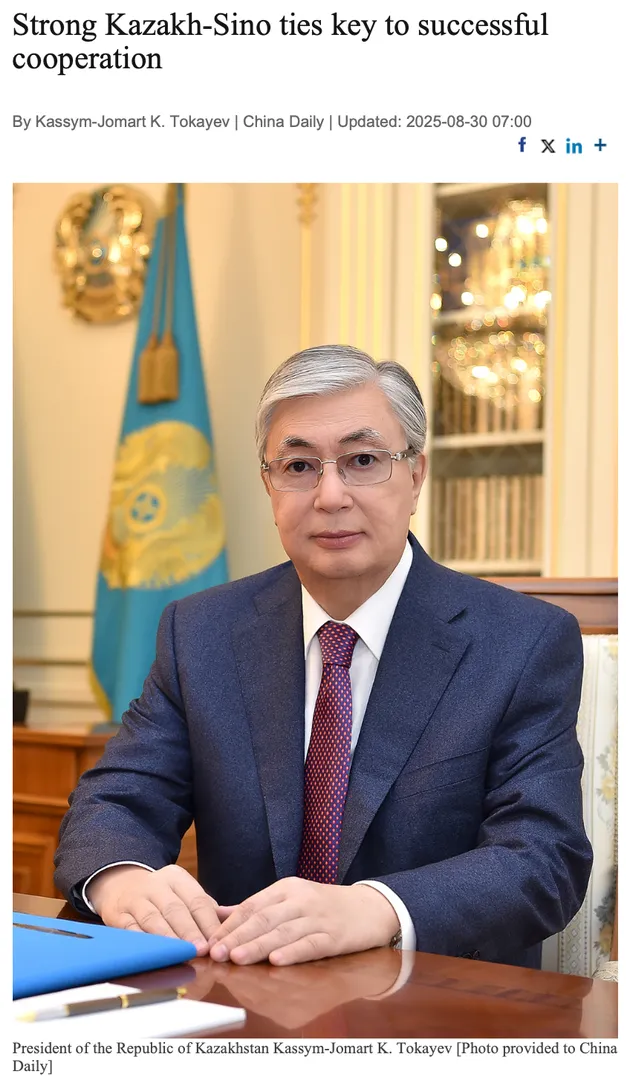
On August 30, China Daily published an article by Kazakhstan’s President Kassym-Jomart Tokayev, titled “Strong Kazakh-Sino ties key to successful cooperation.” This came just before his state visit to Beijing and participation in the Shanghai Cooperation Organization (SCO) Summit.
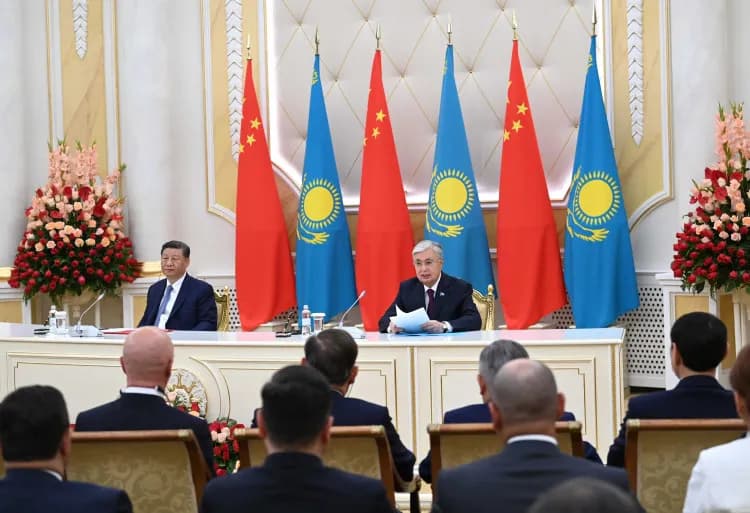
On August 30, China Daily published an article by Kazakhstan’s President Kassym-Jomart Tokayev, titled “Strong Kazakh-Sino ties key to successful cooperation.” The timing and the platform were deliberate. With over 350 million readers across print, online, and mobile, the English-language outlet gave Tokayev direct access to global policymakers and Chinese elites. This came just before his state visit to Beijing and participation in the Shanghai Cooperation Organization (SCO) Summit.
Tokayev’s article serves multiple purposes:
Strengthening Kazakhstan’s image as a reliable partner.
Highlighting the depth of Sino-Kazakh relations.
Positioning both countries as leaders of Eurasian integration in a time of global fragmentation.
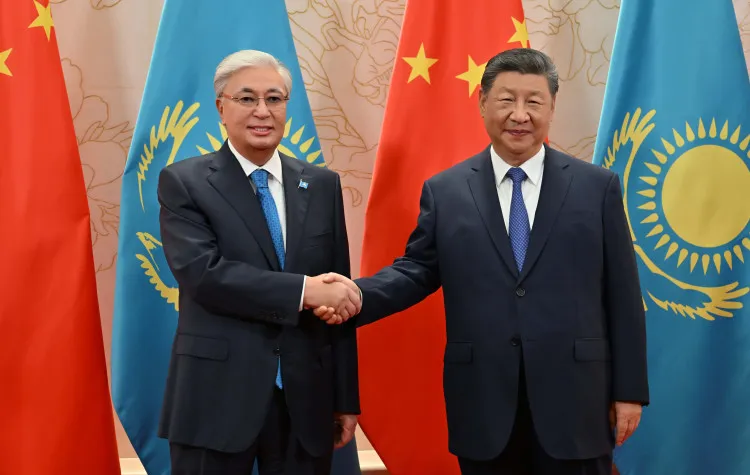
Photo Credit: Akorda.kz
Reframing History: From Silk Road to Belt and Road
Tokayev links the modern partnership to centuries of neighborly ties and the legacy of the Silk Road. This history is connected to China’s Belt and Road Initiative (BRI), first announced in Astana in 2013.
For China, this validates its geopolitical narrative.
For Kazakhstan, it confirms its role as a key Eurasian transit hub.
Tokayev emphasizes transport routes such as the Trans-Caspian International Transport Corridor (Middle Corridor)and the Dostyk-Moyynty railway expansion. These projects aim to make Kazakhstan a land bridge between Asia and Europe. This has become more important as Russia’s war in Ukraine disrupts northern corridors, shifting attention to southern alternatives.
Trade, Investment, and Energy in SCO: Numbers That Matter
Tokayev underlined that bilateral trade reached a record $44 billion in 2024, making China Kazakhstan’s top trading partner. Since 2005, Chinese investment exceeded $27 billion, with nearly 6,000 Chinese companies active in Kazakhstan.
For Chinese investors, this signals Kazakhstan is open for business.
For Western observers, it highlights Kazakhstan’s pivot eastward in a changing global economy.
Energy remains central with expanded oil pipelines and petrochemical facilities. Yet Tokayev also drew attention to agriculture, noting a 10% rise in agro-food exports to China in 2024. This shows Astana’s intent to diversify beyond hydrocarbons.
Beyond Economics: Tourism, Culture, and Soft Power
Tokayev stressed cultural diplomacy. After the “Kazakh Tourism Year in China” (2024), 2025 was declared the “Year of Chinese Tourism in Kazakhstan.”
These symbolic initiatives strengthen soft power reciprocity. They balance economic asymmetry and highlight that Sino-Kazakh ties are not only transactional but also cultural and people-to-people exchanges.
SCO as a Multilateral Platform
Tokayev called the Shanghai Cooperation Organization (SCO) a “cornerstone of multilateral cooperation in Eurasia.” His language echoed Beijing’s view of the SCO as more than a security bloc — as a platform for economic integration and cultural dialogue.
The upcoming Tianjin SCO Summit is crucial. By supporting SCO reforms and security priorities, Tokayev signals Kazakhstan’s readiness to take an active role in shaping Eurasia’s future during a period of global uncertainty.
Conclusion: Kazakhstan’s Eurasian Balancing Act
Tokayev’s article in China Daily is more than diplomatic courtesy. It is a strategic message positioning Kazakhstan at the heart of Eurasian integration.
The messaging layers are clear:
For Beijing: A pledge of loyalty and recognition of Xi Jinping’s leadership.
For Kazakhstan’s domestic audience: Proof of investment, connectivity, and high-level recognition.
For the international community: A signal that Kazakhstan balances East and West but sees China as a central pillar of its future.
As global power dynamics shift, Astana’s ability to balance pragmatism with geopolitics will decide if Tokayev’s vision becomes reality — not only for Kazakhstan but also for the wider Eurasian region.
References:
https://www.chinadaily.com.cn/a/202508/30/WS68b230f7a3108622abc9dea5.html
Botakoz Unbayeva
Contributing writer at EUReflect.
Follow EUReflect
See more of our reporting on Google
Mark EUReflect as a preferred source and our stories are ranked higher for you in Top Stories, Discover and Google News — and carry a “preferred” badge when they are cited in AI results.
Add EUReflect as a preferred source