Tunisia: A Hidden Oasis with History
Written by journalist Danylo Aleksandrov. Tunisia stands out with its rich history including Carthage and El Djem, diverse landscapes like the Sahara Desert and Djerba, and vibrant culture, offering affordable tourism options.
Tunisia is a relatively small country in the Maghreb region of North Africa, located on the coast of the Mediterranean Sea. While sometimes dismissed as a tourist destination, the Republic of Tunisia boasts a wide array of places to visit for every tourist and some key interesting characteristics, at the same time being more affordable and close for some travelers. Let’s go over them, so you can choose the spot for a visit.
1: Rich History
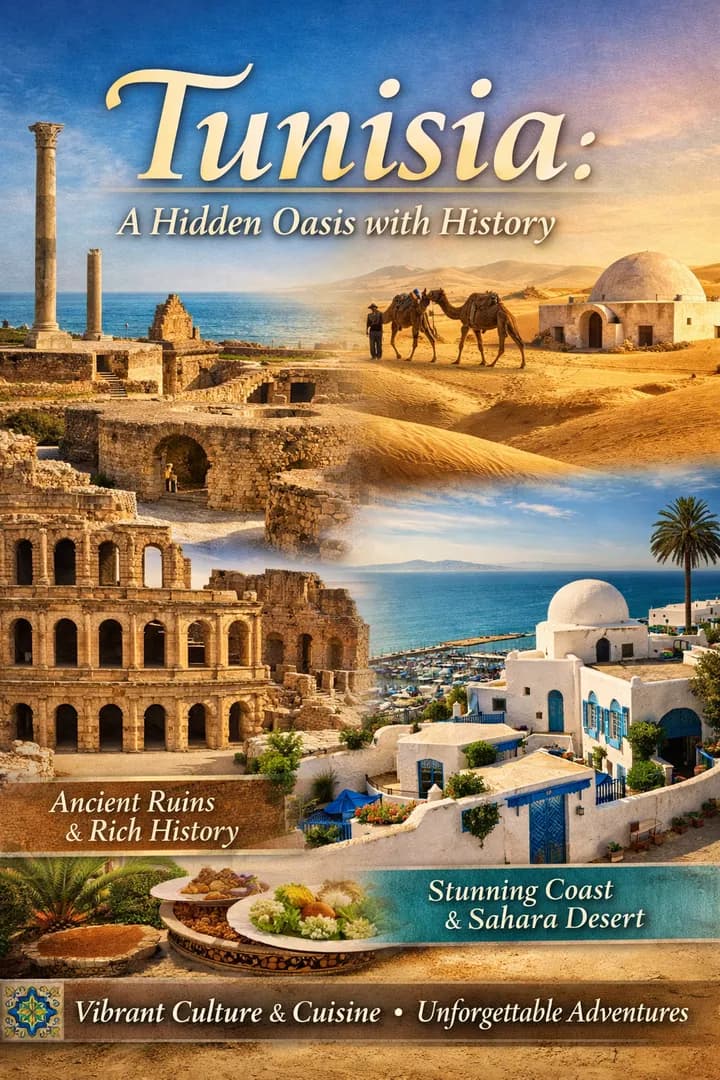
The territory of Tunisia had been a place under control of different civilizations and empires throughout it’s history. One of the more notable of those are, of course, Ancient Carthage and the Roman Empire. Going in chronological order, the city of Carthage was located not far from modern Tunis city. As such, its traces are easy to come across, one of the most popular of which is the ancient harbor. Standing near it, one can think how it looked like at the time of the infamous Hannibal and his contemporaries.
In the Roman times the territories around the current capital as well as the wider surrounding area became an important hub of the ancient empire. Trade and agriculture flourished, which led to the development of the area. A lot of Roman ruins actually reside in the same location as Carthage, as the city was rebuild by a decree of none other than Julius Caesar himself! One of such attractions is the El Jem amphitheater. Another sight is the Antonine’s bath – once a hub where citizens of all classes could relax, now is a preserved ruin which still looks impressive, given it’s age of almost 2000 years!
Another potential point of interest for the tourists might be the European architecture, a leftover from the time when Tunisia was under French control (btw French is still widely spoken there, so don’t panic if you don’t know Arabic). The best known is the "Ville Nouvelle" (New City), built during the colonial times, now a beautiful place to feel as if you were going to France. Now, writing about Tunisian history could take a while, so let’s go over other topics regarding tourism here.
2: Beautiful geography
Situated on the coast of the Mediterranean Sea, Tunis can offer plenty of resorts near the sea where visitors can enjoy the view and the water of the same quality as in European resorts. Among the most popular resorts are Hammamet, Mahdia and Djerba Island. There you can enjoy a seaside vacation and expect a good time like no other. We also should mention Sidi Bou Said — a town which looks like it came from a fairytale, with it’s blue and white buildings, stunning views and numerous open air cafes. Some might compare this site to Greece and while certainly there are some similarities, Sidi Bou Said stands on its own with distinct Eastern and North African flair. The city also has other attractions, for example the Dar El Annabi– a house museum where you can see a glimpse of how life of Tunisia looked like, illustrated by wax figures wearing traditional clothes.
Going further from the coast, the traveler discovers a part of the vast Sahara desert. Guided tours are offered in the cities, which will take you there by a car to see the dunes, beautiful oasises and bedouin camel herders performing their traditional duties. Or you can use public transport to some of the more remote settlements and make your own journey. Although cheaper, this might be more difficult as well as dangerous, so be aware. Science fiction fans might be attracted by a place not far from the town of Nefta, where the decorations of Luke Skywalker’s house on Tatooine still stand, a must visit for every Star Wars fan! Other spots include the numerous Berber villages, canyons and deserts. At the Grand Erg you can see how the shifting sands change the landscape hiding and revealing stunning views, with some tours offering spending a night there to witness majestic sunset and sunrise. The Tunisian part of Sahara has a lot to show to a traveler.
3: Vibrant Culture
Owing to its geographical position, Tunisia has absorbed elements form foreign cultures, while retaining Islam as a centerpiece of national identity. One of the main characteristics of local culture is the artistism and desire of expression, which encompasses a lot of public life aspects, from the street painting to different architectural styles present, including but not limited to Art Nouveau and Art Deco. Performances are a common sight at art galleries and various public spaces.
As was already said, Islam plays an important role in nation’s culture. So calls to prayers are frequently heard and mosques are usually nearby all the time. Don’t forget to pay them a respectful visit. It’s a unique chance to observe the magnificent and elegant Islamic architecture as well as to have a glimpse of Muslim culture and way of life.
Tunisia is also home to a wonderful cuisine, which formed under influence of the country’s geography and interactions with other cultures and peoples. You can find a traditional restaurant not far from a French or Italian one, and none will look out of place here. Speaking of local cuisine, its staple is the couscous – grain which can be eaten on its own, but is usually a part of dishes with lamb or meat. Nutritious and tasty, no wonder that it has spread to neighboring regions. Aside from the food itself, you have lots of places where you can enjoy it with a view on the Mediterranean or other of the local landscapes.
So, aside form its long history and magical landscapes, Tunisian culture is a major tourist attraction by itself. Be sure to not miss it on your trip!
4: Some statistics
Over 11 million tourists visited Tunisia in 2025, a record in comparison to the previous years (for example there were 10.2 million visitors in 2024), bringing around $2.6 billion to the local economy. Tourism is one of the major contributors to the country’s GDP, and the government invests in it so expect more options to
become available in addition to those we already mentioned. Luckily the tourist sector has recovered since the pandemic and now is in the phase of stable growth and expansion. While the numbers rise, Tunisia still remains an often overlooked destination, which makes it a good candidate to become a hidden spot just for you!
Conclusion
Whether you’re a fan of history, nature or just want to spend some good time, Tunisia is definitely the place to go, with something for everyone. Whether you just want to swim in the Mediterranean or see the Sahara — this country got you covered. We hope that you will add Tunisia to your list enjoy the next vacation there!
EUReflect News
Site Administrator
Follow EUReflect
See more of our reporting on Google
Mark EUReflect as a preferred source and our stories are ranked higher for you in Top Stories, Discover and Google News — and carry a “preferred” badge when they are cited in AI results.
Add EUReflect as a preferred source