Turkey–EU: Security Brings Them Together
Turkey-EU relations are entering a pragmatic rapprochement driven by security cooperation and trade interdependence. Customs Union modernization and visa liberalization remain unresolved, while regional disputes like the Blue Homeland law keep reminding both sides how fragile the relationship is.
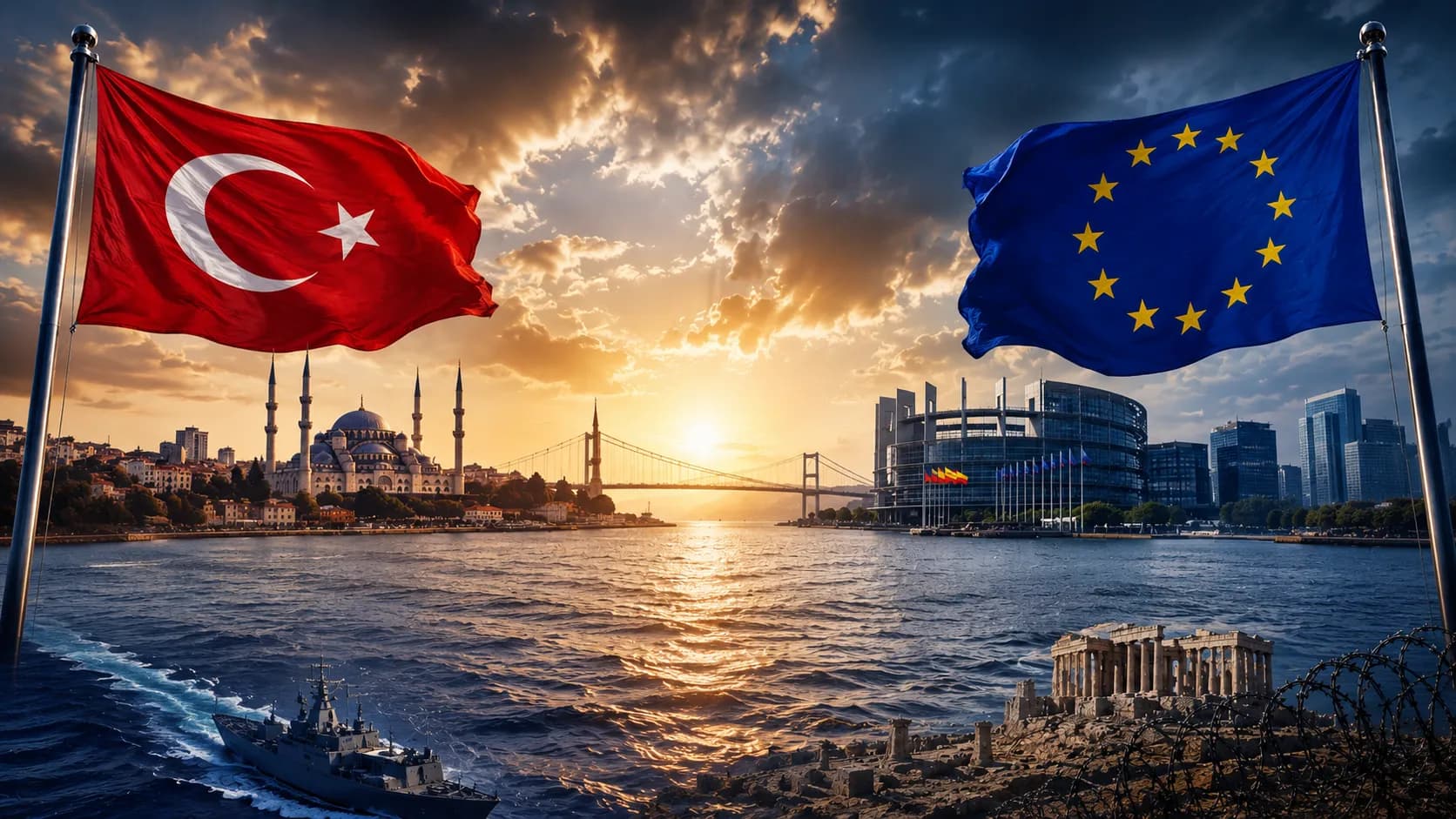
Relations between Turkey and the European Union are showing signs of renewed momentum after years of stagnation. More frequent high-level visits, the reactivation of economic dialogue mechanisms, and deepening cooperation within the NATO framework all point to a more constructive atmosphere between the two sides. Yet this rapprochement is unfolding in the shadow of structural problems that haven't gone away: entrenched disputes in the Aegean and Eastern Mediterranean, reluctance within the EU over full membership, and a persistent deficit of mutual trust. This piece examines the current state of Turkey-EU relations across three dimensions: what's driving the revival in dialogue, the limits of economic integration, and the political flashpoints still casting a shadow over the relationship.
A Revived Dialogue: What's Behind This Rapprochement?
Turkey-EU relations have shown notable activity in recent months. The simultaneous visit to Ankara by three senior European Commission officials — High Representative Kaja Kallas, Enlargement Commissioner Marta Kos, and Home Affairs Commissioner Magnus Brunner — was, as reported by Hürriyet, widely read as a sign of the growing importance the EU attaches to Turkey amid a shifting global landscape. The dynamics behind this rapprochement can't be explained by goodwill alone: the ongoing war in Ukraine, instability in the Middle East, and mounting energy security concerns are pushing Europe to lean more heavily on strong, reliable regional partners.
Turkey's strategic position within NATO plays a decisive role in this equation. The fact that EU Council President Antonio Costa and Commission President Ursula von der Leyen are set to attend the NATO Summit in Ankara on July 7–8 illustrates how security cooperation is currently outpacing political dialogue. From Ankara's perspective, the continued emphasis on full membership as a strategic priority signals a desire to keep the process alive at the official level — though how far the enlargement process actually advances will keep depending on the political will of individual EU member states.
The Limits of Economic Integration: The Customs Union and Visa Question
The economic dimension remains the most tangible and most promising area of Turkey-EU relations. According to TV5, bilateral trade volume reached roughly $233 billion in 2025; the EU remains Turkey's largest trading partner, while Turkey ranks as the EU's fifth-largest. Despite this depth of economic integration, the failure to modernize the Customs Union — in place since 1995 — stands out as one of the relationship's biggest paradoxes. Turkey's exclusion from the free trade agreements the EU signs with third countries under the Customs Union framework is a long-standing grievance that leaves Turkish industry exposed to unfair competition.
The visa liberalization issue has become a symbol of a similar impasse. As Trade Minister Ömer Bolat has pointed out, growing trade and tourism ties make visa facilitation for Turkish citizens increasingly necessary — yet this demand has remained stalled for political reasons for years. Steps such as the European Investment Bank gradually resuming operations in Turkey and Turkey's request to join the Single Euro Payments Area (SEPA) are positive signals, but whether they will translate into large-scale economic integration remains uncertain. New EU measures — such as the customs duty on low-value e-commerce parcels that took effect on July 1 — also show that steps the Union takes to protect its internal market can generate fresh costs for Turkish exporters.
Problems in the Shadows: The "Blue Homeland" Law and the Trust Deficit
Beneath the constructive rhetoric, structural problems capable of straining the relationship at any moment persist. As reported by T24, Turkey's draft maritime jurisdiction legislation — popularly known as the "Blue Homeland Law" — has become a fresh source of tension with Greece. Athens views the bill as an infringement on the sovereign rights of two EU member states, and calls from some members of the European Parliament for sanctions show just how quickly Aegean and Eastern Mediterranean disputes can be pulled into the EU's agenda. It's a reminder that Turkey-EU relations aren't shaped solely along the Ankara-Brussels axis, but along the Ankara-Athens axis as well.
Beyond that, tension persists between the EU's general reluctance on enlargement policy and Turkey's frequently voiced demand for "equal and merit-based treatment." Ankara's push to have the EU Foreign Affairs Council decisions of July 15, 2019 — which restrict Turkey-EU relations — fully lifted shows that past crises remain very much part of today's diplomatic agenda. This picture suggests that even where technical progress is made, rebuilding political trust will remain a long and fragile process.
Conclusion
Turkey-EU relations appear to be entering a period of pragmatic rapprochement shaped largely by geopolitical necessity. Security cooperation, trade volume, and mutual dependence are pulling both sides back to the table, while foundational issues — full membership, Customs Union modernization, visa liberalization — remain unresolved. Regional disputes like the Blue Homeland law serve as a reminder of just how fragile the relationship's footing is, even in its most constructive moments. Deeper technical cooperation can be expected in the short term; but whether the relationship undergoes any real strategic transformation will depend on the political will of both Ankara and Brussels to resolve these structural problems.
Alvara Merrick
Contributing writer at EUReflect.
Follow EUReflect
See more of our reporting on Google
Mark EUReflect as a preferred source and our stories are ranked higher for you in Top Stories, Discover and Google News — and carry a “preferred” badge when they are cited in AI results.
Add EUReflect as a preferred source