Turkiye and United Kingdom Sign £8 Billion Eurofighter Typhoon Deal
The agreement signed between Turkey and the United Kingdom on October 27, 2025, represents a significant step in the defense industry. Under the agreement valued at 8 billion pounds, Turkey will procure 20 Eurofighter Typhoon fighter jets. From a future perspective, significant progress can be achieved for Turkey if the right steps are taken. However, there are also criticisms. The appropriateness of Turkey making such a large expenditure under high inflation and budget pressures is being questioned, especially regarding the use of second-hand aircraft. Geopolitical discussions continue: The agreement may unsettle Russia; Turkey should break the perception of "having chosen sides" created by the deal. Beyond Russia, which Turkey is dealing with, there are many security issues in the region. In this sense, Russia ranks lower on Turkey's list of problems. What is important for Turkey is to close the gap in new-generation fighter jets and to consolidate its leading role in the region as soon as possible.
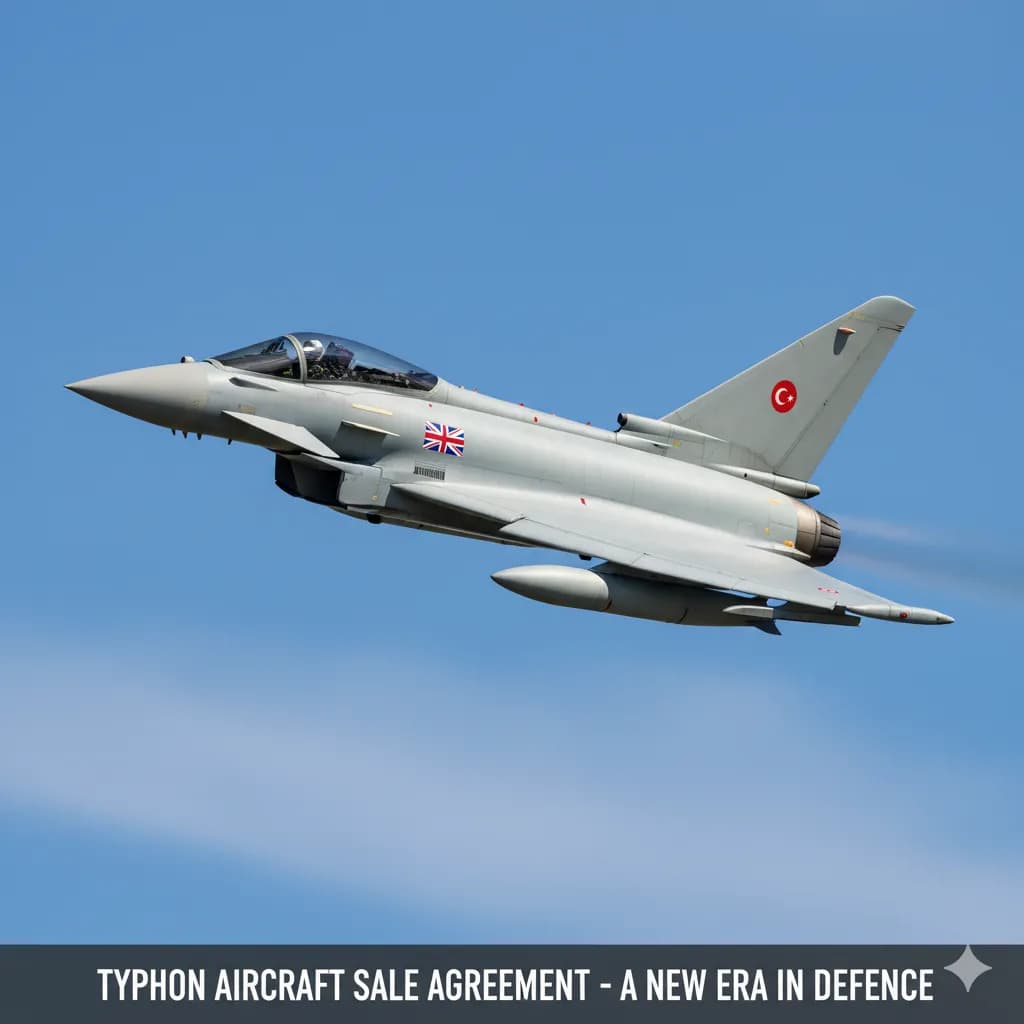
Summary: The Overall Framework of the Agreement
The agreement signed between Turkiye and the United Kingdom on October 27, 2025, stands out as a significant development in the defense industry. Valued at a total of £8 billion (approximately $10.7 billion), this deal involves Turkiye acquiring 20 Eurofighter Typhoon fighter jets. This marks the first new order for the UK's Typhoon production lines since 2017 and the largest fighter jet export deal in nearly two decades. Signed during UK Prime Minister Sir Keir Starmer's visit to Ankara, the agreement is presented as a means to strengthen NATO's security and promote economic growth, though it has faced criticism due to human rights concerns. However, this development is not just a military step; it is seen as part of Turkiye's efforts to modernize its air defense strategy, while securing around 20,000 jobs in the UK. The deal also holds strategic importance as a bridge to Turkiye's indigenous National Combat Aircraft (KAAN) project.
Details of the Agreement: Signing Process and Content
The agreement was signed on October 27, 2025, at the Presidential Complex in Ankara by President Recep Tayyip Erdoğan and Prime Minister Keir Starmer. During his visit, Starmer toured the TUSAŞ (Turkish Aerospace Industries) facilities and received information about Turkiye's indigenous KAAN fighter jet project. The deal covers the procurement of 20 Typhoons, with initial deliveries starting in 2030 and including options for additional purchases in the future. The price encompasses ammunition, training, spare parts, and maintenance services; BAE Systems expects around £4.75 billion ($6.17 billion) in revenue from the agreement. Erdoğan described the deal as "a new symbol of strategic relations," while Starmer called it "a victory for British workers, the defense industry, and NATO security."
This signing is the result of lengthy negotiations: Contacts began in 2023, and progress was made with a preliminary agreement in July 2025 to overcome Germany's veto due to human rights concerns. Additionally, Erdoğan's visits to Qatar and Oman in October 2025 brought separate deals for 24 second-hand Typhoons – aimed at addressing Turkiye's urgent defense needs. The agreement required approval from the Eurofighter consortium (UK, Germany, Italy, Spain); 37% of the aircraft will be produced in the UK (at BAE Systems' Warton and Samlesbury factories).
Technical Specifications of the Eurofighter Typhoon: Why Was This Aircraft Chosen?
The Eurofighter Typhoon is a 4.5+ generation multirole fighter jet, excelling in air superiority, ground attack, and electronic warfare capabilities. Its twin-engine design (Eurojet EJ200, each providing 90 kN thrust) allows for a maximum speed of Mach 2.35 and supercruise capability, enabling Mach 1.5 cruise without afterburners. The airframe is 82% carbon fiber composites, reducing weight by 30% while minimizing radar signature – only 15% of the surface is metal. The Captor-M radar (soon to be upgraded to Captor-E AESA) can track over 200 targets and integrates with the PIRATE IRST sensor, providing superiority in air-to-air and air-to-ground engagements.
It has a weapon payload of up to 7,500 kg across 13 hardpoints, carrying Meteor and ASRAAM (air-to-air) missiles, Storm Shadow and Brimstone (air-to-ground) missiles, and Paveway bombs; an internal 27mm Mauser cannon is ideal for close combat. The cockpit features HOTAS (hands-on throttle and stick) and HMSS (helmet-mounted symbology system), reducing pilot workload; with +9/-3 g limits and a 315 m/s climb rate, it offers high maneuverability. The Tranche 4 variant is proposed for Turkiye, including AESA radar and advanced weapon integration. The aircraft passed its first combat test in Libya's 2011 Operation Ellamy and is currently in service in countries like Austria, Kuwait, Oman, Qatar, and Saudi Arabia. These features make the Typhoon an ideal transitional vehicle for Turkiye's aging F-16 fleet, especially until the 5th-generation KAAN project is ready.
The Strategic Rationale of the Agreement: Is It Logical, What Are the Expectations?
For Turkiye, is this acquisition a strategic necessity or a controversial step? The logical aspects outweigh due to the need for fighter jets, yet it remains debatable in many ways. The S-400 systems acquired from Russia in 2019 cannot be actively used, and integration issues with NATO systems have created a strategic gap in air defense. Although Turkiye's air defense network's longest-range system is currently the S-400s, they remain inactive, putting air superiority at risk. Turkiye's quantitative advantage offers the potential to operate a large number of aircraft across a wide geographic area, but Greece's quality-focused strategy – investments in modernization, radars, and weapon systems – leaves Turkiye's aging air defense behind. While Greece focuses on protecting its airspace and deterrence, Turkiyelacks a completed transformation in this area; thus, quickly closing the air defense gap is critical.
The Typhoon serves as an important transitional step in this context. Turkiye's indigenous 5th-generation KAAN fighter jet project was officially launched around 2016; initial prototype tests occurred in 2023, with the first flight in 2024. KAAN is designed with 5th-generation features such as stealth (low observability), supercruise (supersonic cruise without afterburners), sensor fusion, network-centric warfare capability, high maneuverability, and advanced software – advantages that 4th-generation F-16s lack. For example, F-16s are without stealth design and supercruise, with limited stealth and long-range capabilities. KAAN's serial production is targeted for 2028, with initial blocks (Block 10) surpassing F-16s but below F-35s; full 5th-generation features will come in later blocks. First deliveries to the Air Force are planned for 2028, with a total of 148 aircraft foreseen.
However, KAAN's engine needs are significant. Initially, US-made F-110 engines are planned, with the indigenous TF-35000 engine targeted for 2032. Approval for F-110s is pending in the US Congress; Foreign Minister Hakan Fidan stated that this "does not befit the spirit of alliance." The indigenous engine is being developed by TEI and TRMOTOR; with 35,000 lbf thrust, it will be stealth-compatible. Turkiye's removal from the F-35 program (due to the S-400 crisis) spurred KAAN; the Typhoon acts as a bridge until KAAN is ready. Some analysts note that Turkiye uses the Eurofighter negotiations to send a message to the US that "we are not without alternatives," aiming to bring F-35 sales back on the agenda and apply pressure.
Expectations vary. The agreement could propel Turkiye forward in air power in the Middle East. However, there is criticism over costs: £400 million per aircraft, deemed "excessive" by some analysts – equivalent to four F-35s. Yet, when including the package (ammunition, maintenance), it seems reasonable; alternatives (Russian Su-57) are risky due to NATO incompatibility. Overall, the deal is logical; expectations lean toward strengthening NATO's southern flank and signaling to Russia. The 2030 delivery date raises questions about whether Turkiye has earlier needs. In the face of immediate threats, delays could be risky; second-hand Typhoons (from Qatar/Oman) partially fill this gap, but waiting until 2030 for a full operational fleet may create strategic delays. Additionally, the technological lifespan of the 12 older Typhoons from Qatar is debated; while their structural life is long, they may become obsolete against modern alternatives. Moreover, preparing these aircraft for flight, including personnel training and system integration, takes time, leading some circles to question the decision's effectiveness – the lack of innovations in the latest series deepens the debate.
Economic Impacts, Criticisms, Debates, and Future Expectations
The agreement promises economic gains for both countries. On the UK side, the Warton and Samlesbury factories in Lancashire are the main production centers for Typhoons. This 20-aircraft order has become the basis for protecting 6,000 jobs now. EJ200 engines are produced at Rolls-Royce facilities in Bristol; the deal will lead to 1,100 new hires. In Scotland, 800 new jobs will emerge in the supply chain and support services. In total, more than 7,900 people are directly affected.
The Typhoon production line, normally expected to close in the late 2020s, will remain open until 2035 thanks to this agreement. This means not just jobs, but long-term industrial infrastructure and technological capabilities. In this sense, the UK has signed a significant economic deal. BAE Systems' shares rose 4% after the signing; the defense sector had already exported £15 billion in 2024, and this agreement will add billions in revenue.
For Turkiye, the economic benefits are more long-term. Under the agreement, over 1,000 engineers will receive training in the UK, and new assembly lines will be established at TUSAŞ. Opportunities will arise for exporting Typhoon parts, and the second-hand jets from Qatar and Oman could become additional revenue sources. The KAAN project also gains an economic dimension: A 48-aircraft sales agreement with Indonesia includes technology transfer and local participation. Once the indigenous engine is completed, export freedom will increase, potentially making Turkiye a global player in the defense industry.
Nevertheless, there are criticisms. Some experts question Turkiye's ability to make such a large expenditure under high inflation and budget pressures, especially the rationale for using second-hand aircraft. Geopolitical debates continue: The agreement may unsettle Russia; Turkiye must break the "side-choosing" perception created by the deal. Defense Minister John Healey's words, "We are watching Putin," are a key indicator of the UK and European states' confrontational stance with Russia in Eastern Europe, and Turkiye deals with many security issues in the region beyond Russia. In this sense, Russia falls lower on Turkiye's problem list.
Looking to the future, significant progress can be made if Turkiye takes the right steps. In 2026, new Typhoons with AESA radars could be offered to Turkiye. KAAN's first deliveries begin in 2028, new Typhoons arrive in 2030 and integrate with KAAN. In 2032, the indigenous engine will be used in KAAN, and by 2035, TUSAŞ could export Typhoon parts. In the most optimistic scenario, a return to the F-35 program is possible, but it's important that F-35s are not used as a pressure tool over Turkiye again. Overall, the agreement could trigger economic growth; Starmer's words, "Jets that will fly in our shared future," are hopeful, though costs and rationality will likely remain debatable.
References
BBC News - UK signs £8bn Typhoon fighter jet deal with Turkey : https://www.bbc.com/news/articles/cvgk8zz7r5lo
The Guardian - UK in £8bn deal to sell Typhoon jets to Turkey despite human rights concerns : https://www.theguardian.com/business/2025/oct/27/uk-in-8bn-deal-to-sell-typhoon-jets-to-turkey-despite-human-rights-concerns
The Independent - Starmer signs £8 billion Typhoon fighter jet deal with Turkey : https://www.independent.co.uk/news/uk/politics/starmer-turkey-typhoon-fighter-jet-erdogan-nato-b2853168.html
Reuters - Turkey signs deal to buy 20 Eurofighters from Britain for 8 bln pounds : https://www.reuters.com/world/middle-east/uks-starmer-discuss-eurofighter-jets-sale-with-erdogan-turkey-2025-10-27/
Associated Press (AP) - Turkey signs multibillion-dollar deal with Britain for 20 Eurofighter jets : https://apnews.com/article/turkey-uk-erdogan-starmer-eurofighter-typhoon-jets-da7fdc869a48f0f905b08bd4287772b2
Euronews - Yerli motordan 5. nesil uçak ihtiyacına: Milli Muharip Uçak KAAN'ın hikayesi : https://www.euronews.com/2025/10/03/yerli-motordan-5-nesil-ucak-ihtiyacina-milli-muharip-ucak-kaannin-hikayesi
Euronews-UK and Turkey sign deal for Eurofighter jets as Ankara aims to upgrade air force https://www.euronews.com/my-europe/2025/07/23/uk-and-turkey-sign-deal-for-eurofighter-jets-as-ankara-aims-to-upgrade-air-force
Zeynep Güney
Contributing writer at EUReflect.
Follow EUReflect
See more of our reporting on Google
Mark EUReflect as a preferred source and our stories are ranked higher for you in Top Stories, Discover and Google News — and carry a “preferred” badge when they are cited in AI results.
Add EUReflect as a preferred source