Will India–Pakistan’s Next War Be Driven by Water?
Rising India-Pakistan tensions after the collapse of the Indus Waters Treaty could trigger a future war over water. Climate change, dam disputes, military escalation and nuclear risks may push both nuclear powers toward a catastrophic conflict by 2028–2029.
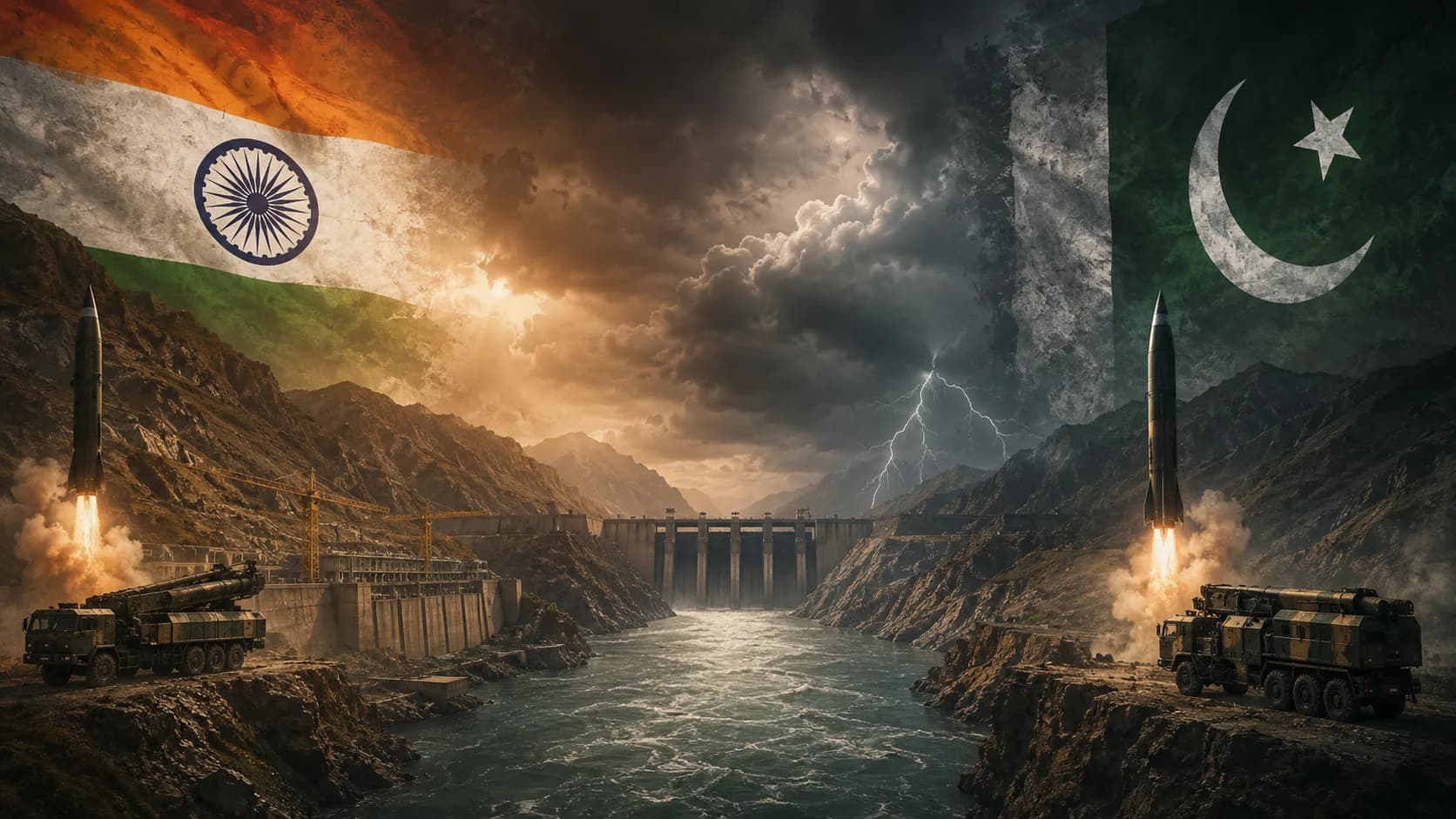
The four day war between India and Pakistan in May 2025 changed everything. For the first time since 1971, both countries used missiles and combat drones to strike deep inside each other's territory. The conflict started when 26 tourists were killed in Pahalgam, Kashmir. It ended with a ceasefire after just four days. Many analysts believe this was a warning. The next major conflict between the two nuclear armed neighbours may not start with a militant attack. It could very well start with water. And if it does, the escalation could be so fast that international diplomacy may have no time to stop it.
The Indus Waters Treaty of 1960 has been the foundation of water sharing between India and Pakistan for over six decades. It survived four wars. But in April 2025, India placed the treaty in abeyance. One year later, India has indicated the treaty may never be fully restored. Pakistan insists it remains valid, but no meaningful dialogue has taken place. The United Nations has given India until December 2026 to respond to Pakistan's complaint, but New Delhi has remained silent. Looking ahead, it is highly likely that the treaty will be formally declared dead by 2027 or 2028. Once that happens, the only mechanism preventing a water war will be gone.
For Pakistan, water is not a political issue. It is a survival issue. Eighty percent of its agriculture depends on the Indus basin. Agriculture employs more than one third of the country's workforce and contributes nearly a quarter of its GDP. Pakistan's dams can store only about 30 days of river flow. This means any upstream reduction in water would cause an immediate crisis. Climate change is making the situation worse. Average inflows of Pakistan's western rivers have already dropped from 135.6 million acre feet between 1976 and 1998 to just 120.8 million acre feet between 1999 and 2022. The World Bank has warned that the Indus basin could lose 30 to 40 percent of its flows in the coming decades due to rapid glacial retreat. In the near future, even without Indian action, Pakistan will face severe water shortages. With Indian action, the situation could become catastrophic.
Indian officials have not openly stated they will use water as a weapon. But the suspension of the treaty sends a clear signal. In August 2025, a senior Pakistani military official warned that if India builds a dam to block flow, Pakistan would destroy it with ten missiles. In February 2026, Pakistan Peoples Party Chairman Bilawal Bhutto Zardari said water disruption could lay the groundwork for the first nuclear war over water. The US Congressional Research Service has reported that Islamabad considers water a vital national interest and would treat any attempt to disrupt flows as an act of war. These statements suggest that if India proceeds with major dam projects on western rivers without notification, Pakistan may feel forced to respond with military force.
So how could a future water war unfold? A likely scenario looks something like this. Between 2027 and 2029, India may complete a major hydroelectric project on the Chenab River, such as the Ratle project. Because the Indus Waters Treaty is no longer in force, India may close the dam gates without sharing data or notifying Pakistan. Water levels downstream would drop sharply, especially during the dry sowing season. Pakistan's Punjab region, the country's breadbasket, would face acute shortages. Crop yields could fall by 20 to 30 percent. Food prices would spike. Civil unrest would grow. Facing economic collapse and public anger, the Pakistani military might calculate that inaction is more dangerous than action. It could issue an ultimatum to India to restore water flows within 48 hours. If India refuses, Pakistan could launch precision strikes against Indian dam infrastructure, targeting facilities like the Salal, Baglihar or Shahpur Kandi dams.
At that point, the conflict would escalate rapidly. India would almost certainly retaliate, not just against Pakistani military targets but against the infrastructure that supports Pakistan's water supply. The fighting would expand beyond water to air bases, missile sites and command centers. The four day timeline of the May 2025 war could compress into 48 hours or less. And this is where the nuclear risk becomes real. Pakistan has developed tactical nuclear weapons specifically to counter conventional disadvantages. If Pakistan faces both military defeat and agricultural collapse, its leadership might invoke its tactical nuclear doctrine. A senior official could announce that if strikes on water infrastructure continue, Pakistan will use all available weapons. The world would have hours, not days, to intervene.
This is not a certainty. It is a prediction based on current trends. The military build up on both sides makes such a scenario more likely. In the 12 months after the May 2025 war, India approved defence procurements worth tens of billions of dollars, including 87 armed heavy duty drones, over 110 BrahMos supersonic cruise missiles, and expanded S 400 air defence systems. India's defence budget for 2025 26 stands at 78.7 billion dollars, a 9.5 percent increase. Pakistan, despite its fragile economy, raised its defence budget by 20 percent to 9 billion dollars, its largest annual increase in a decade. Pakistan has focused on counter drone technologies and tactical nuclear assets. Both sides are preparing for a war they believe can be kept limited. But as US scholar Elizabeth Threlkeld wrote in Foreign Affairs, future conflicts will involve deeper strikes, shorter timelines and new domains. The risk is shifting from deliberate nuclear use to inadvertent escalation. No one may have enough time to think.
The environmental cost of any nuclear exchange would be global. A study published in Science Advances warns that even a limited nuclear exchange between India and Pakistan could release up to 36 teragrams of soot into the stratosphere. That soot would block sunlight and cool the Earth by up to 5 degrees Celsius for nearly a decade. The result would be a global nuclear famine, collapsing food systems from South Asia to the American Midwest. The Centre for Strategic and Contemporary Research noted that the most significant yet often overlooked impact of war is on the environment. A nuclear conflict that destroys Pakistan's irrigation system and India's grain belt would trigger mass starvation on a scale not seen since the Second World War.
Looking ahead to 2027 and beyond, several factors will determine whether this prediction becomes reality. If the international community, particularly the United States and China, pressures both sides to restore some form of water sharing agreement, war could be avoided. But that seems unlikely. The United States is distracted by its rivalry with China and internal political divisions. Russia is aligned with India. Europe has its own crises. Pakistan's diplomatic appeals may achieve little. Climate change will continue to reduce river flows. India may feel emboldened by its conventional military superiority. Pakistan may feel cornered. The most likely outcome is that the Indus Waters Treaty will not be revived. By 2028 or 2029, a crisis over a dam will push both countries to the brink. The war that follows may not begin as a nuclear war. But it could end as one. The world has been warned. Whether anyone will act on that warning remains the only real uncertainty.
Uroosa Khan
Contributing writer at EUReflect.
Follow EUReflect
See more of our reporting on Google
Mark EUReflect as a preferred source and our stories are ranked higher for you in Top Stories, Discover and Google News — and carry a “preferred” badge when they are cited in AI results.
Add EUReflect as a preferred source