A New Model of Stress
A new theoretical model is proposing a different way to understand how people interpret stressful situations. Rather than treating stress appraisal as a collection of separate categories, the Circumplex Model of Stress organizes these experiences along two fundamental dimensions: controllability and threat.
A New Way to Understand Stress
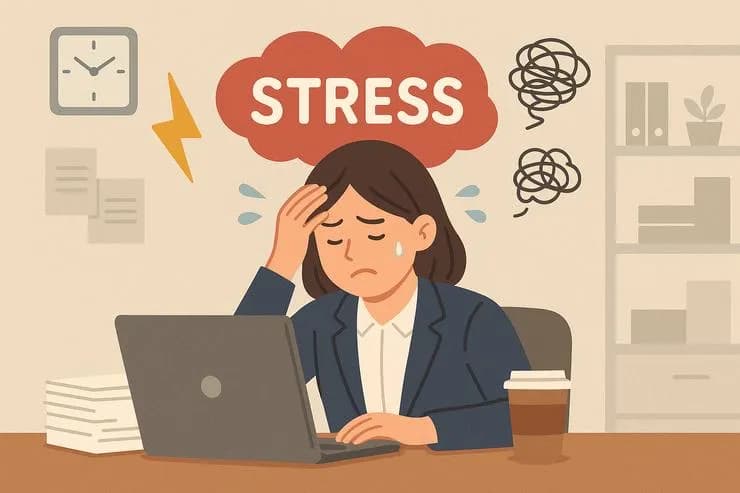
Stress is one of the most extensively studied subjects in psychology. Researchers have developed numerous concepts to explain how people interpret and respond to demanding situations, including threat, challenge, pressure, helplessness and coping.
Yet these concepts are often examined separately.
A new theoretical model proposes bringing them together.
Published in New Ideas in Psychology in 2025, the Circumplex Model of Stress (CMS) attempts to organize different forms of stress appraisal within a common theoretical structure. The model proposes that stress appraisals can be understood according to two fundamental dimensions: controllability versus uncontrollability and mitigation versus threat.
Stress Begins With Appraisal
Stress is not simply a property of an external event.
The same situation can be experienced very differently by different people. An upcoming examination, for example, may be interpreted as a manageable challenge by one person and as an overwhelming threat by another.
This difference is important because psychological responses are influenced not only by what happens, but also by how the situation is interpreted.
The Circumplex Model builds on this idea by focusing on stress appraisal rather than treating stressful events as psychologically identical.
Two Dimensions
The model organizes stress appraisal around two dimensions.
The first concerns controllability.
A person may perceive a situation as something they can influence, manage or change. Alternatively, they may perceive little or no control over what happens.
The second dimension concerns whether the situation is experienced primarily as a threat or something that can potentially be mitigated.
Together, these dimensions create a conceptual space in which different forms of stress appraisal can be positioned.
Challenge and Hopelessness
One implication of the model is that experiences traditionally described using different psychological terms may represent different positions within the same broader system.
A demanding situation can be experienced as a challenge when a person perceives some capacity to influence the outcome.
The same situation can move toward hopelessness when perceived control decreases and the situation becomes increasingly threatening.
This distinction provides a theoretical explanation for why demanding circumstances do not automatically produce the same psychological response.
When Pressure Feels Manageable
Not every stressful experience is necessarily perceived as harmful.
People can experience substantial pressure while still believing that the situation is manageable.
This distinction is important because psychological theories sometimes risk treating stress as a single continuum ranging from low to high.
The Circumplex Model instead suggests that the quality of appraisal matters, not simply the intensity of pressure.
Two people could experience similarly demanding circumstances but place them in very different psychological positions depending on perceived control and threat.
Why a Circumplex Model?
The use of a circumplex structure allows different psychological states to be represented within a continuous space rather than divided into rigid categories.
This is theoretically significant.
Instead of asking whether an experience is simply “challenge” or “threat,” researchers can examine where that experience falls along multiple dimensions.
Such an approach may better capture the complexity of real-world stress, where people can simultaneously experience pressure, uncertainty, perceived control and threat.
Moving Beyond Simple Stress Categories
Traditional psychological language often relies on discrete labels.
A person may be described as experiencing stress, anxiety, pressure, challenge or helplessness.
But human experience rarely fits perfectly into separate boxes.
The Circumplex Model attempts to address this problem by treating stress appraisal as a structured space in which different experiences can overlap and change.
This could make it easier to study transitions between different forms of appraisal.
For example, a situation initially perceived as manageable may become threatening when a person's perceived control decreases.
Conversely, a threatening situation may become more manageable when the individual identifies effective ways of responding.
A Dynamic View of Stress
This perspective also suggests that stress appraisal should not necessarily be considered fixed.
People continually receive new information about their circumstances.
A problem may initially appear uncontrollable but later become manageable. A situation that once seemed like a challenge may become threatening if available resources disappear.
Stress appraisal can therefore change as the relationship between the individual and the situation changes.
The model provides a theoretical framework for representing these differences rather than assuming that stress has one universal psychological form.
What the Model Could Change
The value of a new theoretical model is ultimately determined by whether it helps researchers ask better questions.
The Circumplex Model could encourage researchers to examine stress not only in terms of intensity, but also according to how people interpret control, threat and the possibility of changing a situation.
This could have implications for research on coping, well-being and stress-related psychological responses.
It may also help explain why interventions that work for one type of stress appraisal do not necessarily work for another.
Rethinking Stress
The emerging model represents a broader movement in psychology toward theories that attempt to integrate previously separated concepts.
Instead of treating challenge, threat, pressure and hopelessness as completely independent psychological categories, the Circumplex Model places them within a shared conceptual structure.
The central message is therefore straightforward:
Stress may depend not only on how demanding a situation is, but on how controllable and threatening that situation appears to be.
That distinction could provide psychology with a more precise way to understand why the same stressful circumstance can produce very different psychological experiences.
Ipek Tuncer
M.A. in International Relations
Follow EUReflect
See more of our reporting on Google
Mark EUReflect as a preferred source and our stories are ranked higher for you in Top Stories, Discover and Google News — and carry a “preferred” badge when they are cited in AI results.
Add EUReflect as a preferred source