How Green Spaces Shape Well-Being
The places where people live may influence more than their physical health. Growing research in environmental psychology suggests that access to green spaces can also be associated with psychological well-being. New European evidence is examining how parks, vegetation and greener neighbourhoods shape people's everyday experiences of stress, connection and quality of life.
The Psychology of Living in Greener Cities
For most people, psychological well-being is influenced by more than individual thoughts, emotions and relationships. The physical environment in which people live can also shape everyday experiences.
This question is central to environmental psychology, a field that examines how physical surroundings influence human behaviour, emotions and well-being.
In recent years, researchers have increasingly examined the relationship between urban green space and mental well-being. Parks, gardens, trees and other forms of vegetation are no longer considered simply aesthetic features of cities. They are also being studied as potential components of healthier psychological environments.
Why Green Space Matters Psychologically
Cities can provide employment, education, culture and social opportunities, but urban environments can also expose people to noise, traffic, overcrowding and limited access to nature.
Green spaces can create opportunities for a different type of experience.
A walk through a park, time spent near trees or simply having access to a greener neighbourhood can provide opportunities for physical activity, restoration and contact with natural environments.
Psychological theories of environmental restoration suggest that natural environments may help people recover from the mental demands of everyday life. Instead of requiring sustained attention, natural settings can provide a less demanding form of attention that may support psychological recovery.
This does not mean that every visit to a park automatically improves mental health. The psychological experience of green space depends on factors such as accessibility, safety, quality and how frequently people use it.
Evidence From Long-Term Research
One of the most important developments in this field is the increasing use of longitudinal data.
A recent European study examined almost two decades of data from more than 10,000 participants to investigate the relationship between residential green space and mental well-being. The researchers found evidence of a positive association between greener residential environments and mental well-being over time.
Longitudinal research is particularly valuable because it can provide a stronger basis for understanding relationships than a single snapshot of people's lives.
Rather than simply asking whether people who live near green spaces are happier, researchers can examine how changes in people's environments and well-being develop over longer periods.
Green Space Is Not Only About Nature
An important psychological point is that green space does not work in isolation.
A park can provide opportunities for physical activity, social interaction, relaxation and exposure to nature at the same time. These different experiences may contribute to well-being through different pathways.
For example, a well-designed public park can encourage people to walk or exercise. It can also create opportunities to meet neighbours, spend time with family or simply take a break from a demanding routine.
The psychological benefits of green environments may therefore emerge from a combination of experiences rather than from vegetation itself.
The Importance of Access
Not everyone has equal access to high-quality green spaces.
Research into urban environments increasingly considers the distribution of parks and natural areas across neighbourhoods. If greener environments are concentrated in wealthier areas, access to potential psychological benefits may also become socially unequal.
This makes green space an issue not only for environmental psychology but also for questions of social inequality.
The psychological value of a park depends partly on whether people can reach it easily, feel safe there and actually have the time and opportunity to use it.
Green Cities and Everyday Stress
Another important area of research concerns stress.
Modern urban life often involves multiple simultaneous demands: commuting, work, digital communication, noise and constant exposure to information.
Green environments may offer short periods of psychological separation from these demands.
Even brief contact with nature can create a change in sensory experience. The presence of vegetation, natural sounds and open space can provide an environment that differs significantly from dense urban surroundings.
Researchers therefore increasingly examine green space as part of the wider environmental conditions that may support psychological resilience.
From Individual Psychology to Urban Design
The implications extend beyond individual behaviour.
If the physical environment influences psychological well-being, urban planning becomes relevant to psychology.
Designing cities with accessible parks, tree-lined streets, public gardens and walkable green areas may create environments that support healthier everyday routines.
This approach does not suggest that urban design can replace psychological treatment. Rather, it recognises that prevention can also occur through the environments in which people live.
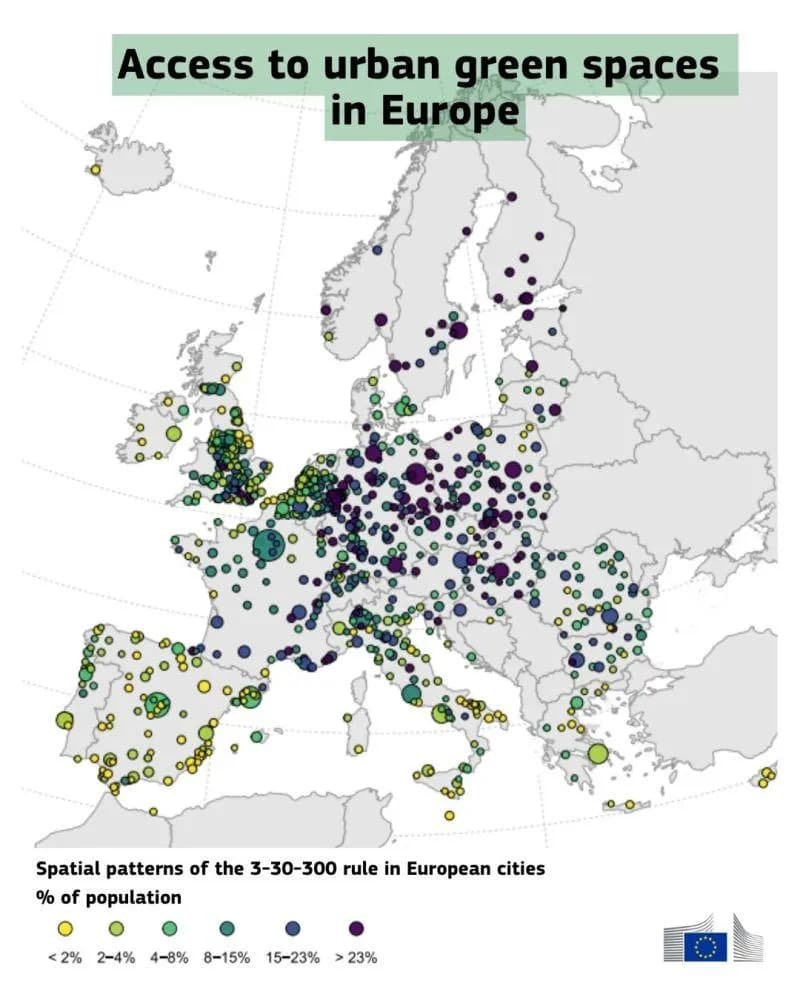
The European Environment Agency has increasingly highlighted the importance of urban green and blue spaces for health and well-being, particularly as European cities face challenges related to climate change, urbanisation and unequal access to nature.
The Social Side of Green Spaces
Green spaces can also influence psychological well-being through social relationships.
A public park is not simply an area containing trees. It can become a place where people meet, exercise, talk and participate in community activities.
This is particularly relevant to the growing psychological interest in social connection.
A greener neighbourhood may therefore influence well-being through several interconnected mechanisms: exposure to nature, physical activity, opportunities for social interaction and relief from environmental stress.
Understanding these mechanisms is important because it moves the discussion beyond the simplistic idea that “nature makes people happier.”
What Environmental Psychology Can Teach Us
The growing evidence around green spaces highlights a broader principle of environmental psychology: people do not experience their psychological lives separately from their surroundings.
The places where people live, work and spend their free time can influence behaviour, emotional experiences and opportunities for social connection.
For rapidly growing European cities, this creates an important challenge.
Urban development is not simply about building more housing, transport infrastructure or commercial areas. It is also about creating environments in which people can recover, connect and maintain psychological well-being.
Designing Healthier Everyday Environments
The future of environmental psychology may therefore involve closer cooperation between psychologists, urban planners, public-health researchers and policymakers.
Rather than asking only how individuals can adapt to stressful environments, researchers are increasingly asking how environments themselves can be designed to support healthier behaviour and well-being.
Green spaces are one part of this broader approach.
They cannot eliminate loneliness, anxiety or other psychological difficulties on their own. But accessible and well-designed natural environments may form part of a wider social and environmental infrastructure that supports psychological health.
As European cities continue to become denser and more complex, understanding the psychological value of the environments people inhabit may become increasingly important.
Ipek Tuncer
M.A. in International Relations
Follow EUReflect
See more of our reporting on Google
Mark EUReflect as a preferred source and our stories are ranked higher for you in Top Stories, Discover and Google News — and carry a “preferred” badge when they are cited in AI results.
Add EUReflect as a preferred source