The Psychology of Workplace Well-Being
Work is more than a source of income. It can provide structure, social connection, purpose and a sense of belonging, but workplace conditions can also create significant psychological pressure. New European research is placing greater emphasis on how workload, communication, job insecurity and organisational culture shape employees' mental well-being.
Why Workplaces Shape Psychological Well-Being
For many adults, work occupies a substantial part of everyday life. As a result, the psychological experience of work can influence much more than professional satisfaction. It can affect people's sense of purpose, social relationships, emotional well-being and ability to maintain a healthy balance between work and private life.
Recent European research is increasingly examining these connections through the concept of psychosocial risks. These are factors related to the way work is organised and managed, as well as to social relationships and the broader working environment. According to the European Agency for Safety and Health at Work (EU-OSHA), psychosocial risks can negatively affect both individual health and organisational performance.
When Work Becomes a Psychological Stressor
Work does not automatically damage psychological well-being. In fact, employment can provide structure, social interaction, financial security and a sense of identity.
The psychological problem emerges when demands become difficult to manage or when employees have insufficient resources to deal with those demands.
These pressures can include excessive workload, severe time pressure, unclear responsibilities, limited autonomy, poor communication, interpersonal conflict and insufficient support. EU-OSHA identifies these factors as important elements of the psychosocial working environment.
The distinction between ordinary work pressure and chronic psychosocial risk is important. Short periods of increased pressure may be manageable. Persistent demands without adequate recovery or support, however, can contribute to prolonged stress and poorer mental health.
What European Workers Are Reporting
Recent European data show that these issues are not marginal.
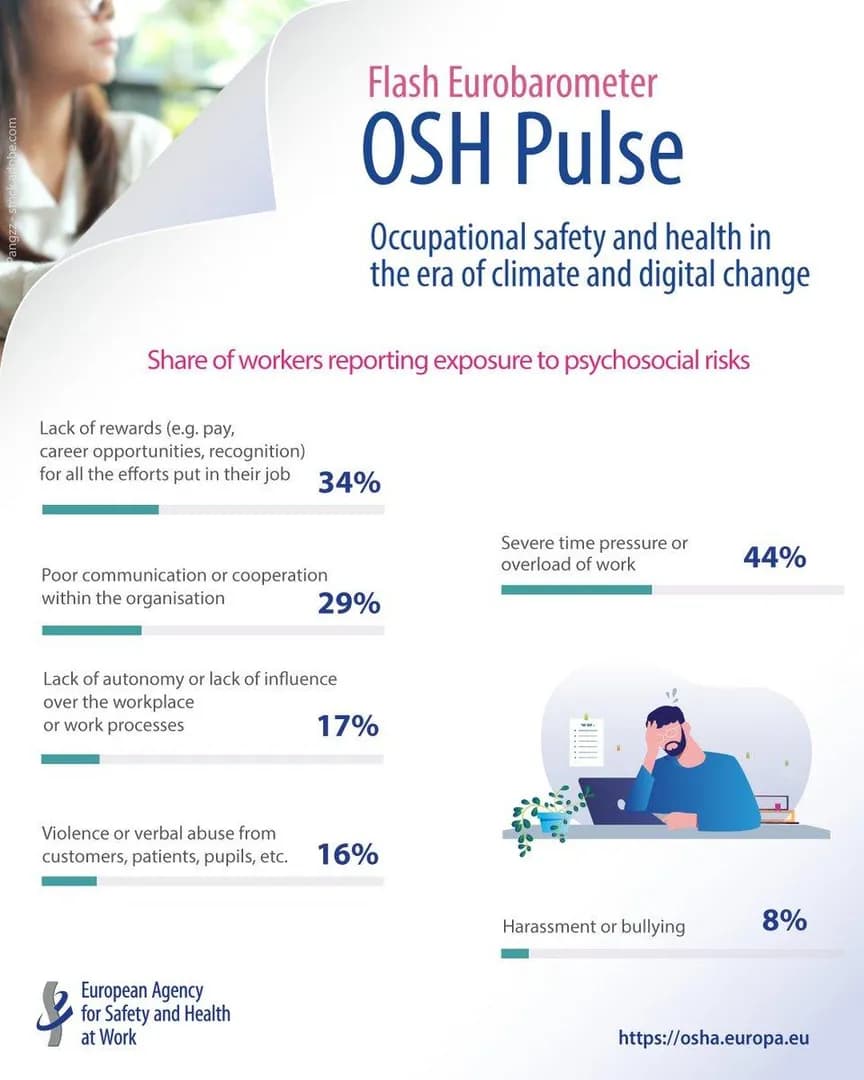
EU-OSHA's OSH Pulse 2025 survey found that more than 40% of workers reported severe time pressure, while around one in three said their efforts at work went unnoticed. Nearly 30% reported problems with communication or cooperation.
These findings are significant from a psychological perspective because they involve more than workload alone.
Being under constant time pressure can reduce opportunities for recovery. A lack of recognition may affect employees' sense of competence and value, while poor communication can weaken trust and social support.
In other words, psychological well-being at work is influenced not only by how much people work, but also by how the workplace makes them feel about their role and relationships.
The Importance of Social Relationships at Work
Workplaces are also social environments.
Colleagues, managers and teams can provide emotional support, practical assistance and a sense of belonging. Conversely, conflict, isolation, discrimination or poor cooperation can increase psychological strain.
This is one reason why organisational psychology increasingly examines workplace relationships alongside workload and job design.
EU-OSHA's recent research on psychosocial risks highlights poor social environments, discrimination, inequality and job insecurity as factors that can contribute to stress, anxiety and burnout, particularly among more vulnerable groups.
A supportive workplace therefore does not simply reduce stress. It can also create psychological resources that help employees deal with unavoidable demands.
Recognition and Psychological Well-Being
Recognition is another important psychological dimension of work.
Employees do not necessarily expect constant praise. However, when effort consistently goes unnoticed, workers may begin to perceive a gap between what they contribute and what they receive in return.
This can influence motivation, job satisfaction and the sense that one's work has meaning.
The issue is particularly relevant in environments where performance is measured continuously but positive feedback is limited. A workplace can therefore create psychological pressure even when the formal workload appears manageable.
Why Prevention Is Becoming More Important
European policy is increasingly moving toward prevention.
EU-OSHA's Healthy Workplaces Campaign 2026–2028, titled “Together for Mental Health at Work”, focuses specifically on mental health and the prevention and management of psychosocial risks across Europe.
This represents an important change in perspective.
Rather than treating mental health as something that belongs exclusively to the individual employee, prevention requires organisations to examine the conditions that may be contributing to psychological strain.
EU-OSHA states that managing psychosocial risks is essential for creating workplaces that support mental health and notes that employers have responsibilities to assess and manage workplace risks.
The Changing Psychology of Work
The psychological study of work is therefore moving beyond traditional questions about job satisfaction.
Researchers increasingly ask how autonomy, workload, social relationships, recognition, job security and organisational culture interact to influence well-being.
This is particularly relevant as workplaces continue to change through digitalisation, hybrid working, new forms of management and technological monitoring.
A recent 2026 report by Eurofound based on the European Working Conditions Survey 2024 also examines job quality, workplace practices and the quality of working life across the European Union.
These developments suggest that workplace psychology cannot be reduced to teaching individuals how to “cope with stress”. The organisation itself is part of the psychological environment.
From Individual Resilience to Healthy Organisations
One of the most important implications of current research is the need to reconsider the concept of resilience.
Individual resilience can help people manage difficult situations, but it cannot compensate indefinitely for excessive workload, poor management or an unhealthy organisational culture.
If the same psychological pressures affect large numbers of employees, the issue may no longer be primarily an individual problem.
It may indicate a problem in the organisation of work.
This is why European approaches increasingly combine individual support with organisational prevention. Risk assessment, employee participation, supportive management and better work organisation can all play a role in reducing psychosocial risks.
The Future of Workplace Well-Being
The future of workplace psychology is likely to focus increasingly on the relationship between people and the systems in which they work.
A psychologically healthy workplace is not simply one where employees have access to counselling or mental health resources. It is also a workplace where workloads are manageable, expectations are clear, communication functions effectively and employees have opportunities for autonomy, recognition and social connection.
As Europe begins its new 2026–2028 focus on mental health at work, the central question is shifting from “How can employees cope with stress?” toward “How can workplaces prevent unnecessary psychological stress from developing in the first place?”
That shift places organisational conditions at the centre of psychological well-being and makes workplace psychology increasingly relevant to both employees and employers.
Ipek Tuncer
M.A. in International Relations
Follow EUReflect
See more of our reporting on Google
Mark EUReflect as a preferred source and our stories are ranked higher for you in Top Stories, Discover and Google News — and carry a “preferred” badge when they are cited in AI results.
Add EUReflect as a preferred source