Active Inference: A New Theoretical Framework for Understanding Human Behaviour
Active inference offers a new theoretical framework for understanding human behaviour by connecting prediction, perception, learning and action.
From Passive Perception to Active Prediction
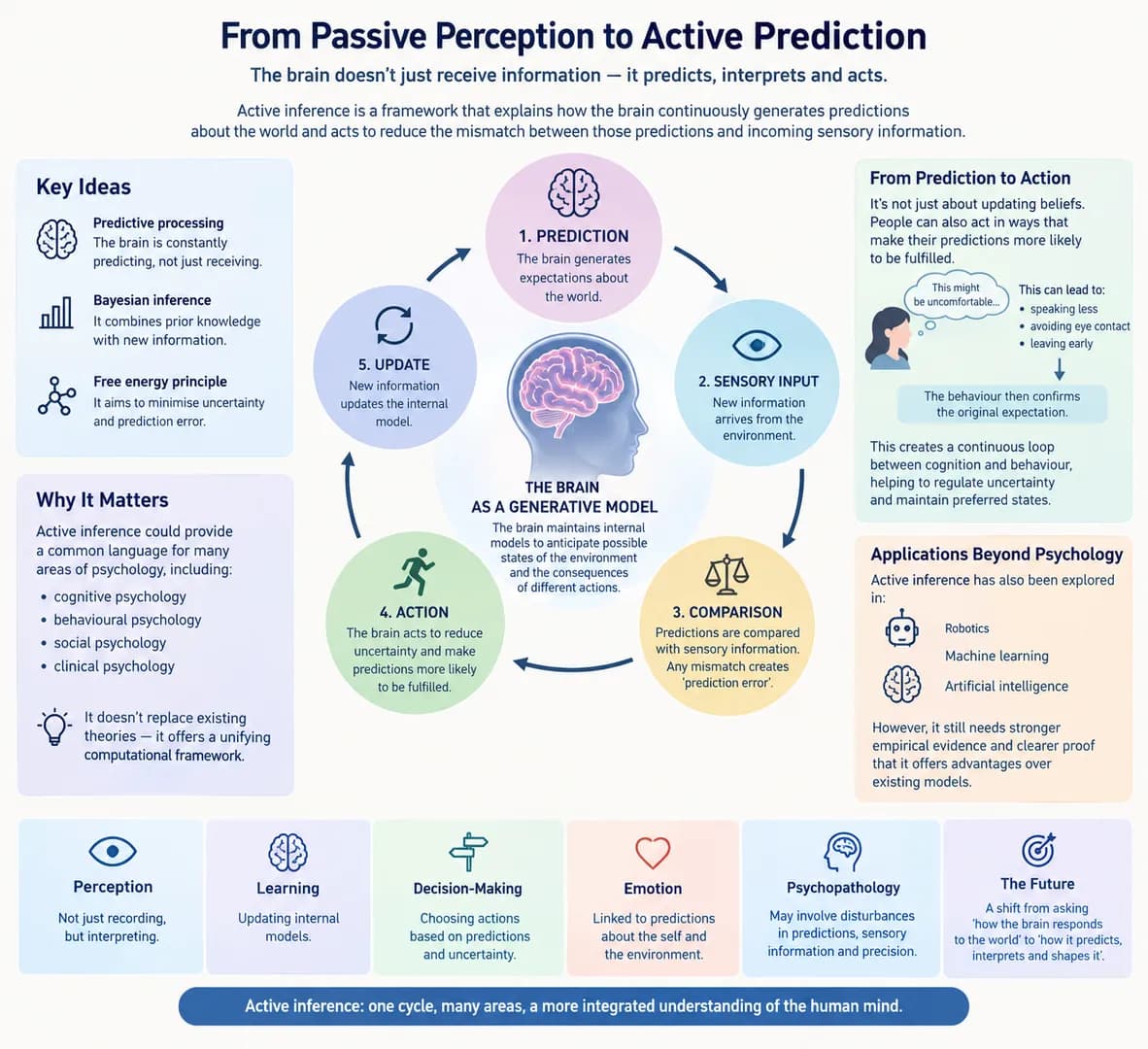
Psychology has long relied on different theories to explain perception, learning, decision-making and behaviour. A growing theoretical approach known as active inference is now attempting to connect these processes within a single framework. Rather than viewing the brain as a passive system that simply receives information from the outside world, active inference proposes that the brain continuously generates predictions about its environment and acts to reduce the mismatch between those predictions and incoming sensory information.
The approach has developed from work on predictive processing, Bayesian inference and the free energy principle. Although active inference remains an emerging theoretical framework, recent reviews suggest that it could provide a common language for several areas of psychology, including cognitive, behavioural, social and clinical psychology.
From Passive Perception to Active Prediction
Traditional approaches to perception often begin with the assumption that information from the environment is received by the senses and subsequently processed by the brain. Active inference reverses part of this logic. It proposes that the brain is constantly generating internal models of the world and comparing predictions derived from these models with sensory information.
In this framework, perception is therefore not simply a process of recording what is happening outside the individual. It is an inferential process in which the brain attempts to determine which explanation best accounts for the available sensory information.
This theoretical shift is significant because it places prediction, uncertainty and action at the centre of psychological functioning.
The Brain as a Generative Model
A central concept in active inference is the generative model. The brain is theorised to maintain internal representations that allow it to anticipate possible states of the environment and the consequences of different actions.
For example, when entering an unfamiliar room, a person does not process every visual detail independently. Previous experiences generate expectations about what is likely to be present, where objects might be located and how the environment might behave. New sensory information is then interpreted in relation to these expectations.
Active inference therefore treats perception and action as closely connected processes. The individual does not simply perceive the environment and subsequently decide how to respond. Instead, perception and action form a continuous loop in which predictions influence behaviour while new sensory information updates those predictions.
Why Does This Matter for Psychology?
One of the most important theoretical claims surrounding active inference is that it could help connect psychological processes that have traditionally been studied separately.
Recent work has applied the framework to phenomena including emotion, perceptual awareness, consciousness, learning and decision-making. Researchers have also explored its potential relevance to clinical psychology and psychiatry, including theoretical accounts of depression and other forms of psychopathology.
This does not mean that active inference has replaced established psychological theories. Instead, it represents an attempt to provide a unifying computational framework through which different psychological processes can be examined.
A 2024 review by Badcock and Davey argues that the framework has the potential to contribute to a broader theoretical integration within psychology, while also emphasising that its clinical and empirical implications remain under development.
From Prediction to Action
The word “active” is particularly important in active inference.
The theory does not suggest that people merely update their beliefs when predictions are incorrect. Individuals can also act on the environment in ways that make their predictions more likely to be fulfilled.
Consider a person who expects a social interaction to be uncomfortable. That expectation may influence how they behave: they might speak less, avoid eye contact or leave the interaction early. Their behaviour can then produce an interaction that appears to confirm their original expectation.
From an active-inference perspective, behaviour can therefore be understood partly as a mechanism through which individuals regulate uncertainty and maintain preferred states of interaction with their environment.
This provides a theoretical bridge between cognition and behaviour, rather than treating thoughts and actions as entirely separate psychological domains.
A New Perspective on Psychological Disorders
The theoretical implications become particularly interesting when active inference is applied to psychopathology.
Researchers have proposed that some psychological difficulties could involve disturbances in the way predictions, sensory information and the precision assigned to different forms of information are processed. In this view, symptoms may partly reflect persistent or inflexible predictions about the self, other people or the environment.
For example, if an individual consistently expects negative outcomes, ambiguous experiences may be interpreted through that predictive framework. The resulting behaviour may then reinforce the original expectations.
However, these applications remain theoretical and require further empirical validation. A 2024 review of predictive coding and active inference concluded that existing evidence provides promising but still limited support for some of the framework's empirical claims, highlighting the need for further testing.
From Psychology to Artificial Intelligence
The influence of active inference extends beyond psychology and neuroscience. Because the framework describes agents as systems that maintain internal models, make predictions and select actions, researchers have also explored its applications in robotics, machine learning and artificial intelligence.
This interdisciplinary potential is one reason why active inference has attracted increasing theoretical attention. It provides a framework in which perception, learning, decision-making and action can be described as interconnected components of a single adaptive process.
Nevertheless, its broad scope also presents a challenge. Critics have noted that the framework still requires stronger empirical evidence and clearer demonstrations that it offers explanatory advantages over existing psychological models.
What Could Active Inference Mean for the Future of Psychology?
Active inference represents a broader change in how researchers are beginning to conceptualise the human mind. Instead of treating perception, cognition and behaviour as isolated processes, it proposes that they form part of a continuous cycle of prediction, inference and action.
The theory is still developing, and it would be premature to describe it as a replacement for established psychological theories. Its significance lies instead in its attempt to provide a common theoretical framework capable of connecting different levels of psychological explanation.
As empirical research continues, one of the key questions will be whether active inference can move beyond an attractive theoretical model and demonstrate measurable advantages in explaining human behaviour and psychological disorders.
For psychology, this may ultimately represent a shift from asking how the brain responds to the world towards asking how the brain continuously predicts, interprets and actively shapes its relationship with the world.
Ipek Tuncer
M.A. in International Relations
Follow EUReflect
See more of our reporting on Google
Mark EUReflect as a preferred source and our stories are ranked higher for you in Top Stories, Discover and Google News — and carry a “preferred” badge when they are cited in AI results.
Add EUReflect as a preferred source