ACWA Power Beyond the Gulf: Central Asia & Caucasus
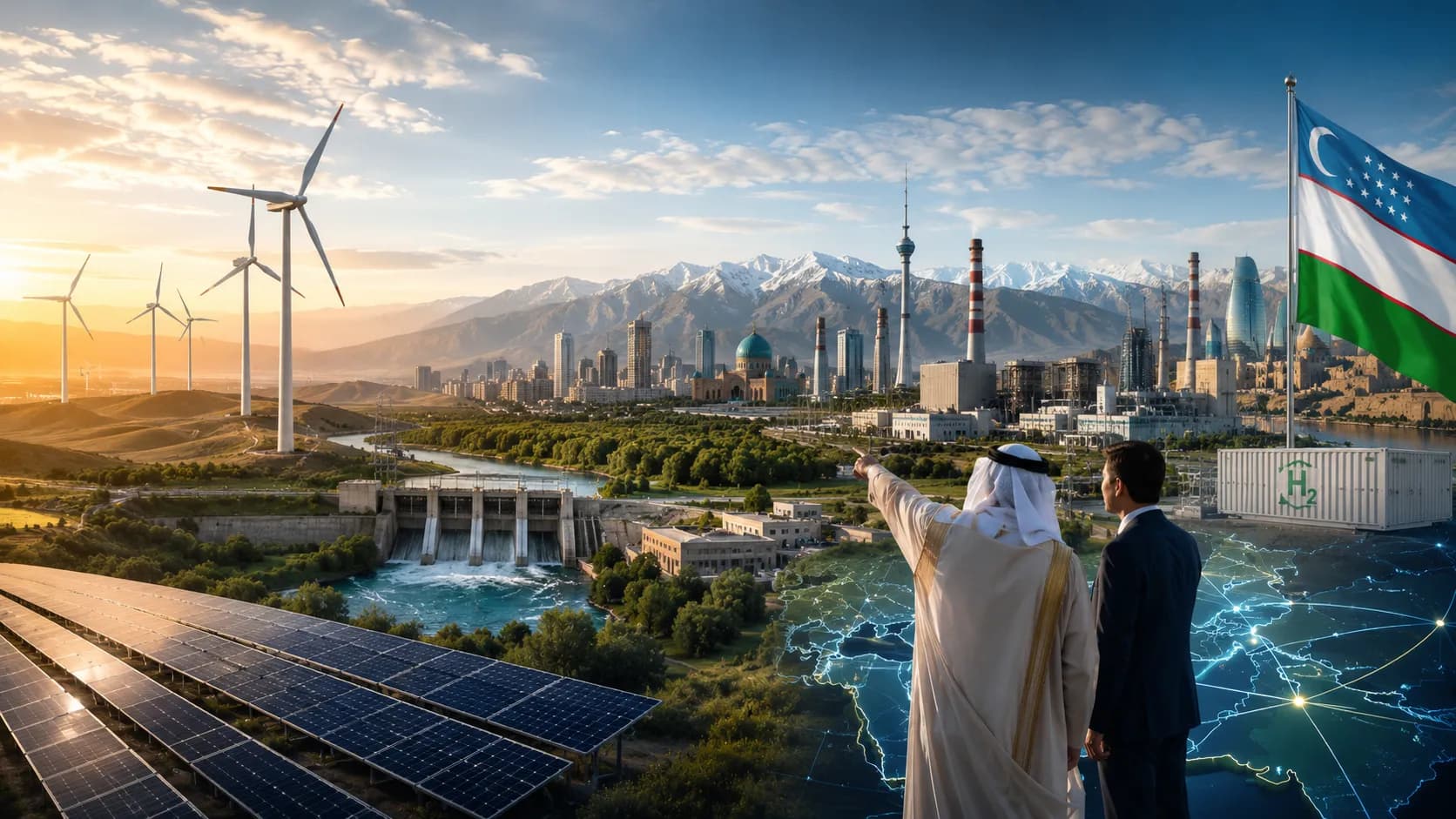
Since 2019, Uzbekistan has become ACWA Power’s main hub in Central Asia through major energy reforms. The company expanded renewable energy, hydrogen, and infrastructure investments into Kazakhstan, Azerbaijan, Kyrgyzstan, and Tajikistan, shaping a wider regional geopolitical and economic transformation.
Abdulhamid Hamid Al-Kba
Writer specializing in Central Asian and Azerbaijani affairs
Over recent years, the transformation taking place in the energy sector across Central Asia has evolved beyond a simple process of infrastructure modernization or increased electricity production. It has increasingly become part of a broader economic and geopolitical restructuring across a region that for decades relied heavily on aging Soviet-era energy systems and inefficient transmission networks.
In this context, Uzbekistan emerged as one of the region’s most ambitious states in restructuring its energy sector, driven by rapid population growth, rising industrial demand, and growing pressure on domestic electricity supplies. Since the rise of Shavkat Mirziyoyev in 2016, Tashkent has pursued a wide-ranging reform agenda focused on economic liberalization, foreign investment attraction, and modernization of strategic sectors.
Beginning in 2019, this transformation accelerated significantly as Uzbekistan opened large parts of its energy sector to international partnerships and private investment. Within this evolving landscape, ACWA Power gradually emerged as one of the most influential foreign actors in the country’s energy transition.
What initially emerged as a strategic energy partnership in Uzbekistan gradually evolved into one of the largest renewable energy investment portfolios in Central Asia. Over time, the company’s activities expanded beyond Uzbekistan toward Kazakhstan, Azerbaijan, Kyrgyzstan, and Tajikistan, reflecting the emergence of a growing Saudi economic presence in regional infrastructure and energy sectors.
This expansion should not be viewed merely as the commercial growth of an energy company. Rather, it reflects wider geopolitical and economic shifts involving the restructuring of regional energy networks, intensifying competition over infrastructure and clean energy markets, and the search by Central Asian and Caucasus states for diversified international partners capable of providing financing, technology, and technical expertise outside traditional regional frameworks.
Uzbekistan: The Center of ACWA Power’s Regional Expansion
Uzbekistan quickly became the company’s largest operational hub outside the Gulf region. The country’s urgent need for electricity generation capacity, combined with government-backed reforms and investment incentives, created favorable conditions for large-scale foreign participation in the energy sector.
Among the most prominent projects was the Sirdarya combined-cycle gas power plant, with a generation capacity of 1.5 gigawatts. The project represented one of the most efficient gas-fired power plants in the region and symbolized Uzbekistan’s effort to modernize aging electricity infrastructure while improving energy efficiency.
At the same time, renewable energy projects rapidly expanded. ACWA Power launched major wind projects in the Bukhara region, including the Bash and Dzhankeldy wind farms, with a combined capacity of approximately 1 gigawatt. These projects were designed to strengthen electricity generation capacity and support Uzbekistan’s long-term energy diversification strategy while contributing to lower carbon emissions.
The company also moved toward larger strategic renewable projects, particularly in Karakalpakstan through the Kungrad wind project, which includes some of the world’s largest wind turbines alongside battery energy storage systems intended to stabilize grid performance.
In parallel, Uzbekistan increasingly focused on integrating renewable energy with storage technologies. This shift was reflected in the Riverside Solar and Battery Energy Storage project in the Tashkent region, which became one of the country’s earliest large-scale attempts to combine solar generation with grid-scale storage infrastructure.
Hydrogen also became part of the long-term transition strategy. Joint initiatives involving green hydrogen production highlighted Uzbekistan’s ambition to position itself within emerging clean industrial supply chains rather than remaining solely dependent on conventional hydrocarbon exports.
The scale of investment has been equally significant. By 2026, the value of ACWA Power’s announced and developing projects in Uzbekistan exceeded billions of dollars across gas, solar, wind, storage, and hydrogen sectors. More importantly, these projects contributed to attracting broader international financing from institutions such as the European Bank for Reconstruction and Development and the Asian Development Bank, further integrating Uzbekistan into global energy investment networks.
Political Support and Strategic Partnership
One of the defining features of ACWA Power’s expansion in Uzbekistan has been the consistent political support provided at the highest levels of government.
Between 2022 and 2026, multiple meetings took place between President Shavkat Mirziyoyev and Mohammad Abunayyan. These meetings repeatedly focused on expanding strategic cooperation in renewable energy, infrastructure modernization, hydrogen development, digitalization, transport infrastructure, and industrial investment.
Official Uzbek statements increasingly described the company as a strategic partner in the country’s broader modernization agenda rather than simply a foreign investor operating isolated energy facilities.
This political alignment reflected Uzbekistan’s wider objective of diversifying international partnerships while accelerating economic reforms and infrastructure development.
Public Perception Inside Uzbekistan
Beyond official statements and investment figures, public perception inside Uzbekistan offers another important dimension in understanding the company’s growing role.
For many citizens, especially in provincial and rural areas, chronic electricity shortages and unstable winter energy supplies have remained among the country’s most pressing domestic concerns for years. In this context, large-scale energy projects are often viewed less through environmental narratives and more through expectations of stable electricity access and improved living standards.
Employment opportunities generated during the construction phases of large projects also contributed to positive perceptions in some regions. Young Uzbek engineers and technical workers increasingly viewed international energy companies as channels for professional development and access to modern industrial expertise.
The Saudi identity of the company additionally carries symbolic significance for parts of Uzbek society, particularly given the generally positive public perception toward Saudi Arabia across cultural and religious dimensions.
Despite the optimism surrounding the new projects, the priority for a broad segment of citizens remains tied to practical outcomes, foremost among them the stability of electricity supplies and the impact this may have on daily living conditions.
Expansion Beyond Uzbekistan
The company’s regional expansion gradually moved beyond Uzbekistan into broader Central Asian and Caucasus markets.
In Kazakhstan, ACWA Power signed agreements to develop a 1-gigawatt wind power project in the Zhetisu region, representing one of the company’s first major entries into the Kazakh energy market. The project aligned with Kazakhstan’s long-term target of increasing the share of renewable energy in its national energy mix.
In Azerbaijan, cooperation increasingly expanded into water infrastructure and desalination projects, reflecting Baku’s growing interest in integrating energy transition policies with water security and industrial modernization strategies along the Caspian region.
Meanwhile, discussions in Kyrgyzstan focused on potential Saudi participation in hydropower, solar, and wind projects, while Tajikistan announced plans involving large-scale solar power generation projects aimed at diversifying its domestic electricity sources.
Taken together, these developments indicate that the company is no longer operating solely as a Gulf-based energy investor, but increasingly as part of a broader regional transformation involving energy security, infrastructure modernization, and economic diversification across Central Asia and the Caucasus.
A Broader Geopolitical Dimension
The rise of Gulf investments in Central Asia’s energy sector also reflects broader geopolitical changes.
For decades, regional infrastructure remained heavily connected to Russian systems and Soviet-era networks. However, the growing involvement of Gulf, Chinese, European, and other international actors illustrates the emergence of a more diversified economic environment where Central Asian states seek multiple external partnerships rather than dependence on a single geopolitical center.
Saudi investment through companies such as ACWA Power therefore intersects with broader trends involving economic diplomacy, strategic infrastructure competition, and the global transition toward cleaner energy systems.
At the same time, the expansion of renewable energy projects in Central Asia cannot be separated from wider international climate commitments and long-term concerns regarding water security, industrial modernization, and demographic growth.
Conclusion
The story of ACWA Power’s expansion from Uzbekistan into Central Asia and the Caucasus represents more than the rise of a single energy company abroad. It reflects a larger regional transformation in which energy infrastructure, foreign investment, and geopolitical realignment increasingly intersect.
Since 2019, Uzbekistan has effectively become the central gateway for this expansion, serving as both a testing ground and a regional platform for broader Saudi economic engagement across neighboring states.
While major challenges remain — including electricity pricing, infrastructure sustainability, financing pressures, and long-term regulatory reforms — the scale of ongoing projects demonstrates that Central Asia is gradually becoming one of the most important emerging arenas for international energy competition and cooperation beyond the traditional Middle Eastern energy landscape.
Sources
Official statements from the Presidency of Uzbekistan
Ministry of Energy of Uzbekistan
ACWA Power
Times of Central Asia
Asharq Al-Awsat
Akhbar24
Kabar News Agency
Khovar News Agency
Abdul Hamid Hamid Al-Kba
Contributing writer at EUReflect.
Follow EUReflect
See more of our reporting on Google
Mark EUReflect as a preferred source and our stories are ranked higher for you in Top Stories, Discover and Google News — and carry a “preferred” badge when they are cited in AI results.
Add EUReflect as a preferred source