Africa Pushes Back on Mineral Exploitation
With 76% of global cobalt and 41% of bauxite, Africa's minerals are pivotal to the energy transition, yet 95% are exported unprocessed.
Africa's vast mineral wealth is becoming one of the central battlegrounds of the global economy.
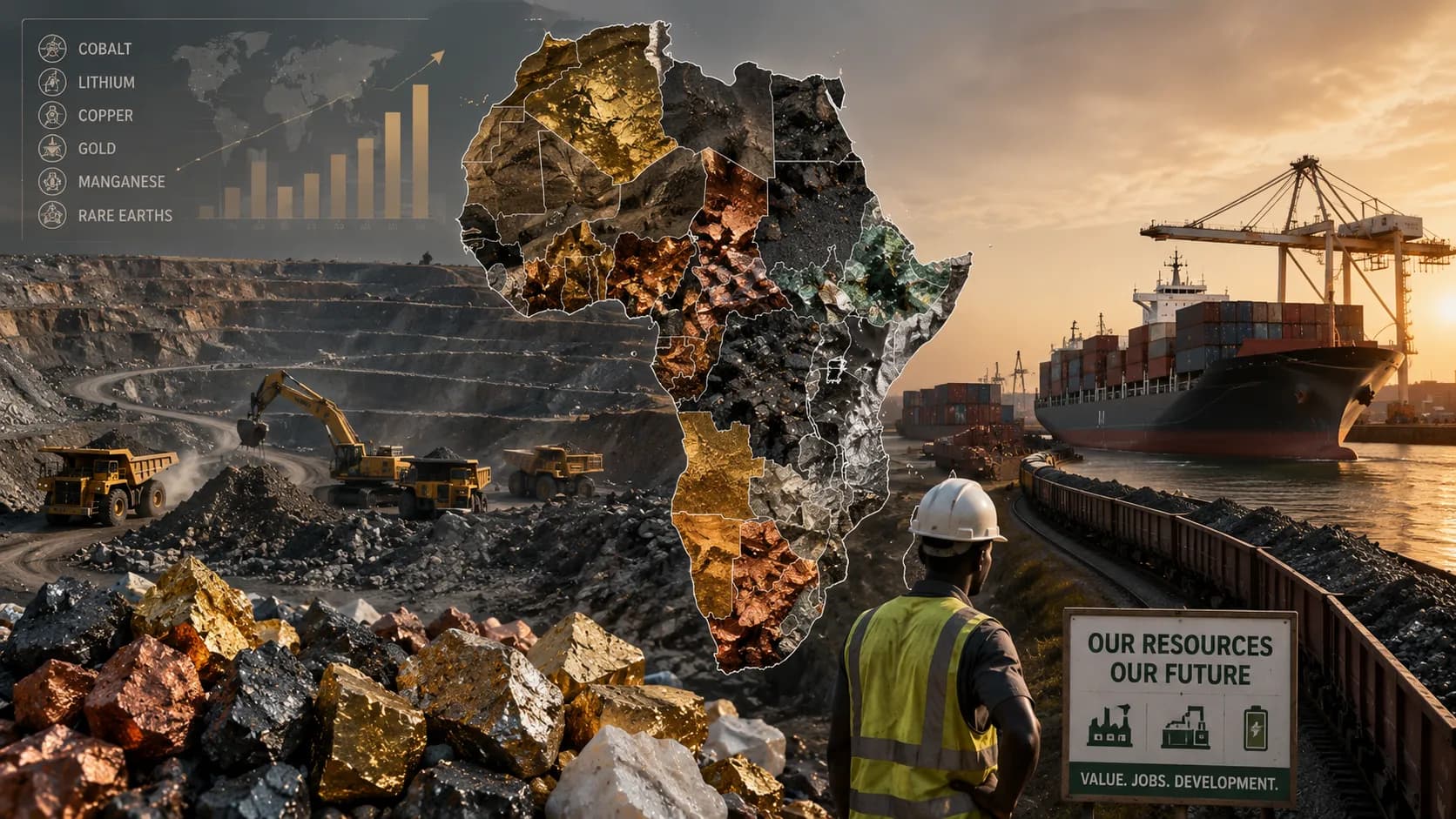
Cobalt from the Democratic Republic of Congo, lithium from Zimbabwe, bauxite from Guinea, manganese, graphite, copper, gold and rare earths are increasingly essential to electric vehicles, batteries, renewable energy, electronics and defense technologies.
But an old question is returning with new urgency: Will Africa simply supply the raw materials for another global industrial revolution, or will African countries capture more of the wealth created from their own resources?
Recent developments in 2026 suggest that several African governments are no longer willing to accept the traditional model of exporting minerals cheaply while processing, manufacturing and most profits remain abroad.
Africa Holds the Minerals the World Needs
The global energy transition is dramatically increasing Africa's strategic importance.
S&P Global estimates that Africa currently accounts for around 76 percent of mined cobalt and 41 percent of bauxite. By 2030, the continent could supply approximately 60 percent of global lithium and 40 percent of graphite.
These resources are becoming increasingly valuable because the United States, China, Europe, India, Japan and Gulf countries are all attempting to secure critical-mineral supply chains.
China has established a particularly strong position through decades of investment in African mining and processing. According to S&P Global, China receives virtually all Zimbabwean lithium exports and approximately 95 percent of Congolese cobalt exports.
The United States and other powers are now accelerating their own investments and strategic partnerships.
Africa is therefore becoming a major arena of geopolitical competition.
The Problem Is Not Only Extraction
For decades, one of Africa's biggest economic problems has been that minerals frequently leave the continent before significant value is added.
Recent analysis indicates that roughly 95 percent of Africa's critical minerals have traditionally been exported without processing on the continent.
Consider the economic chain surrounding a battery.
Mining lithium or cobalt represents only one stage. Refining the mineral, producing battery materials, manufacturing cells, assembling batteries and eventually producing electric vehicles create considerably more economic value.
When Africa exports primarily raw or minimally processed minerals, much of that additional value — including industrial employment, technology, intellectual property and manufacturing profits — is generated elsewhere.
This is why the debate over “mineral exploitation” increasingly concerns not only ownership of mines but who controls the value chain after extraction.
Congo Says More Processing Must Stay Home
The Democratic Republic of Congo is making one of the strongest moves.
In August, Kinshasa prohibited exports of copper and cobalt concentrates as part of an effort to increase domestic processing and retain more economic value from its mineral resources.
The government order replaces an earlier system that allowed broader exemptions because Congo lacked sufficient processing capacity.
The decision matters internationally.
DRC is the world's dominant cobalt producer and an increasingly important copper supplier. Decisions taken in Kinshasa can therefore affect global battery and technology supply chains.
The message is becoming clearer:
Congo does not simply want foreign companies to extract its minerals. It wants more of the industrial economy surrounding those minerals to remain inside the country.
Zimbabwe Tries a Different Model
Zimbabwe is pursuing a similar strategy with lithium.
After restricting exports of raw lithium, Harare has pressured mining companies to invest in domestic processing facilities rather than simply shipping ore abroad.
The strategy produced an important milestone in May 2026 when Africa's first major lithium refinery of this new generation began operating in Zimbabwe, according to recent reporting.
Zimbabwe is not alone.
The OECD reports that Tanzania, Namibia, Ghana, Malawi, the DRC and other African states have introduced or announced restrictions affecting exports of unprocessed minerals. Gabon plans restrictions on manganese exports as well.
At least 14 African countries are now pursuing some form of policy designed to encourage greater domestic mineral processing.
This represents an important shift from resource extraction toward resource nationalism and industrialization.
Conflict Minerals Remain a Dark Reality
But controlling mineral wealth is considerably harder in countries affected by armed conflict.
Eastern Congo remains the clearest example.
Gold and other valuable minerals can pass through informal networks, traders and neighboring countries before entering international supply chains.
The United Nations warned in July that minerals extracted in conflict areas can quietly enter legitimate global markets after being mixed with legally produced material.
Despite years of Security Council resolutions designed to restrict conflict-mineral networks, enforcement remains difficult because instability and weak state control allow illegal systems to survive.
The connection between minerals and conflict has therefore become part of current peace negotiations involving the DRC, Rwanda, the M23 conflict and international mediators.
In August, Congo and Rwanda continued implementation discussions under the Washington peace framework, with the United States, Qatar, African Union representatives and other actors involved.
Mineral governance is no longer simply an economic question.
In some African countries, control over resources is directly connected to control over territory.
The Human Cost Remains High
The extraction model also has consequences for workers and local communities.
A recent global assessment documented 329 allegations of human-rights abuses connected with transition-mineral mining in 2025, a 73 percent increase from the previous year. Africa experienced the sharpest increase.
Concerns include working conditions, environmental damage, displacement and inadequate consultation with communities affected by mining projects.
The dangers of poorly regulated extraction were again demonstrated this week in the Central African Republic.
Authorities closed the Zamboye gold-mining site after a collapse killed more than 100 people. The government said mining standards and administrative requirements had not been respected. Illegal miners had reportedly continued operating despite the site previously being closed.
The tragedy demonstrates another side of Africa's resource problem: enormous mineral wealth can coexist with weak regulation, dangerous working conditions and extreme poverty.
A New Scramble for Africa?
The situation is increasingly compared with previous periods of competition for African resources.
But there is one important difference.
African governments today possess considerably greater political and economic leverage.
Demand for lithium, cobalt, copper, graphite, manganese and rare earths is increasing precisely when major powers are trying to reduce dependence on rival supply chains.
The UN has warned that demand for critical energy-transition minerals such as lithium, cobalt, nickel and rare earths could almost triple by 2030.
That gives mineral-producing countries bargaining power.
The question is whether they can convert geological wealth into industrial power.
Export bans alone will not accomplish this. Africa also needs electricity, railways, ports, processing facilities, skilled workers, financing and transparent institutions capable of negotiating effectively with multinational companies.
The emerging struggle is therefore no longer simply about who owns Africa's mines.
It is about who refines the minerals, who controls the supply chains, who manufactures the final products — and ultimately, who keeps the wealth.
Africa possesses many of the resources required for the next global industrial transformation.
The battle of the coming decade will be over whether those resources continue to leave Africa primarily as raw materials, or become the foundation of Africa's own industrial transformation.
Ahmet Balakan
Contributing writer at EUReflect.
Follow EUReflect
See more of our reporting on Google
Mark EUReflect as a preferred source and our stories are ranked higher for you in Top Stories, Discover and Google News — and carry a “preferred” badge when they are cited in AI results.
Add EUReflect as a preferred source