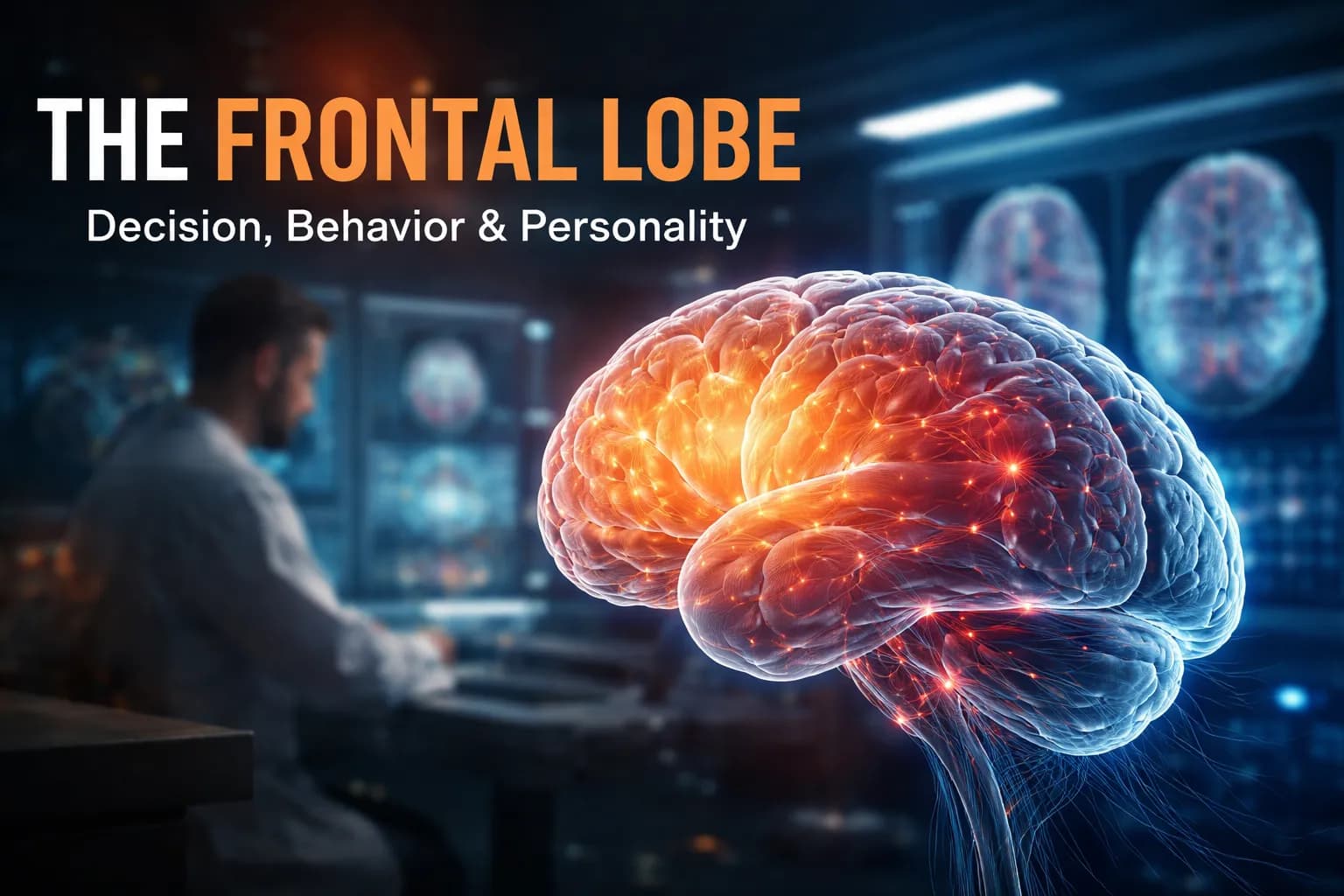
The frontal lobe is the brain’s central system for executive control, decision-making, emotional regulation, and personality. Its proper functioning enables self-regulation, social adaptation, and responsible behavior, while dysfunction may lead to impulsivity, poor judgment, and social instability.
Human behavior often changes in the presence of others. Individuals who appear calm, reserved, or cautious when alone may behave more boldly, emotionally, or even aggressively in crowds. Such transformations are commonly explained through the concept of group psychology, which assumes that individuals lose their personal characteristics and become absorbed into a collective mind. However, the individualistic psychology perspective challenges this assumption by arguing that groups do not possess an independent psychological existence. Instead, what is described as group behavior emerges from changes in individual cognitive, emotional, and perceptual processes within a social context.
From this viewpoint, crowds do not override individual psychology; rather, they alter how individuals perceive responsibility, evaluate risk, interpret social cues, and regulate emotions. This article examines crowd behavior through the lens of individualistic psychology, focusing on how individual mental processes operate differently in collective settings. Drawing on everyday examples from Türkiye, the study aims to explain crowd-related behavioral changes in a clear and accessible manner while maintaining academic rigor.
Jean Piaget’s cognitive development theory explains how children actively construct knowledge through schemas, assimilation, accommodation, and equilibration. By outlining developmental stages and their educational implications, the theory shows why learning must align with cognitive readiness and remains central to constructivist education.
Trauma affects individuals who experience it directly and may also influence subsequent generations. In Türkiye, traumatic experiences such as earthquakes, forced migration, terrorism, and domestic violence are widespread. This article examines the intergenerational transmission of trauma through psychological processes and epigenetic approaches. The aim is to explain, in clear and accessible language and with examples from Türkiye, how trauma can be transmitted to children through family relationships, parenting styles, and biological vulnerabilities.
In the digital age, social media has significantly transformed the ways individuals perceive and present themselves. This article examines the impact of social media on the self within the frameworks of symbolic interactionism and individualistic psychology. The aim of the study is to explain, in simple terms, how the self is reshaped in digital environments through social interactions and individual psychological processes.
Kohlberg’s stages of moral development constitute not only a psychological model but also a roadmap that connects individual conscience with societal order. The framework continues to serve as one of the most influential compasses in humanity’s ongoing pursuit of what is truly “right.”
Erik Erikson's Psychosocial Development Theory divides human life into eight stages, each involving a psychosocial conflict that must be resolved. Positive resolution of these conflicts promotes healthy personality development and adaptation, while negative resolution can lead to psychological difficulties. The theory provides an important framework for understanding development, identity formation, and social adaptation across the entire lifespan, from childhood to old age.
This article defines the concepts of cognitive intelligence (IQ) and emotional intelligence (EQ), highlighting their differences as well as their complementary nature. While IQ emphasizes cognitive functions such as problem-solving and logical reasoning, EQ focuses on emotional and social skills. A review of the literature demonstrates that high IQ alone is insufficient for long-term success in personal and professional life; EQ also plays a critical role. The article further proposes a four-week integrated program for developing both EQ and IQ, illustrated with practical case studies.
Maslow’s theory remains a central reference in motivational psychology due to its integrative perspective—bridging biological, psychological, and social dimensions.
Schizophrenia is a complex disorder manifesting with positive, negative, and cognitive symptoms that collectively affect individual functioning and social participation.
MDD is not a momentary emotional downturn; it is a persistent disturbance in brain chemistry, cognition, and social functioning that can fundamentally alter a person’s perception of life.