Azerbaijan's Victory Day: An Analysis of Geopolitical Transformation
This article analyzes the new geopolitical balance of power that emerged in the South Caucasus following Azerbaijan's November 8th Victory and its implications for the regional security architecture. Employing the Regional Security Complex (RSC) theoretical framework, the paper examines the core dynamics that led to the end of the thirty-year status quo. Our main thesis posits that the post-victory era has eroded traditional Russian hegemony, increased Turkey's strategic influence, and enhanced the agency of regional actors (Azerbaijan). The analysis focuses on peace negotiations, the geopolitics of transportation corridors like the Zangezur Corridor, and the increased intervention of external actors (Iran, EU, US). The article argues that while these changes offer potential for normalization, they also introduce a risk of a new instability cycle driven by corridor disputes and border conflicts, concluding with policy implications for regional stability.
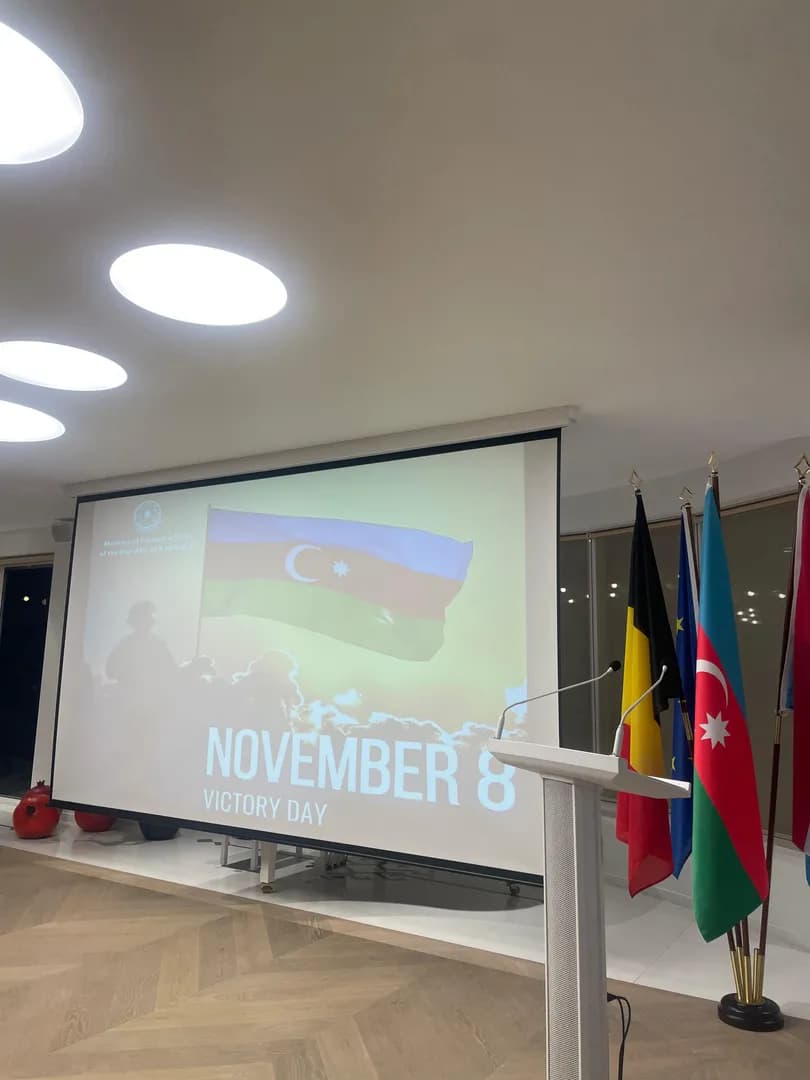
The diplomatic reception held in Brussels on the occasion of the Republic of Azerbaijan's November 8th Victory Day, and honored by EUReflect's attendance, underscores the event's critical importance not only as a national commemoration but also for the international recognition of post-conflict normalization processes in the South Caucasus. This event, hosted by the mission led by H.E. Ambassador Vaqif Sadıqov, was specifically designed to reflect the diplomatic achievement of national resilience and the goal of restoring territorial integrity based on international law.
1. The Synthesis of National Will and International Law
The emphasis on the "long struggle" at the reception elevates November 8th beyond merely the result of a military action, positioning it as the triumph of a legal and political will that challenged a thirty-year status quo. In this context, Azerbaijan leveraged its national capacity to address the legal vacuum resulting from the non-implementation of UN Security Council resolutions, thereby actualizing core principles of international law, such as state sovereignty and territorial integrity. This serves as a significant case study for the resolution of protracted conflicts in the post-Soviet space.
2. Post-Conflict Transition Management and Building Sustainable Peace
The central theme of the discussions—the necessity of "translating victory into sustainable peace, reconstruction, and regional cooperation"—encapsulates Azerbaijan's macro-strategy for the post-conflict period. This strategy rests upon three main pillars:
Reconstruction and Integration: The demographic resettlement and infrastructure modernization in the recovered territories represent not only a humanitarian return but also a development vector intended to accelerate regional economic integration.
Normalization Diplomacy: The call for dialogue, central to the Ambassadors' diplomatic efforts, is based on the premise that securing lasting stability in the region requires the signing of a comprehensive peace treaty with neighboring Armenia and the mutual recognition of borders.
Regional Connectivity: The potential for opening transport corridors (including the Zangezur Corridor) in the South Caucasus aims to increase the region's geo-economic significance, enabling it to assume a new role in international energy and trade flows.
3. Euro-Atlantic Relations and Geopolitical Vision
The reception in Brussels is part of Azerbaijan's sustained effort to strengthen its diplomatic communication with the EU and NATO. The presence of H.E. Jafar Huseynzada and Colonel Ramil Hasanov from the NATO missions indicates the country's desire to integrate its security and defense policies into the Euro-Atlantic framework. This diplomatic platform provided an opportunity to explain and legitimize Azerbaijan's role in regional energy security and the newly emerging geopolitical balance to its Western allies.
In conclusion, the November 8th Victory Day reception transcends the mere commemoration of a national achievement; it is a profound reflection of the diplomatic determination to establish a new regional order in the South Caucasus.
EUReflect News
Site Administrator
Follow EUReflect
See more of our reporting on Google
Mark EUReflect as a preferred source and our stories are ranked higher for you in Top Stories, Discover and Google News — and carry a “preferred” badge when they are cited in AI results.
Add EUReflect as a preferred source