Beyond Taxes: How a Modern State Can Fund Itself
In contemporary political economy, taxation has long constituted the primary mechanism through which states finance public services and maintain institutional stability. However, structural transformations driven by globalization, technological change, and automation have increasingly exposed the limitations of a tax system that relies predominantly on labor and consumption. Growing inequality, the erosion of traditional employment, and declining public trust highlight the need to reassess how modern states generate revenue. This text introduces an alternative framework for public finance that complements taxation with public ownership of productive assets, equitable resource-based taxation, and citizen-oriented income mechanisms. Rather than advocating the abolition of taxes, it emphasizes the necessity of a balanced and sustainable funding model capable of supporting social welfare, economic resilience, and long-term state legitimacy in a rapidly evolving economic landscape.
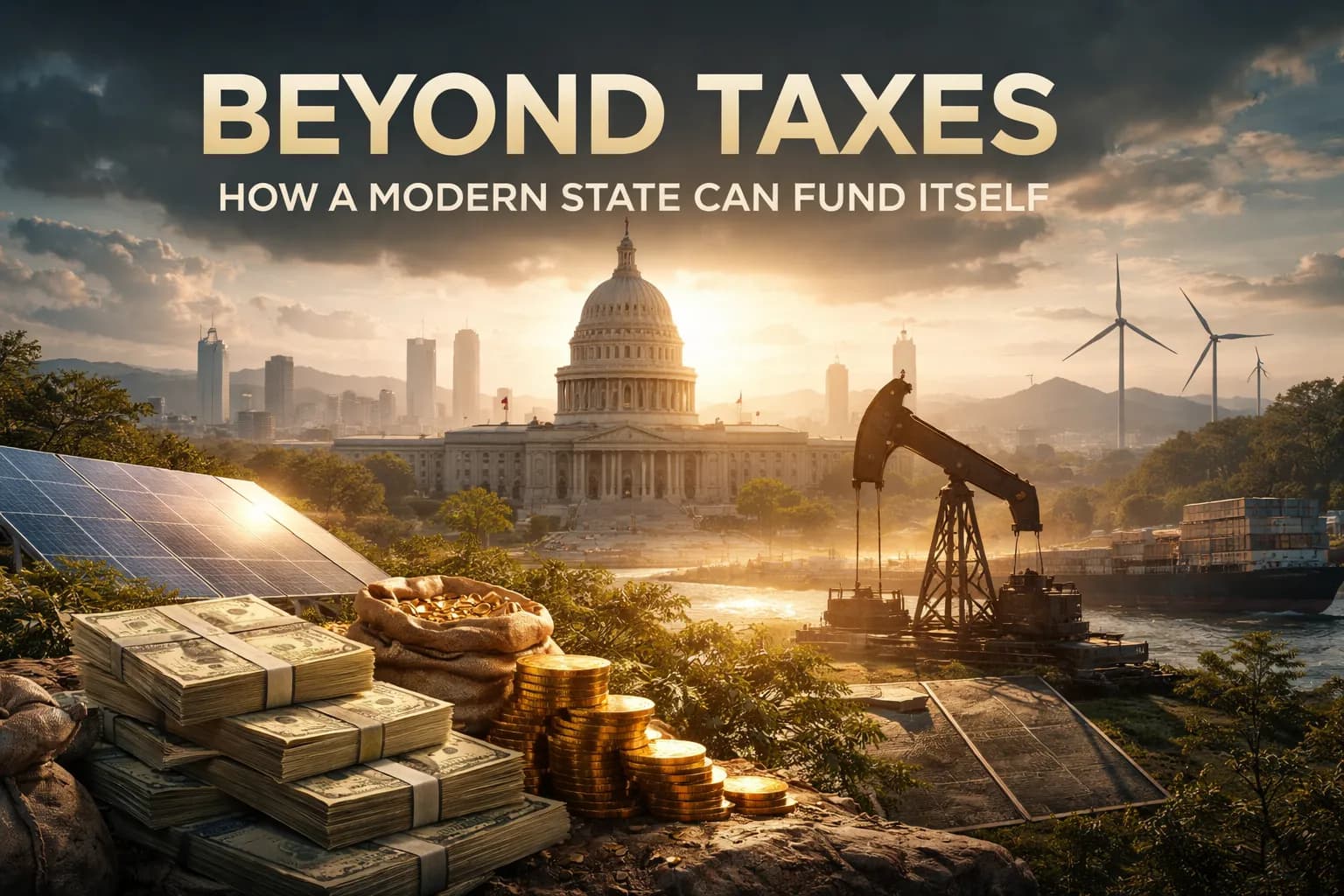
In the modern world, almost every country depends on taxes to run its government. People pay income tax on their salaries, sales tax on daily purchases, and other charges to support public services. These taxes are used to build roads, run hospitals, pay teachers, and maintain law and order. Over time, taxation became the main source of government income because it is stable and predictable. However, as populations grow and economies change, heavy dependence on taxes is creating serious pressure on ordinary citizens, especially the middle and lower classes.
Governments use taxes because they need a guaranteed way to collect money. If paying taxes were optional, many people would avoid them, and the system would collapse. Taxes allow governments to plan long-term projects such as highways, schools, and power plants. Even in countries like the United States and the United Kingdom, which issue their own currency, taxes are still important. They help control inflation, reduce inequality, and maintain trust in the national currency. This shows that taxes are not only about raising money but also about managing the economy.
Despite their importance, the current tax system has clear weaknesses. In many countries, taxes fall heavily on wages, small businesses, and everyday consumption. For example, a salaried worker pays income tax every month, while a poor family pays sales tax on food and electricity. At the same time, wealthy individuals who own large amounts of land or natural resources often pay far less in comparison to their wealth. This creates a system where hard work is punished while unearned income is protected. As a result, inequality increases, and public trust in the state weakens.
Another major challenge comes from technology and automation. Machines, artificial intelligence, and robots are replacing human labor in factories, offices, and even service industries. For example, automated checkouts in supermarkets and AI-based customer service systems are reducing the need for workers. When people lose jobs, they lose income, and governments collect less tax. This makes it clear that a system based only on taxing wages cannot survive in the long term.
One important alternative is for the state to act as an owner, not just a tax collector. In this model, the government earns income by owning productiveassets. Norway is a strong example of this approach. The Norwegian government owns oil resources and invests the profits through a national fund. The returns from this fund help pay for healthcare, education, and pensions. Similarly, Singapore owns major companies in sectors like transport, banking, and telecommunications. The profits from these companies allow the government to keep taxes relatively low while still providing high-quality public services.
A fairer tax system can also be created by taxing what no one created. Land, natural resources, rivers, and minerals are not produced by individuals; they are part of nature. For example, when land values rise because of nearby roads, markets, or cities, this increase is created by society, not the landowner. Taxing land value instead of labor encourages productive use of land and reduces speculation. Likewise, taxing pollution forces companies to pay for environmental damage instead of passing the cost to society.
As automation increases and traditional jobs become less secure, many economists support the idea of a citizen dividend or universal basic income. In this system, every citizen receives a regular payment from the state, regardless of employment. Alaska provides a real-world example, where residents receive an annual payment from oil revenues. This income helps families cover basic needs and reduces poverty. Such systems do not replace work but provide security and dignity in a changing economy.
The future of public finance does not require the complete removal of taxes. Instead, it requires balance and reform. Governments can reduce taxes on labor and small businesses while increasing income from public assets and natural resources. By combining fair taxation, public ownership, and citizen dividends, states can create a system that is more just and sustainable.
To conclude, taxes played a vital role in building modern states, but they should not become a heavy burden on hardworking people. As economies evolve, governments must also change their methods of funding. A system based on shared ownership, fair taxation, and public benefit can reduce inequality, strengthen trust, and create a more stable future. The true strength of a modern state lies not in how much tax it collects, but in how wisely it manages and shares its national wealth.
Uroosa Khan
Contributing writer at EUReflect.
Follow EUReflect
See more of our reporting on Google
Mark EUReflect as a preferred source and our stories are ranked higher for you in Top Stories, Discover and Google News — and carry a “preferred” badge when they are cited in AI results.
Add EUReflect as a preferred source