Bridge to the Balkans: The 2026 Bosnia and Herzegovina-BeNeLux FIRST Business Forum
Authors: Armanzhan Narbekov and Olha Horina. The Bosnia and Herzegovina Business Forum held in Brussels on March 27, 2026 highlighted the country’s economic potential in its EU integration process. Despite structural challenges, the recovering economy offers opportunities for investors, while the forum served as a key platform for new partnerships.
On March 27, 2026, Brussels became the epicenter of a new chapter in diplomatic and economic cooperation as the Embassy of Bosnia and Herzegovina hosted its first-ever Business Forum. This landmark event brought together government representatives, international investors, and multisectorial enterprises to explore the untapped potential of a nation standing at the doorstep of the European Union.
The Economic Foundation: From Resilience to Stability
The economic landscape of Bosnia and Herzegovina (BiH) has been shaped by a complicated history - from its role as the industrial and energy heart of socialist Yugoslavia to the devastating effects of the 1990s conflict. Following the 1992–1995 war, which saw industrial production plummet by 90%, the Dayton Agreements ushered in a period of recovery supported by over five billion dollars in international capital.
A cornerstone of this recovery was the 1998 introduction of the Convertible Mark (BAM). By establishing a fixed exchange rate—initially to the Deutsche Mark and later to the Euro - the country secured lasting currency stability and protection against hyperinflation. Today, BiH boasts a modern economic profile where the service sector generates over 50% of national income, complemented by strong traditional industries in metallurgy, woodworking, and electricity generation. In particular, the country remains one of the few net electricity exporters in the Balkans due to its abundant hydroelectric and thermal resources.
Navigating Structural Challenges
Despite an educated workforce and candidate status, the country’s unique political structure presents ongoing hurdles. The dual-entity system - comprising the Federation of Bosnia and Herzegovina and Republika Srpska - often leads to duplicated institutions and complex tax environments. Furthermore, the economy remains heavily reliant on diaspora remittances (contributing 10% to GDP), while the migration of young talent to Western Europe continues to challenge the local labor market and investor appeal.
The Path to the European Union
Bosnia and Herzegovina’s journey toward EU membership is one of the most significant geopolitical narratives in the Western Balkans. Since its formal application in 2016, the country has managed a challenging series of structural adjustments to align with EU conditions. A big breakthrough was reached in December 2022 when the European Council granted BiH candidate status, followed by the historic decision in March 2024 to open accession negotiations.
As of now, BiH is in the "Screening" stage, adapting its laws to the Acquis Communautaire. While challenges remain regarding judicial reforms and political synchronization between its entities, the "New Growth Plan for the Western Balkans" has provided a new engine. This plan offers BiH access to the EU Single Market even before full membership, provided it meets rigorous socio-economic reform agendas. For investors, this signifies a country transitioning from a "potential candidate" to a stabilizing, rules-based economy integrated with European standards.
A Vision of Transformation
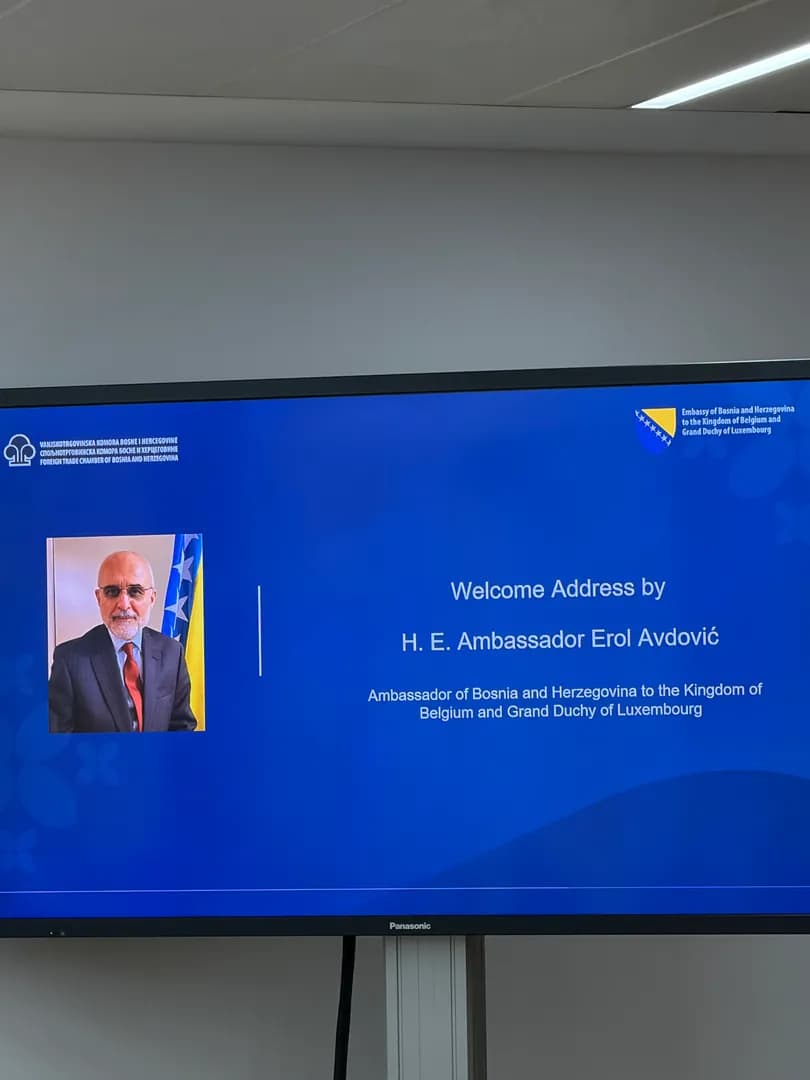
This transition was echoed by His Excellency Ambassador Erol Avdović, who emphasized in his welcoming speech that this momentum represents more than just a formal gathering; rather, it serves as a strategic platform for concrete partnerships and long-term cooperation.
"For us," the Ambassador noted, "the impact of EU integration goes beyond the political—it is, above all, an economic transformation."
Supporting this vision, Valentina Superti, Director for the Western Balkans at DG NEAR, highlighted the region's significant economic potential and the EU’s consistent commitment to its modernization. While acknowledging existing challenges, Superti pointed to the "vibrant ecosystem" for startups as a key driver, emphasizing that the path to regional well-being lies in deeper integration with EU private value chains and the single market.
The forum
At the first BiH forum, 19 companies were represented across 10 diverse sectors. These companies include key players from the metal industry (such as Igman d.d. Konjic), electronics, IT (Bloomteq), food and wine (HEPOK), and tourism, showcasing the breadth of the BiH economy. The company's representatives had a B2B meeting where they could connect and use the forum as a platform for new beginnings and cooperation. Approximately 80 participants attended the event, all seeking valuable opportunities for collaboration and business development and new connections. The 2026 Business Forum served as more than a networking milestone; it acted as a critical institutional bridge.
To conclude
The success of the 2026 Business Forum proves that BiH is no longer just a candidate country - it is a prospective EU partner ready to bridge the gap between Southeast Europe and the European market. Whether through the precision of its metal industry or the charm of its tourism sector, BiH is proving that its journey toward the Union is not just a political milestone, but an invitation to the world to discover one of Europe's most promising and resilient frontiers.
Armanzhan Narbekov
Contributing writer at EUReflect.
Follow EUReflect
See more of our reporting on Google
Mark EUReflect as a preferred source and our stories are ranked higher for you in Top Stories, Discover and Google News — and carry a “preferred” badge when they are cited in AI results.
Add EUReflect as a preferred source