China's National Computing Grid Builds the Infrastructure of the AI Age
A key innovation is the direct connection between desert solar and wind farms and data centers, bypassing the grid to cut costs and carbon emissions.
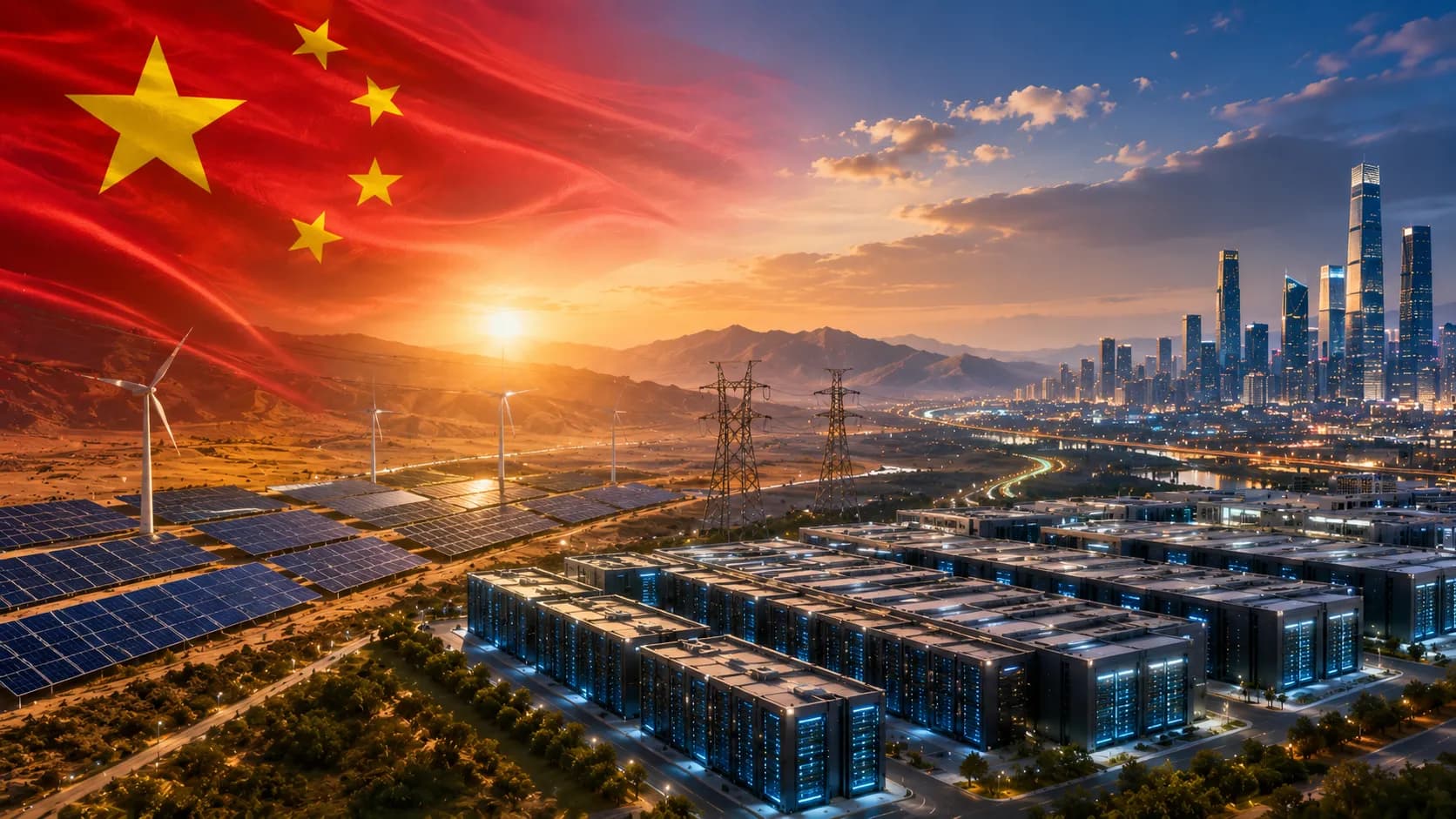
The invisible front of the AI race is energy and data centre infrastructure — and China is running a project on this front that has no parallel in the world. Launched at full scale in 2022, the "Eastern Data, Western Computing" (EDWC) project aims to channel the dense computing demand of the eastern coast, in an orderly fashion, towards the western regions rich in renewable energy. Under the project, a total of eight national computing power hub nodes are being built — in eastern centres such as Beijing-Tianjin-Hebei, the Yangtze River Delta, and the Guangdong-Hong Kong-Macao Greater Bay Area, as well as in Chengdu-Chongqing, Guizhou, Inner Mongolia, Gansu, and Ningxia.
The Grid in Numbers: 6.1 Billion Dollars, 20 Milliseconds, 1.04 Efficiency
The project's technical report card is strong. According to official statements, more than 6.1 billion dollars has been invested in major computing hubs; network latency between the eastern and western nodes has generally met the 20-millisecond requirement, while the power usage effectiveness (PUE) of newly established data centres has been reduced to as low as 1.04 — an efficiency well above global industry averages. Upon completion of all nodes and hubs, total computing power is targeted to reach 300 EFLOPS, with intelligent (AI) computing exceeding a 35 per cent share; according to the government-backed think tank CCID, the number of data centres built or under construction has surpassed 250.
The Energy Advantage: Direct Green Electricity from the Desert to the Data Centre
The project's real trump card is energy infrastructure. In 2024 alone, China added 429 GW of net new power generation capacity, reaching more than 15 times the capacity added by the United States in the same period — a structural answer to the power problem that is the biggest bottleneck for AI data centres. Commissioned in May 2026, the country's first large-scale "computing-power coordination" project — the 500,000 kW Datang Zhongwei photovoltaic power station — connected desert wind and solar resources to the data centre in Ningxia via a direct line. According to analysts, this model resolves the geographic mismatch between renewable generation concentrated in the west and data demand concentrated in the east, and is accelerating the direct sale of renewable electricity to data centres through "Green Power Industrial Park" policies.
Risks and Debates: Oversupply or Strategic Reserve?
The scale of the project also brings a debate over oversupply. Warnings are being voiced that the state's enthusiastic involvement could lead to inefficient capacity use and that some data centres sit idle. Yet the same assessments also note that computing demand will surge as AI technologies advance and that, in a growth phase, excess capacity is preferable to shortage; official planning likewise foresees cities piloting different technical routes over the next two to three years in pursuit of the best national solution.
Conclusion
Eastern Data, Western Computing is read as the digital-age successor to China's continent-scale engineering projects such as the West-East Gas Pipeline and the South-North Water Transfer. With eight hub nodes, a 300 EFLOPS target, record efficiency figures, and direct green electricity lines running from the desert to the data centre, the project turns cheap and abundant computing power — the decisive input of the AI race — into a national grid. While the model race makes the headlines, the real big move at the infrastructure layer of that race is quietly rising in China's west.
Botakoz Unbayeva
Contributing writer at EUReflect.
Follow EUReflect
See more of our reporting on Google
Mark EUReflect as a preferred source and our stories are ranked higher for you in Top Stories, Discover and Google News — and carry a “preferred” badge when they are cited in AI results.
Add EUReflect as a preferred source