EU Tightens Migration Control
Irregular border crossings into the EU fell by 37% in the first seven months of 2026 compared with the same period last year, according to preliminary Frontex data.
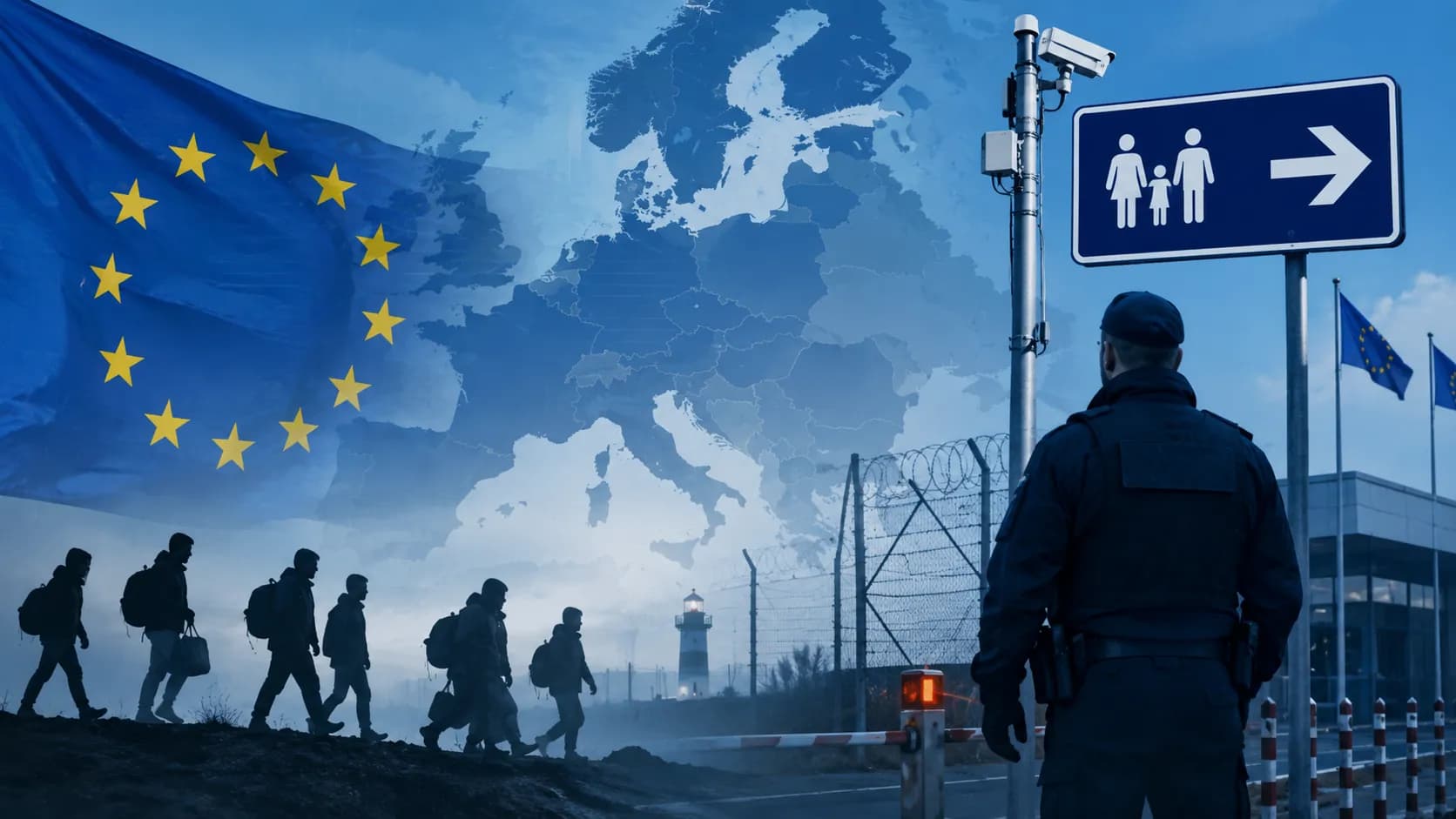
The European Union is entering a new phase in its struggle with irregular migration. Although illegal border crossings have fallen sharply in 2026, recent pressure at the bloc’s southern borders has shown that migration remains one of Europe’s most difficult political and security challenges.
Preliminary Frontex data indicate that irregular border crossings into the EU fell by 37% in the first seven months of 2026 compared with the same period of 2025, to approximately 61,000 detections. Most major migration routes recorded declines, although the Eastern and Central Mediterranean remained the busiest corridors.
The decline is significant, but it does not mean that Europe’s migration problem has disappeared. Instead, the challenge is increasingly shifting from the total number of arrivals toward sudden migration surges, border management, secondary movements inside the Schengen area and the return of people who have no legal right to remain.
Ceuta Puts Europe on Alert
That vulnerability became particularly visible at the end of July when Spain’s North African enclave of Ceuta experienced an exceptional mass movement across the EU’s external border.
The incident immediately pushed irregular migration back to the top of the European political agenda. EU interior ministers subsequently called for stronger action against migrant-smuggling networks, more effective returns and deeper cooperation with countries outside the Union.
The European Commission has since said that Spanish and Moroccan authorities must maintain control of the situation and that people remaining illegally in Ceuta should be returned according to applicable rules. Brussels has also offered financial and operational assistance, including possible support from Frontex, Europol and the EU Agency for Asylum.
The episode demonstrated one of the fundamental characteristics of contemporary migration toward Europe: overall numbers can decline while individual border regions remain vulnerable to sudden and concentrated pressure.
A New Migration System Is Now in Force
Europe is confronting these pressures under a substantially different legal framework.
The EU Pact on Migration and Asylum entered into application on June 12, 2026, following a two-year implementation period. The package introduces common procedures for screening and registering irregular arrivals, faster asylum and return procedures and clearer rules determining which member state is responsible for an asylum application.
Irregular arrivals are now subject to identity, security, health and vulnerability checks. Screening at the EU's external borders generally has to be completed within seven days.
The system also introduces mandatory border procedures for certain applicants, including people considered unlikely to qualify for international protection and individuals presenting security concerns.
Perhaps most importantly politically, the new framework attempts to distribute migration pressure more evenly across the Union.
Countries facing disproportionate pressure can receive assistance through relocation, financial contributions or other forms of solidarity from fellow member states.
The Commission's first assessment, published in July, found considerable progress in implementation, while also identifying areas where additional work remains necessary.
Returns Become the Next Major Issue
Reducing arrivals is only one part of Europe's strategy.
The EU is increasingly focusing on what happens after an asylum application is rejected.
In June, the Council and European Parliament reached a provisional agreement on new common rules intended to accelerate the return of third-country nationals who have no legal right to stay in the Union.
The proposed framework strengthens obligations for individuals to cooperate with authorities and provides mechanisms for greater coordination between EU governments. It also creates the possibility of establishing return hubs outside the EU, subject to legal and fundamental-rights safeguards.
This represents a significant development in European migration policy.
For years, the political debate concentrated heavily on preventing irregular arrivals. The emerging approach combines prevention with faster asylum decisions, stronger external borders and more effective return mechanisms.
Schengen Faces Internal Pressure
Irregular migration is also influencing Europe's internal borders.
Several Schengen countries currently maintain temporary border controls, citing migration, smuggling, security concerns or pressure on asylum systems among their reasons.
Germany, Austria, Poland and the Netherlands are among the countries maintaining controls affecting parts of their internal Schengen borders. Following the recent Ceuta developments, Spain and Italy also introduced temporary controls affecting travel between the two countries.
This creates a difficult balance for Brussels.
The EU wants stronger external border protection without undermining one of its greatest achievements: free movement inside the Schengen area.
If governments increasingly respond to migration pressure by restoring national border controls, the economic and political costs could extend far beyond migration policy itself.
Europe Moves Toward Prevention
The direction of EU policy is therefore becoming increasingly clear.
Europe is attempting to move from crisis management toward prevention: detecting irregular movements earlier, strengthening cooperation with neighbouring and transit countries, disrupting smuggling networks, accelerating border procedures and increasing returns.
The numbers suggest that irregular migration is currently moving downward. EU Council data recorded 45,077 irregular arrivals through the main routes during the first six months of 2026.
Yet the Ceuta episode demonstrated how quickly the situation can change.
For the European Union, the central challenge is therefore no longer simply how many migrants reach Europe. It is whether the bloc can create a system capable of absorbing sudden pressure without producing political confrontation between member states or weakening the Schengen system.
The success or failure of the new Migration and Asylum Pact will increasingly be judged against that standard.
Ahmet Balakan
Contributing writer at EUReflect.
Follow EUReflect
See more of our reporting on Google
Mark EUReflect as a preferred source and our stories are ranked higher for you in Top Stories, Discover and Google News — and carry a “preferred” badge when they are cited in AI results.
Add EUReflect as a preferred source