Migration Routes Are Shifting
Despite a 37% drop in irregular crossings, Frontex data shows the Eastern Mediterranean is now the busiest route, with over 20,000 detections in the first seven months of 2026.
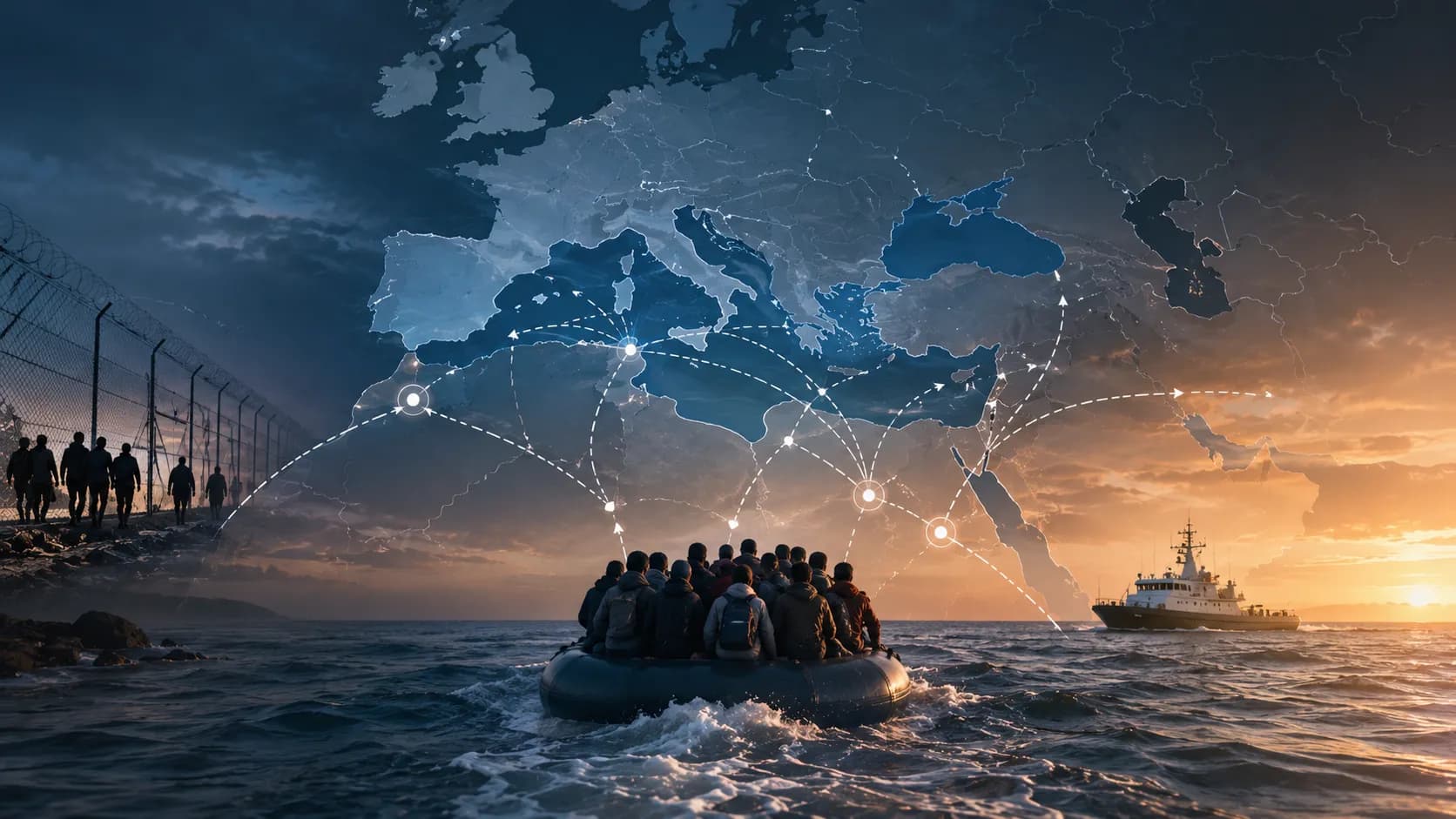
Irregular migration remains one of the most difficult international challenges of 2026, even as the number of people detected entering Europe through irregular routes has fallen sharply.
The latest figures reveal an important contradiction: overall crossings are declining, but migration routes are shifting and the human cost remains extremely high.
Conflict, economic instability, political insecurity and limited legal migration opportunities continue to push people from Africa, the Middle East and parts of Asia toward Europe, while governments are strengthening border controls and expanding cooperation with transit countries.
EU Crossings Fall Sharply
Preliminary data from Frontex show that approximately 61,000 irregular border crossings were detected at the European Union's external borders during the first seven months of 2026.
That represents a 37 percent decline compared with the same period in 2025.
The decline, however, is not evenly distributed.
The Eastern Mediterranean was the busiest route, recording 20,232 detections, while the Central Mediterranean recorded 16,454. Together, the two corridors accounted for around 60 percent of irregular entries detected by Frontex.
The Central Mediterranean experienced a particularly significant 55 percent decline, with Libya remaining its main country of departure.
Meanwhile, the Western Mediterranean moved in the opposite direction, becoming the only major European migration route to record an increase.
The Mediterranean Remains Deadly
Lower migration numbers have not eliminated the humanitarian crisis at sea.
The International Organization for Migration's latest European tracking data recorded 63,340 arrivals in Europe by August 24, including 51,834 by sea and 11,506 by land.
More importantly, IOM has recorded 2,077 people dead or missing on migration routes to Europe in 2026.
The Central Mediterranean remains the deadliest route, with 914 recorded deaths or disappearances, followed by the Western Mediterranean, Eastern Mediterranean and Western African/Atlantic routes.
The EU Agency for Fundamental Rights reported that at least 559 people died or disappeared on Mediterranean and Atlantic routes between April and June alone, describing the beginning of 2026 as exceptionally deadly despite falling arrival numbers.
Tunisia Shows the Continuing Danger
A new tragedy off Tunisia has again demonstrated how dangerous these journeys remain.
A boat carrying migrants toward Italy sank off Tunisia's southeastern coast last week. Tunisian authorities recovered 11 bodies, while only one person was reported rescued and several others remained missing.
Tunisia has become an important part of Europe's strategy to reduce departures across the Mediterranean.
European cooperation with Tunisia and other North African governments has contributed to stronger border controls, but human-rights organizations continue to question whether these policies adequately protect migrants and asylum seekers.
North Africa Becomes the Front Line
Migration management is increasingly taking place before migrants reach European territory.
Algeria and Mauritania recently reported intercepting or rescuing more than 500 irregular migrants attempting to move toward Europe.
Algerian authorities alone said they prevented 223 people from attempting maritime crossings between August 12 and 18 and detained another 211 irregular migrants elsewhere in the country.
This reflects a broader transformation in European migration policy.
Instead of concentrating exclusively on Europe's external borders, governments are increasingly cooperating with countries of origin and transit to prevent irregular journeys before migrants reach the Mediterranean.
Migration Pressure Is Moving, Not Disappearing
The 2026 figures therefore should not simply be interpreted as the end of Europe's migration crisis.
The Western African route fell by 60 percent, the Central Mediterranean by 55 percent and the Eastern Mediterranean by 28 percent during the first seven months of the year. Yet pressure increased along the Western Mediterranean, while major incidents demonstrated how quickly individual borders can come under pressure.
Migration networks adapt to border controls.
When one corridor becomes more difficult, dangerous or expensive, smugglers and migrants may search for alternatives. That can redirect pressure toward different countries rather than eliminating the underlying movement.
A Global Challenge Beyond Borders
The deeper challenge is therefore not simply how many people cross a particular border.
Irregular migration increasingly connects conflict, demographic pressures, economic inequality, organized smuggling networks, climate vulnerability, border security and humanitarian protection.
Governments can strengthen borders and reduce individual routes. But unless countries also address conditions driving migration and expand workable legal pathways, irregular movements are likely to continue adapting.
The emerging picture in 2026 is therefore clear:
Irregular migration is declining on several major routes, but it is not disappearing. It is changing direction — while the journey itself remains dangerously lethal.
Ahmet Balakan
Contributing writer at EUReflect.
Follow EUReflect
See more of our reporting on Google
Mark EUReflect as a preferred source and our stories are ranked higher for you in Top Stories, Discover and Google News — and carry a “preferred” badge when they are cited in AI results.
Add EUReflect as a preferred source