EU–India: A trade agreement concluded at the cost of major political compromises
The EU–India free trade agreement signed on 27 January 2026 concludes two decades of negotiations. Beyond trade liberalisation, it reflects strategic convergence, aiming to diversify partnerships, boost investment and technology flows, and manage skilled labour mobility in a fragmented global order.
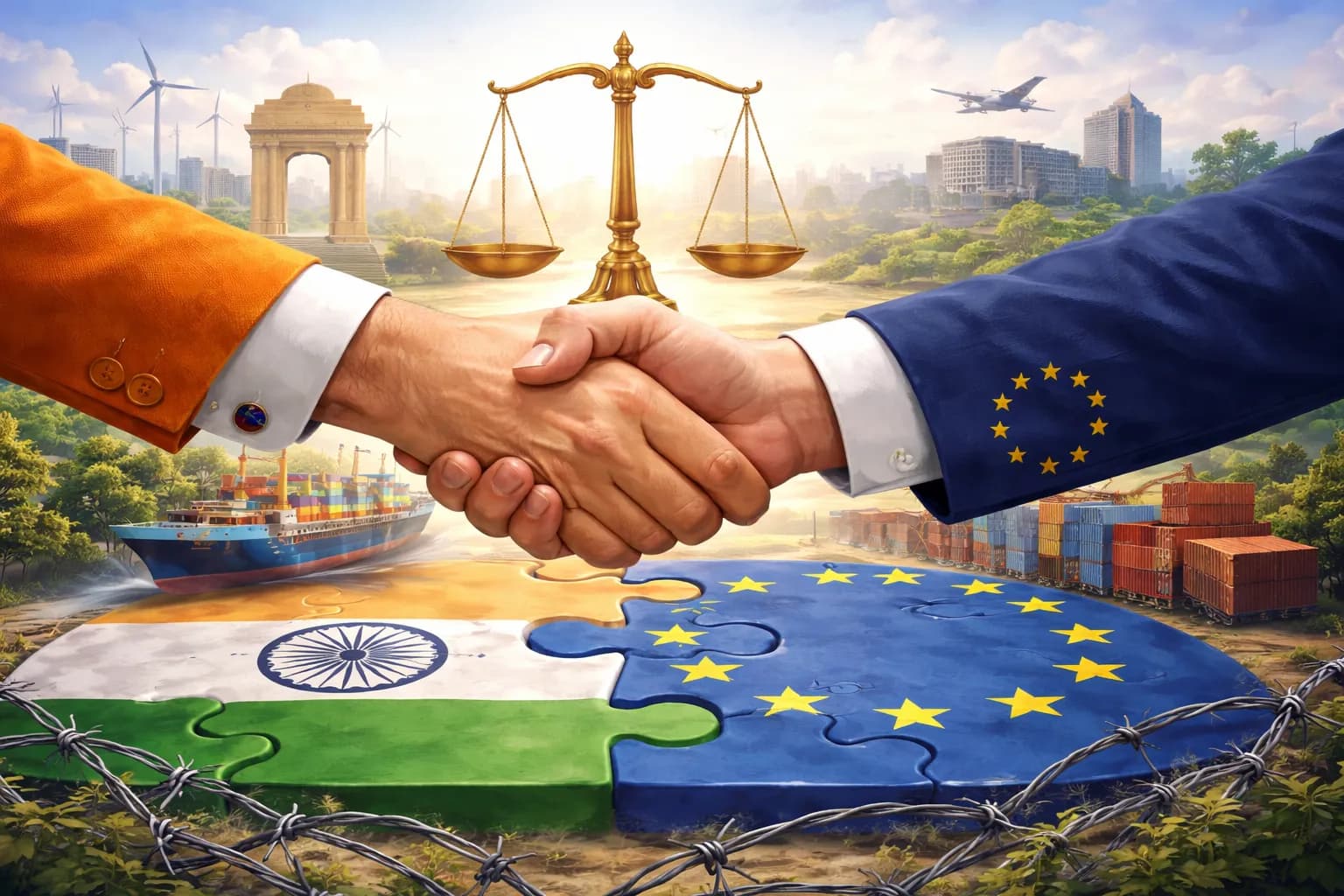
The conclusion, on 27 January 2026 in New Delhi, of the free trade agreement between the European Union and India marks the end of a long and difficult negotiation process that began nearly twenty years ago. Presented as “historic” by both sides, the agreement primarily reflects a strategic convergence shaped by an unstable international environment and the shared need to diversify economic partnerships.
From the European perspective, the agreement fits into a broader effort to reduce certain trade dependencies and to strengthen the EU’s presence in the Indo-Pacific region. For India, the objective is twofold: attracting European investment and technology while consolidating its status as an emerging economic power, without committing to exclusive alignment with any single geopolitical bloc.
One of the most striking elements of the agreement concerns India’s concessions on market access. Customs duties on European cars will be gradually reduced from 110% to 10%, while tariffs on wines will fall from 150% to 20%. Long considered politically sensitive, these reductions open new opportunities for European exporters, while transition periods are intended to limit disruption for domestic producers.
The decisive compromise, however, was reached on the issue of professional mobility. In order to unlock the negotiations, the European Union agreed to a Mobility Pact, facilitating visas for Indian students, researchers and highly skilled workers, particularly in the fields of information technology and engineering. While this responds to a long-standing Indian demand, it remains politically sensitive for several EU Member States.
By contrast, agriculture was deliberately excluded from the most sensitive aspects of the agreement. Products such as beef, rice, sugar and poultry are not covered, in order to avoid the type of political backlash seen in other trade negotiations, notably with Mercosur. On climate issues, a cooperation protocol will accompany the adaptation of Indian industry to European standards, easing concerns related to the EU’s carbon border adjustment mechanism.
More than a purely commercial deal, the EU–India agreement thus appears as a pragmatic political compromise, reflecting shifting strategic priorities in an increasingly fragmented international order.
Sources
Commission européenne, EU–India Trade Agreement
Commission européenne, Factsheet on EU–India Free Trade Agreement and agri-food exports
News on Air, India–EU exchange on historic Free Trade Agreement
NDTV, What will be cheaper after India–EU pact?
Enes Taskin
Contributing writer at EUReflect.
Follow EUReflect
See more of our reporting on Google
Mark EUReflect as a preferred source and our stories are ranked higher for you in Top Stories, Discover and Google News — and carry a “preferred” badge when they are cited in AI results.
Add EUReflect as a preferred source