EU–India: a trade agreement concluded through hard- fought compromises, signalling a strategic shift
Signed on 27 January 2026, the EU–India free trade agreement ends two decades of talks. It reflects strategic convergence through selective market access, protected agriculture, mobility concessions, and climate cooperation, prioritising political balance over full liberalisation.
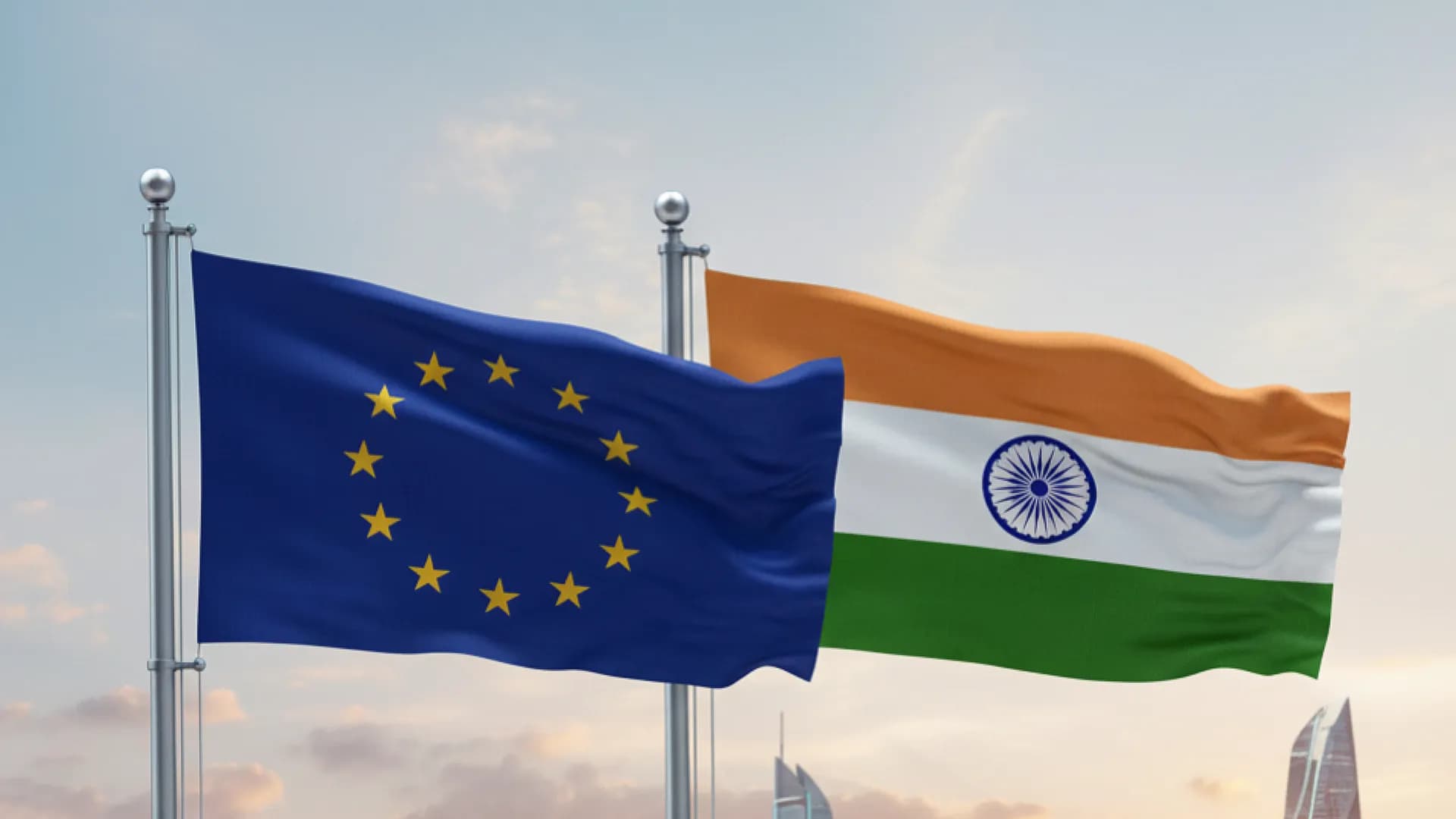
The signing on 27 January 2026 in New Delhi of the free trade agreement between the European Union and India marks the culmination of nearly two decades of intermittent negotiations. Presented by both sides as a “historic” agreement, it reflects not only a growing strategic convergence but also a series of carefully calibrated political compromises.
An agreement concluded amid heightened geopolitical tensions
The finalisation of the agreement comes at a time of profound international instability. The war in Ukraine, intensifying Sino-American rivalry, and the fragmentation of global trade have strengthened the European Union’s determination to diversify its economic partnerships and reduce certain strategic dependencies. India has increasingly emerged as a key partner, owing to its demographic weight, economic potential and non-aligned diplomatic posture.
For New Delhi, the agreement serves a dual purpose. On the one hand, it supports India’s strategy of attracting European investment and technology. On the other, it allows the country to consolidate its position in the global economy without becoming overly dependent on any single power bloc.
Automotive and wines: unprecedented Indian concessions
One of the most striking elements of the agreement concerns access to the Indian market for European products. India agreed to a historic reduction in customs duties on cars, which will be gradually lowered from 110% to 10%, as well as on wines, with tariffs falling from 150% to 20%. Long considered politically untouchable in New Delhi, these concessions underline the importance attached to concluding the agreement.
For the European Union, these measures create tangible opportunities for its automotive and wine industries while strengthening its economic footprint in a rapidly growing market. For India, the gradual implementation timetable is designed to mitigate the impact on domestic producers.
Professional mobility: the decisive compromise
The political turning point of the agreement lies in the issue of professional mobility. In order to break the deadlock in negotiations, the European Union accepted a Mobility Pact, facilitating visas for Indian students, researchers and highly skilled workers, particularly in information technology and engineering.
This compromise addresses a long-standing Indian demand and represents a strong political signal. However, it has also raised concerns in several EU Member States, where migration remains a highly sensitive political issue. The agreement therefore reflects a clear trade-off between economic needs, labour market considerations and domestic political constraints.
Agriculture deliberately protected: an “anti-Mercosur” agreement
Unlike other recent trade agreements, agriculture was deliberately kept out of the most sensitive areas of liberalisation. To avoid the political tensions observed during the Mercosur negotiations, products such as beef, rice, sugar and poultry were excluded from the agreement. This approach aims to protect both European farmers — particularly in France — and India’s agricultural sector, which remains socially and politically central.
This “anti-Mercosur” dimension illustrates the EU’s attempt to draw lessons from past internal divisions and to prioritise a politically sustainable compromise over comprehensive liberalisation.
Climate and the CBAM: defusing confrontation
Another sensitive issue concerned the EU’s Carbon Border Adjustment Mechanism (CBAM). Rather than pursuing a confrontational approach, the two sides agreed to launch, in early 2026, a climate cooperation protocol designed to help Indian industry adapt to European standards.
This arrangement allows the European Union to maintain its climate ambitions while reducing perceptions of the CBAM as a punitive or protectionist tool. For India, it provides both political and technical flexibility in responding to European environmental requirements.
A fundamentally political agreement
Beyond its economic implications, the EU–India free trade agreement should be understood as a political act. It formalises a strategic rapprochement between two actors seeking to defend their interests in an increasingly fragmented international order. Far from being an ideal or fully liberalised agreement, it is built on explicit compromises that reveal the priorities and red lines of both sides.
Conclusion
The conclusion of the EU–India free trade agreement does not mark the end of debate, but rather the beginning of a new phase in bilateral relations. By combining targeted concessions, sectoral protections and strategic cooperation, the agreement reflects a pragmatic approach to international trade, in which economic objectives remain inseparable from political considerations.
Enes Taskin
Contributing writer at EUReflect.
Follow EUReflect
See more of our reporting on Google
Mark EUReflect as a preferred source and our stories are ranked higher for you in Top Stories, Discover and Google News — and carry a “preferred” badge when they are cited in AI results.
Add EUReflect as a preferred source