Europe Bets Big on Tech
The EU's new AI Gigafactories initiative will channel up to €10 billion in public funds, aiming to mobilize an additional €20 billion from private investors.
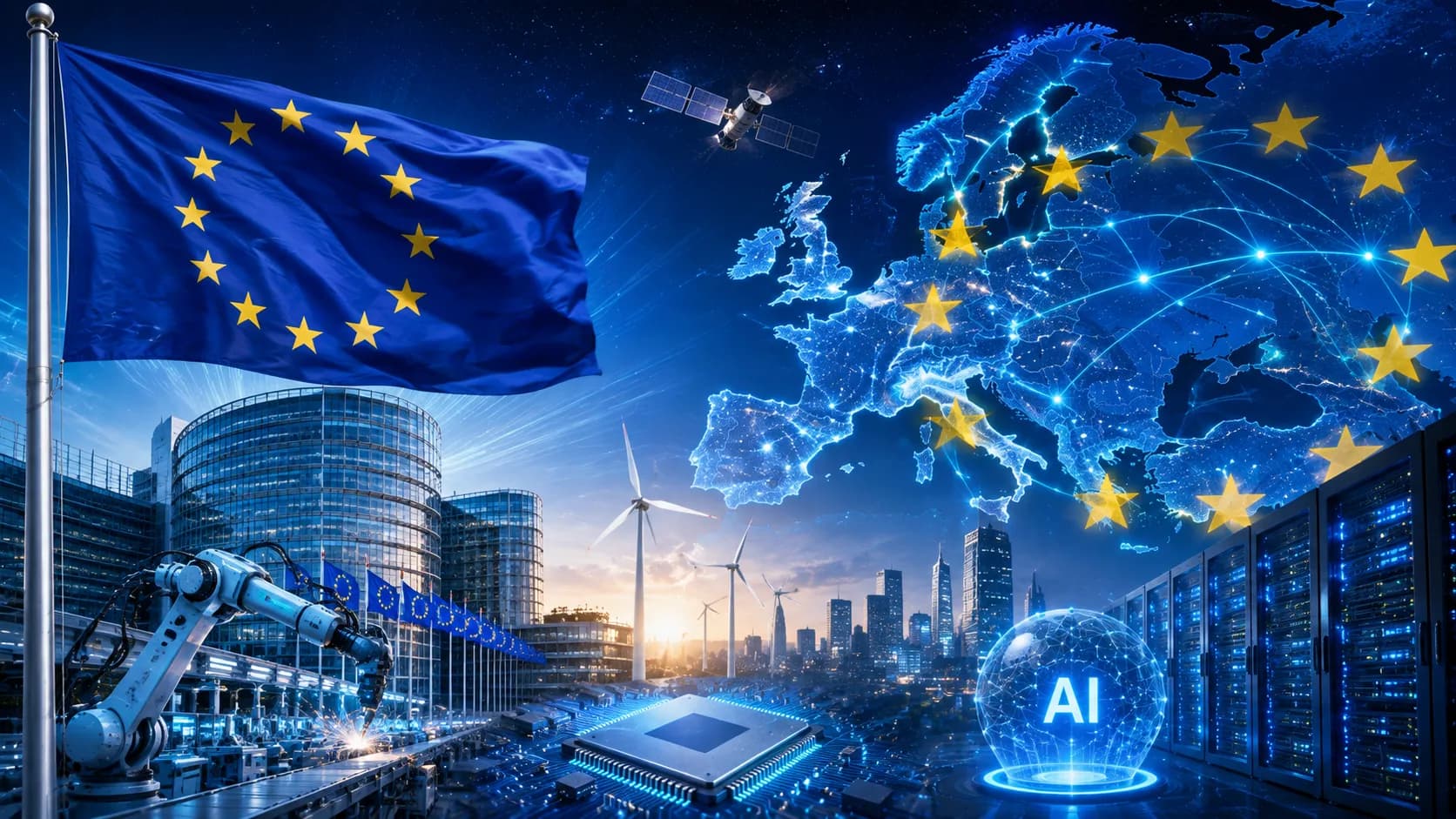
The European Union is accelerating financial support for technology investment in 2026 as Brussels attempts to close the innovation gap with the United States and China and reduce Europe's dependence on foreign semiconductors, cloud infrastructure and artificial intelligence.
The policy is increasingly moving beyond traditional research grants. The EU is now combining direct grants, equity investment, public loans, guarantees and public-private financing to encourage companies to develop and scale strategic technologies inside Europe.
The clearest example came in July, when the European Commission launched a call to establish up to seven AI Gigafactories. The projects will receive up to €10 billion in EU and national public support, which Brussels expects to mobilize at least another €20 billion in private investment.
AI Becomes the Main Investment Priority
Artificial intelligence has moved to the center of Europe's technology strategy.
The planned AI Gigafactories will combine advanced processors, large-scale computing infrastructure, cloud systems, high-speed connectivity and energy-efficient data centers.
Unlike ordinary data centers, they are intended to provide the enormous computing capacity required to train and operate advanced AI models.
The initiative will complement Europe's existing network of 19 AI Factories, while giving European startups, scaleups, researchers and industrial companies access to computing infrastructure that would otherwise require enormous private investment.
This represents a significant change in European industrial policy.
Brussels is effectively treating computing power as strategic infrastructure, comparable in importance to energy, transportation and telecommunications.
€5 Billion to Keep European Startups in Europe
Europe's problem is not simply creating technology companies.
It is keeping successful companies in Europe once they begin to grow.
European startups have historically faced a financing gap compared with American competitors, particularly when they need hundreds of millions of euros to expand internationally.
The EU formally established the Scaleup Europe Fund this month to address that weakness. The fund targets approximately €5 billion and is designed to provide growth capital to promising European technology companies capable of becoming global leaders.
The strategic objective is straightforward: European companies should not need to relocate, sell themselves to foreign corporations or depend entirely on non-European capital simply because they have reached the scale-up stage.
Deep-Tech Companies Can Receive Up to €30 Million
The European Innovation Council is also becoming an increasingly important investment vehicle.
Its 2026 work programme provides more than €1.4 billion across several financing schemes supporting breakthrough technologies and innovative companies.
The EIC Accelerator alone has a €634 million budget, combining grants with equity investments for startups and SMEs.
Another €300 million has been allocated to the STEP Scale Up programme. Individual companies can receive between €10 million and €30 million in equity investment, with the objective of attracting much larger private financing rounds.
In July, six European technology companies were selected for potential investments totaling €97 million. Their technologies include AI processors, sovereign data-center CPUs, laser communications, battery recycling and infrastructure for next-generation AI computing.
The EU therefore increasingly wants public capital to act as a catalyst rather than the sole source of financing.
A €20 million European investment, for example, can be structured to help a company attract a €100 million private funding round.
Semiconductors Remain Strategic
Chips are another major priority.
The original European Chips Act aims to strengthen semiconductor research, design, manufacturing and advanced packaging inside the EU.
The EU budget provides up to €3.3 billion for the Chips for Europe Initiative, split between Horizon Europe and the Digital Europe Programme.
But Brussels now believes further intervention is necessary.
In June, the Commission proposed Chips Act 2.0 as part of a broader European Technological Sovereignty Package covering semiconductors, AI, cloud computing and open-source technology.
The strategic motivation is clear.
Europe currently accounts for only around 9 percent of the global semiconductor market, while its 2030 objective remains 20 percent.
The semiconductor incentives are therefore not simply economic subsidies. They are increasingly considered part of European economic-security policy.
The EIB Becomes Europe's Technology Bank
The European Investment Bank is also playing a much larger role.
Through its TechEU programme, the EIB Group is using loans, guarantees, venture debt, equity and private-sector partnerships to increase financing for European technology.
In June alone, the EIB Group approved €7.9 billion in financing, including €3 billion under TechEU for projects supporting technological leadership, digital connectivity and research.
The EIB has also expanded the European Tech Champions Initiative, which is designed to mobilize institutional investors for European technology scaleups.
Another €500 million lending envelope has been approved specifically to support SMEs and mid-sized companies operating in the European space industry.
This means European technology companies increasingly have access to financing instruments extending far beyond traditional EU grants.
Cloud Infrastructure Becomes a Sovereignty Issue
Cloud computing represents another major European vulnerability.
A significant share of Europe's cloud infrastructure depends on non-European providers.
The Commission's proposed Cloud and AI Development Act therefore aims to accelerate investment in European data centers and next-generation cloud infrastructure while creating an EU-wide framework for technological sovereignty.
The legislation focuses on three areas: research and innovation, expanding computing capacity, and strengthening European technological autonomy.
The underlying idea is that Europe cannot realistically become an AI power if the computing infrastructure required to operate European AI systems remains overwhelmingly dependent on foreign technology.
Public Money Is Being Used to Attract Private Capital
The broader strategy reveals an important transformation in EU economic policy.
Europe is no longer relying primarily on regulation to shape the technology industry.
It is increasingly attempting to finance the technologies it wants Europe to control.
Member states' Digital Decade roadmaps now contain 1,934 measures worth €289.3 billion, including approximately €205.9 billion from public budgets.
The priorities include AI, semiconductors, quantum computing, cybersecurity, cloud infrastructure, advanced connectivity, clean technologies, biotechnology and space.
The EU is also increasingly willing to support technologies with both civilian and military applications. Since June, parts of the European Innovation Council have been opened to dual-use and defense technologies, including a dedicated €100 million STEP Scale Up Defence call.
Europe Is Changing Its Economic Model
For decades, the European technology debate focused heavily on creating common rules and regulating markets.
That approach is changing.
The competition with the United States and China has convinced European policymakers that regulation alone cannot create technological sovereignty.
Europe needs factories, chips, data centers, AI computing infrastructure, venture capital and globally competitive technology companies.
The emerging model therefore combines regulation with industrial policy and strategic financing.
The success of this strategy will ultimately depend on whether European incentives can generate companies capable of competing globally rather than companies permanently dependent on subsidies.
But the direction is increasingly clear.
Europe is beginning to treat technological capacity not simply as an economic sector, but as a strategic asset — and public money is becoming one of its main instruments for building it. (digital-strategy.ec.europa.eu)
Alvara Merrick
Contributing writer at EUReflect.
Follow EUReflect
See more of our reporting on Google
Mark EUReflect as a preferred source and our stories are ranked higher for you in Top Stories, Discover and Google News — and carry a “preferred” badge when they are cited in AI results.
Add EUReflect as a preferred source