France Rewrites Its Post-Colonial Strategy
France is pivoting from its former Francophone colonies to new partners like Kenya, seeking to shed colonial baggage and compete with China and Türkiye.
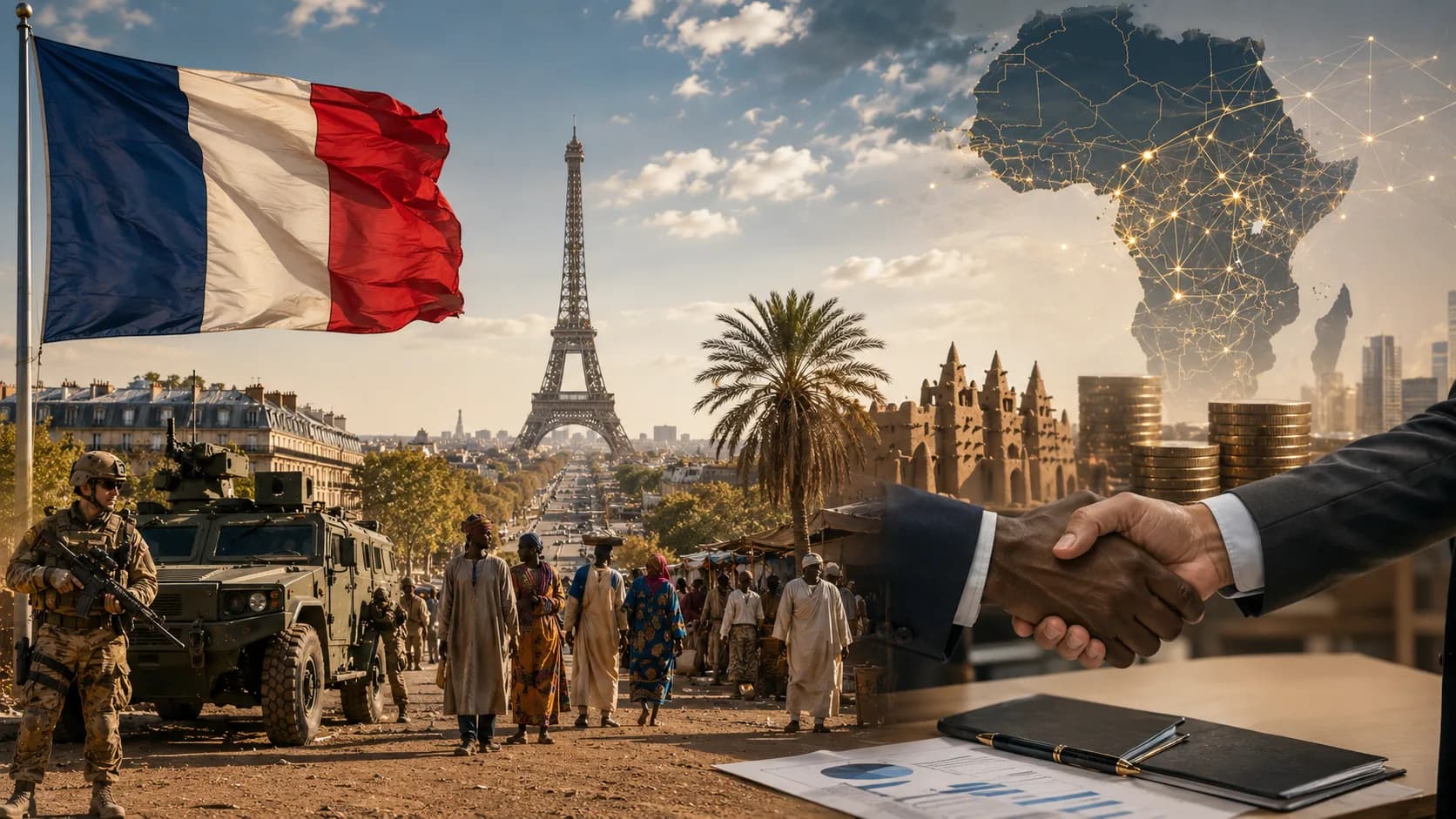
France is being forced to redefine its global influence as the political, military and economic structures that once connected Paris to its former colonies face growing resistance.
The change is particularly visible in Africa. For decades after formal decolonization, France maintained extensive military bases, political relationships, monetary arrangements and commercial networks across its former African territories—a system commonly associated with the term “Françafrique.”
In April 2026, even the French National Assembly's Foreign Affairs Committee described France as operating in a “postcolonial world” and acknowledged that, after decolonization, Paris retained substantial military, political and economic influence in what had long been considered its privileged sphere of influence.
The central question today is therefore no longer whether France still possesses influence in its former colonial territories. It is whether Paris can preserve that influence without reproducing relationships increasingly criticized as colonial or neo-colonial.
The Old French Model Is Weakening
The most dramatic transformation has occurred in the Sahel.
France once maintained one of the strongest foreign military networks in West and Central Africa. Counter-terrorism operations and bilateral defense agreements gave Paris considerable strategic influence.
That architecture has largely collapsed.
French forces withdrew from Mali following deteriorating relations with the military government. Similar political transformations subsequently reduced the French military presence in Burkina Faso and Niger.
By summer 2025, France had transferred several permanent military facilities in West and Central Africa, forcing Paris to reorganize its entire African defense structure. The French military itself describes the process as a fundamental restructuring of its presence on the continent.
The significance goes beyond military bases.
For many African governments, removing permanent French forces became a symbolic declaration that the post-independence relationship with Paris had to change.
France Is Moving Beyond Francophone Africa
Paris has responded by changing geography.
Instead of concentrating overwhelmingly on its former colonies in Francophone West Africa, France is increasingly developing partnerships with countries where it carries less colonial baggage.
Kenya has become an important example.
In May, President Emmanuel Macron participated in France's first major Africa summit held in an English-speaking African country. Paris has also been developing a new defense agreement with Nairobi.
This represents an important strategic shift.
France increasingly wants to present itself not as the former colonial power managing a privileged African sphere, but as one international partner among several competing for African cooperation.
That competition is becoming intense.
China offers infrastructure and investment. Türkiye has expanded diplomatic, commercial and defense relations. Gulf states are increasing investment, while Russia has developed security relationships with several governments that previously cooperated closely with France.
African states consequently have more alternatives than they did several decades ago.
The CFA Franc Debate Has Not Disappeared
Money remains another sensitive part of France's colonial legacy.
France continues monetary cooperation with the West African Economic and Monetary Union, the Central African Economic and Monetary Community and the Comoros.
Important reforms have already reduced direct French involvement in the West African CFA framework. The requirement to centralize foreign-exchange reserves at the French Treasury was abolished, and France withdrew from relevant governance bodies.
However, the exchange-rate arrangement remains linked to the euro, while France continues to guarantee convertibility.
Paris argues that participation is voluntary and that African states remain sovereign over their monetary choices.
Critics, however, continue to see the CFA system as a symbol of the economic structures created during colonial rule.
The controversy illustrates the broader challenge confronting France: institutions can be legally reformed while their historical symbolism remains politically powerful.
Algeria Shows Why History Still Matters
No relationship demonstrates the persistence of colonial memory more clearly than Algeria.
France ruled Algeria for 132 years, and the Algerian War of Independence remains deeply embedded in the political cultures of both countries.
Relations have experienced repeated crises since 2024, involving migration, diplomatic disputes, historical memory and other bilateral disagreements.
Yet Paris and Algiers have continued talking.
Several high-level visits took place during the first half of 2026 as the two governments attempted to restore cooperation. France also remains Algeria's second-largest African trading partner after Morocco, with bilateral goods trade totaling approximately €9.4 billion in 2025.
The relationship demonstrates the limits of purely economic diplomacy.
Commercial interests can encourage reconciliation, but they cannot erase unresolved arguments over colonial violence, memory and political responsibility. Recent reporting from Algeria shows that demands for recognition of colonial crimes and formal apologies remain significant parts of the debate.
New Caledonia Keeps Colonialism Inside France's Borders
France's colonial debate is not limited to Africa.
New Caledonia represents perhaps the clearest contemporary example of the unresolved relationship between French sovereignty and decolonization.
The territory has gone through decades of negotiations over political status, indigenous Kanak rights and possible independence.
The 2025 Bougival agreement attempted to create a new institutional settlement, while the January 2026 Élysée-Oudinot agreement sought to clarify the arrangement and explicitly reaffirm recognition of Kanak identity.
But political consensus has remained difficult.
The Bougival project subsequently failed to secure the constitutional settlement originally envisioned, while disputes over electoral reform and independence continued into 2026.
New Caledonia therefore exposes an important contradiction.
France presents itself internationally as a modern European democracy operating in a postcolonial world, yet it continues to administer overseas territories whose political futures remain connected to unresolved processes of decolonization.
Economic Influence Is Replacing Direct Control
France's emerging strategy is nevertheless very different from classical colonialism.
Paris does not directly govern independent African states, and contemporary relationships cannot accurately be described simply as extensions of nineteenth-century colonial administration.
The more useful question is how post-colonial influence operates.
Today, influence is exercised through investment, development finance, multinational companies, defense agreements, education, language, diplomacy and monetary cooperation.
France is consequently moving from a model built heavily around privileged relationships with former colonies toward one based more openly on economic and geopolitical competition.
The French language and Francophone institutions remain important instruments of soft power, but they now operate in an environment where African governments can simultaneously cooperate with Paris, Beijing, Ankara, Moscow, Washington and Gulf capitals.
From “Françafrique” to Competition
France's greatest challenge may ultimately be psychological as much as geopolitical.
The old system assumed that France possessed a special position in parts of Africa because of history.
The emerging international system provides no such guarantee.
African governments increasingly demand relationships based on sovereignty, investment, technology transfer, industrial development and mutual strategic interests rather than historical attachment.
France appears to understand this transition. Its own parliamentary debate now openly examines how French influence should function in a postcolonial world.
The result is not the disappearance of French influence.
It is its transformation.
France is moving away from a system in which historical relationships automatically produced political access toward one in which Paris must compete continuously for economic, diplomatic and strategic relevance.
The decisive question for French foreign policy is therefore no longer how to preserve the structures created after colonialism.
It is whether France can build new partnerships strong enough to survive after those structures disappear.
Ahmet Balakan
Contributing writer at EUReflect.
Follow EUReflect
See more of our reporting on Google
Mark EUReflect as a preferred source and our stories are ranked higher for you in Top Stories, Discover and Google News — and carry a “preferred” badge when they are cited in AI results.
Add EUReflect as a preferred source