Germany Rearms: Reshaping Europe's Defence
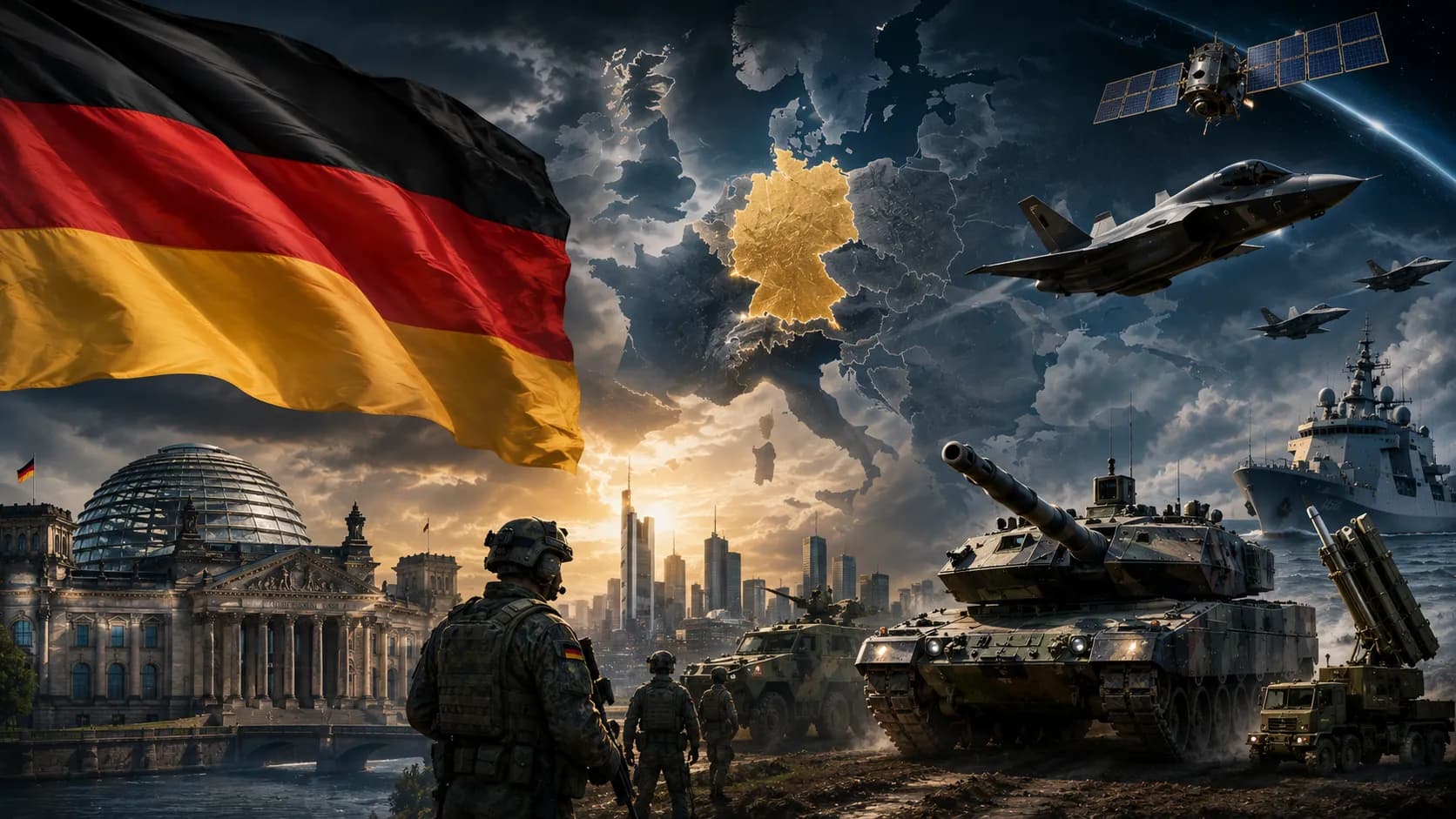
Germany is rapidly becoming Europe's leading military power through record defence spending, long-term procurement and an expanding defence industry led by Rheinmetall. Berlin's historic rearmament is reshaping European security, strengthening NATO capabilities while altering the continent's strategic balance.
A European perspective — June 2026
For decades a country that kept its military profile deliberately low, Germany has become the unmistakable engine of Europe's rearmament. Chancellor Friedrich Merz's pledge to build “the strongest conventional army in Europe” is no longer rhetoric: it is now backed by record budgets, multi-year procurement contracts, and a defence industry growing at a pace unseen since the 1950s. From the artillery plants of Lower Saxony to satellite ventures reaching into orbit, the German defence sector has moved to the centre of the continent's evolving security architecture — and its allies, suppliers, and rivals are all adjusting to a heavier, more assertive Berlin.
A Budget Without Precedent
The scale of Germany's shift starts with money. The 2026 federal budget allocates roughly €82.7 billion to the Bundeswehr, an increase of more than €20 billion over 2025, and combines with the special “Zeitenwende” fund to push total defence commitment to about €108.2 billion — the highest in the Federal Republic's history and the largest military budget in Europe, nearly double France's €57.2 billion for the same year.
What made this possible was as much constitutional as it was political. In March 2025, Merz secured a Bundestag exemption for defence spending from Germany's strict debt brake, removing the fiscal restraint that had capped military investment for years. Defence Minister Boris Pistorius — architect of the goal to make the Bundeswehr kriegstüchtig (war-ready) — has set a trajectory toward 3.5% of GDP by 2029, naming Russia as the most immediate threat. The shopping list that follows is vast: Leopard 2A8 tanks, thousands of Boxer and Patria vehicles, Skyranger and IRIS-T air defence systems, F-35 jets, and Tomahawk cruise missiles. Crucially for industry, many of these are multi-year commitments, signalling that Berlin views rearmament as a long-term project rather than a one-off correction.
Rheinmetall Rides the Wave
No company embodies this transformation more than Düsseldorf-based Rheinmetall, Germany's largest defence supplier. The group reported 2025 sales of €9.9 billion, up 29% year on year, with operating profit reaching a record €1.84 billion. For 2026 it forecasts growth of 40–45%, targeting revenue of up to €14.5 billion — and by the end of March its order backlog had already climbed to a record €73 billion, with management expecting that figure to roughly double again by year-end.
The expansion is also reshaping what kind of company Rheinmetall is. It acquired German shipbuilder NVL (Naval Vessels Luerssen), adding corvettes, frigates and unmanned vessels to a portfolio long dominated by land systems and ammunition, and launched a joint venture with Finland's ICEYE to build synthetic-aperture-radar reconnaissance satellites. At Eurosatory 2026 in Paris this June, the firm unveiled new artillery, counter-drone systems for airports, and deep-strike missile concepts — underscoring CEO Armin Papperger's claim that the group is now a player “on land, at sea, in the air, in the cyber sector and in space.” Investors remain watchful — shares dipped despite the record results — but the growing long-term backlog gives the business an unusually stable foundation stretching well into the next decade.
Ripples Across Europe
Germany's build-up does not stop at its borders. The surge has lifted the entire national sector: according to the SIPRI research group, Germany overtook China to become the world's fourth-largest arms exporter in 2021–2025, accounting for 5.7% of global exports. As Berlin commits to a permanent heavy brigade in Lithuania and German-led exercises with allies, its industrial weight is rippling outward to suppliers across the continent — from munitions plants in Spain and Hungary to partnerships in the Nordic and Baltic states.
That ascendancy is not without friction. A more capable and assertive Germany changes the internal balance of European defence: unlike France and the United Kingdom, Berlin will not field nuclear weapons or aircraft carriers, and is instead exploring deterrence cooperation with Paris and London while investing heavily in space-based surveillance to reduce dependence on the United States. At home, the spending faces pointed opposition, with critics on the left and in segments of the public uneasy about the social cost and the historical weight of German rearmament. Analysts also flag execution risk: absorbing the new funds efficiently, reforming a slow procurement bureaucracy, and ensuring that quantity translates into genuine battlefield capability remain open questions.
Conclusion
Germany's pivot from frugality to force projection marks the most significant shift in European conventional military power since the Cold War. With a historic budget, a constitutional green light for sustained borrowing, and a defence champion in Rheinmetall expanding across every domain of modern warfare, Berlin is positioning itself as the continent's industrial and strategic heavyweight. Whether the bet pays off will depend less on the headline figures than on execution — on turning euros and contracts into a ready, credible force — and on how comfortably Germany's partners adjust to a neighbour no longer content to be a junior military player. For now, the message from Europe's largest economy is unmistakable: it intends to lead.
Alvara Merrick
Contributing writer at EUReflect.
Follow EUReflect
See more of our reporting on Google
Mark EUReflect as a preferred source and our stories are ranked higher for you in Top Stories, Discover and Google News — and carry a “preferred” badge when they are cited in AI results.
Add EUReflect as a preferred source