How the Closure of the Strait of Hormuz Broke Europe
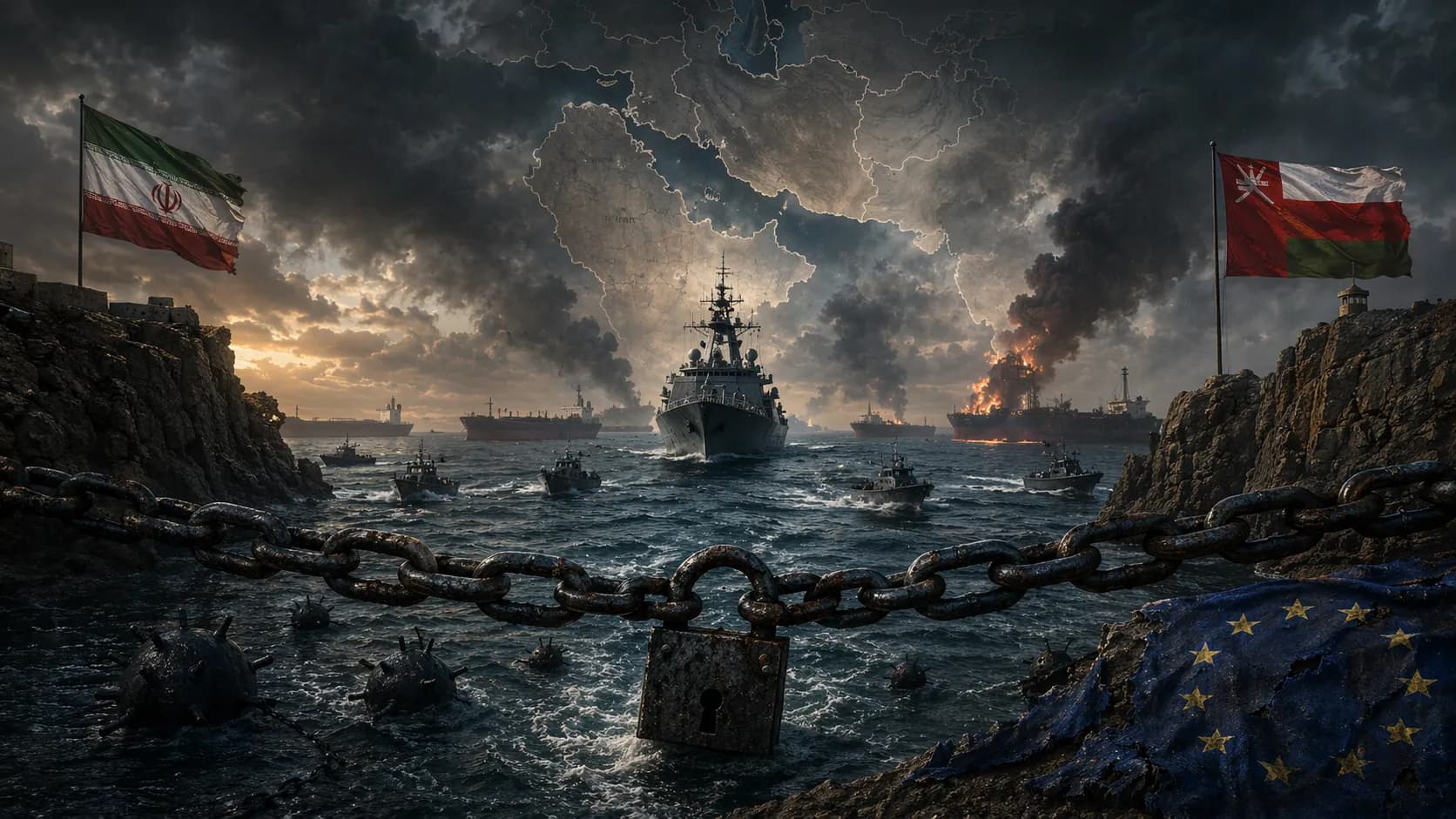
For nearly seven weeks, the Strait of Hormuz has been effectively closed. The narrow waterway between Iran and Oman through which one‑fifth of the world’s oil once passed is now a militarised chokepoint. On 13 April, President Trump ordered a full US naval blockade. Iran has mined the surrounding waters and deployed fast attack craft. The result is stark: almost no oil or natural gas is getting through.
Europe is paying an excruciating price. Yet the critical truth that political leaders refuse to acknowledge is that European governments caused much of their own vulnerability. They had years to prepare for exactly this kind of disruption. They did almost nothing. Now they stand divided, reactive, and dangerously exposed.
Before the closure, 129 ships transited the strait every day. Now, only four do. Almost all liquefied natural gas (LNG) shipments from Qatar to Europe have ceased a loss of roughly 130 cargoes in six weeks.Europe receives only about 5% of its crude oil and 13% of its LNG via the strait. Those figures appear modest. But when the global market loses 20% of its total oil supply as has happened, prices explode for every consumer, everywhere. Europe cannot insulate itself from global markets.
The most acute danger is jet fuel. Half of Europe’s aviation fuel originates in the Gulf. That supply chain is now severed. Airports have warned that systemic shortages will become reality within three weeks. If that happens, passenger flights will cease. No holidays. No business travel. No air cargo. The European aviation industry supports 14 million jobs, all of which are now at immediate risk.
The price indicators are alarming. Brent crude futures reached $119 per barrel in March. More tellingly, physical oil for immediate delivery hit $148 per barrel on 13 April, a record premium that signals a genuine supply crunch, not speculative froth.
Natural gas prices, while down slightly from their peak, remain 60% above pre‑conflict levels. The European Commission has confirmed that the additional cost of energy imports over the past 44 days stands at €22 billion. That burden falls directly on households and businesses – at the petrol pump, in supermarket aisles, and on heating bills. Fertilisers, aluminium, plastics, every energy‑intensive commodity is rising. Inflation is accelerating. And European leaders, instead of acting, are arguing among themselves.
The political fragmentation is striking. Britain has refused to join the US blockade; Prime Minister Starmer has stated that he will not be “dragged into the war.” France has declared that using force to reopen the strait is unrealistic. Italy insists on a UN mandate before any military involvement. Portugal permits the US to use Lajes Air Base for logistics but will not contribute combat forces.
This is not a united Europe. It is a collection of sovereign governments each prioritising domestic political risk over collective action. Meanwhile, the strait remains closed and the European economy burns.
The EU has released 400 million barrels from strategic petroleum reserves, the largest such release in history. But reserves are a temporary palliative, not a solution. When they are exhausted, the continent will have no buffer left. Energy Commissioner Dan Jorgensen has urged citizens to work from home, use public transport, and reduce highway speeds. These are not acts of leadership. They are admissions of policy failure dressed as public service announcements.
Policymakers frequently cite alternative supply routes. The reality is that no viable substitute exists.
The Saudi East‑West crude pipeline can carry 5 million barrels per day to the Red Sea. However, the vast majority of that capacity is already contracted to Asian buyers, principally China and India. Europe cannot simply claim those volumes.
The Cape of Good Hope route adds thousands of nautical miles and weeks of transit time. Shipping costs and war risk insurance would multiply. Moreover, the oil would still originate from the same Gulf producers now trapped behind the blockade.
The proposed Nigeria‑Morocco gas pipeline, which could eventually deliver 15–30 billion cubic metres annually to Europe, remains in the engineering design phase. It is years from completion and carries a $25 billion price tag. It offers no help for today’s emergency.
The brutal truth is that Europe spent decades building an economy on cheap energy from a geopolitically unstable region and assuming that instability would never directly affect supply. That assumption has now collapsed.The United States initiated the military escalation with airstrikes on Iran. President Trump’s subsequent blockade has been reckless in its execution and escalatory in its effect. Iran’s mining of the strait is illegal under international law and dangerously provocative.
But Europe cannot blame others indefinitely. After Russia’s full‑scale invasion of Ukraine in 2022, European leaders repeatedly promised “energy independence.” They delivered grand speeches about renewable energy, new gas import terminals, and diversification away from authoritarian suppliers. Yet implementation moved at a snail’s pace. Wind farms were approved on paper but not built on the ground. Pipeline dealswere discussed but not signed.
Germany shut down its remaining nuclear power plants. France has struggled to maintain its reactor fleet. The European Commission has refused to suspend the Emissions Trading System even as energy‑intensive industries shut down. This is not principled environmental policy. It is a form of economic self‑harm. And now, with the crisis at full force, Europe’s leading nations are pulling in different directions. No unified command. No strategic plan. No credible hope of near‑term relief.
Oxford Economics projects that the strait will remain effectively closed until the end of April. Traffic may recover to 50% of normal levels in May and June, with full normalisation taking six months or more. In the best‑case scenario, Brent crude will average $113 per barrel in the second quarter of 2026. In a worst‑case scenario which could include Iranian attacks on the Bab al‑Mandeb strait in the Red Sea, the situation would deteriorate far further.
Europe faces a difficult summer and a potentially catastrophic winter. The European Central Bank is expected to raise interest rates again, increasing borrowing costs and pushing thecontinent closer to recession.The honest assessment is harsh: Europe was not prepared. European leaders failed to translate warnings into action. And ordinary citizens will bear the consequences, in higher energy bills, grounded flights, and lost livelihoods.
The Strait of Hormuz lies 8,000 kilometres from Brussels. Yet today, it feels as if the crisis is at Europe’s doorstep. And no one holds a key. If European leaders wish to prevent further deterioration, they must move beyond consultation and implement emergency measures immediately.
Voluntary appeals are insufficient. Governments should impose legally binding speed limits of 90 km/h on highways, mandate remote work for all non‑essential office jobs, and prohibit non‑essential intra‑European flights. This is a wartime footing. The ETS is currently raising energy costs for both industry and households. A 12‑month suspension would provide immediate relief. Climate objectives cannot be pursued at the expense of economic survival.
Europe cannot rely solely on Washington. A joint French‑German‑British delegation should travel to Tehran to offer sanctions relief in exchange for guaranteed safe passage of tankers. Europe needs its own negotiating channel.Turkiyealready operates pipelines from Azerbaijan and Iraq. Europe has pipeline infrastructure reaching Turkey. Military engineering units should be deployed to complete the missing links within six weeks, not six months.
Governments must take control of all jet fuel stocks at major airports and create an EU aviation fuel authority. That authority should determine which flights operate, prioritising cargo and emergency services. Civilian leisure travel cannot takeprecedence over supply chains. Germany should restart its recently closed nuclear plants. France must bring every available reactor online, even if that means accelerated safety inspections. New solar and wind farms should receive permits in weeks, not years, using emergency powers.
Governments must stop sugar‑coating the outlook. Citizens need to know that winter will be expensive, factories may close, and air travel will be severely restricted. Direct cash transfers should be made to low‑income households to help cover energy bills. Once the immediate emergency subsides, a full, transparent inquiry must investigate which ministers ignored early warnings and which member states blocked energy infrastructure projects. The findings should be published. Accountability is the only guarantee against repeated failure.
Europe has run out of excuses. The strait is closed. The oil and gas are not coming. The leaders who failed to prepare must now act decisively or step aside for those who will.
Uroosa Khan
Contributing writer at EUReflect.
Follow EUReflect
See more of our reporting on Google
Mark EUReflect as a preferred source and our stories are ranked higher for you in Top Stories, Discover and Google News — and carry a “preferred” badge when they are cited in AI results.
Add EUReflect as a preferred source