Malaysia's Four-Way Balancing Act
Defence spending will rise to 1.5% of GDP by 2030, but the minister insists the build-up is not aimed at any specific country.
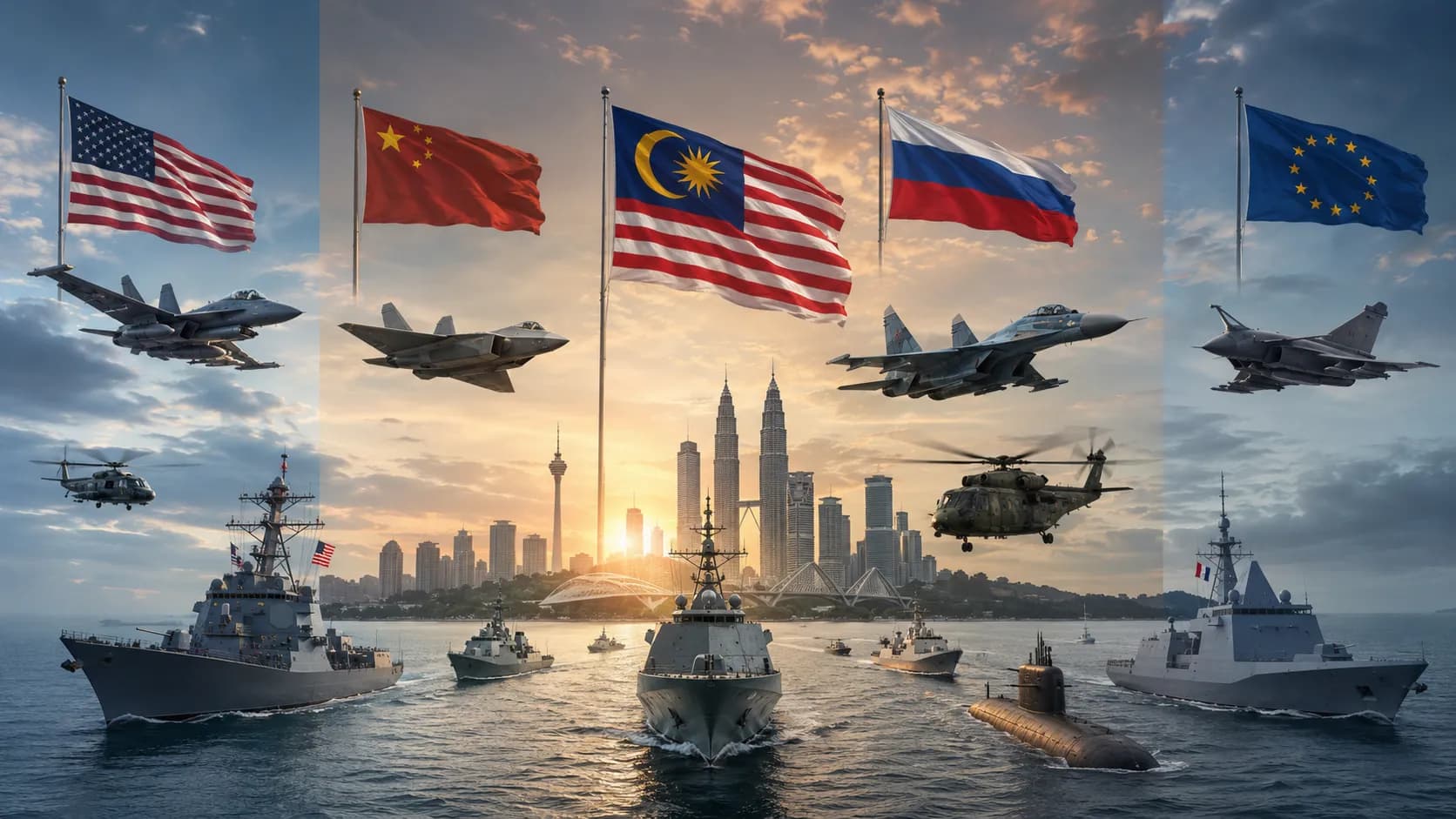
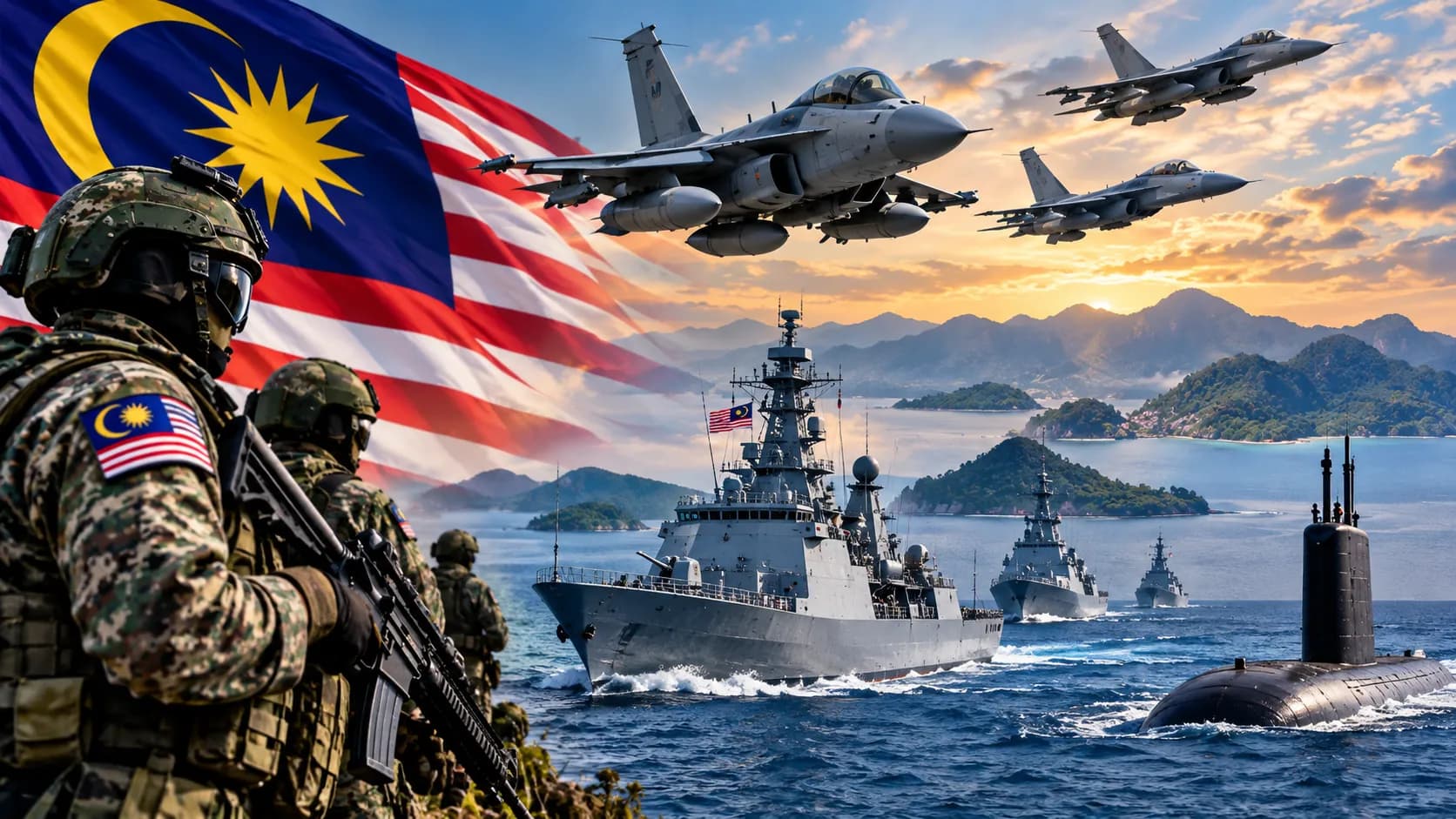
KUALA LUMPUR, 1 September 2026 – Fresh from its National Day celebrations, Malaysia is showing how a Southeast Asian middle power tries to keep Washington, Beijing, Moscow and Europe all at arm's length and all on side at once. Defence Minister Mohamed Khaled Nordin summed up the doctrine on 20 August: increased military activity in the region amid intensifying great-power competition has created a more complex environment, but Malaysia does not see any particular country as a threat. He announced a gradual rise in defence spending towards 1.5% of GDP by 2030, insisting the build-up is not directed at the Philippines, the United States, China or anyone else (The Star).
Washington: reassurance under scrutiny
The US relationship is being tested from both sides. On 3 August, US Ambassador to ASEAN Kevin Kim used a courtesy call at the 37th Military Law and Operations Conference in Kuala Lumpur to say Washington will keep strengthening close ties with Malaysia, including in defence, though the talks stayed away from policy matters (Malay Mail). The reassurance came a month after eight US lawmakers urged Secretary of State Marco Rubio to review security and economic ties with Malaysia following remarks by Prime Minister Anwar Ibrahim (FMT). Structurally, however, the two sides still describe defence cooperation as a fundamental pillar of their Comprehensive Strategic Partnership, as reaffirmed by Khaled and US Secretary of War Pete Hegseth on the sidelines of the ADMM-Plus last October (US Embassy Malaysia). Kuala Lumpur has also had to defend the participation of its Defence Intelligence Organisation in Five Eyes exercises, with Deputy Defence Minister Adly Zahari stressing that this does not compromise Malaysia's neutral policy toward China (Malay Mail).
Beijing: trade partner, not arms partner
China remains the elephant in the room. In March, Anwar and Chinese Minister of State Security Chen Yixin agreed to strengthen security cooperation and diplomatic ties in the face of rising global uncertainty (Business Today). Yet on procurement the line is clear. Analysts noted that Chinese firms dominated the DSA exhibition in April, but that dealing with China on defence remained a no-go because of conflicting interests in the South China Sea, with military and foreign affairs officials still preferring the West, especially the US (FMT). Khaled has said Malaysia is strengthening capabilities at Pulau Layang-Layang in the Spratlys, framing it as a matter of national interest, while urging all parties to show restraint and pushing for progress on the Code of Conduct (The Star).
Moscow: the legacy supplier returns
Russia is quietly regaining ground. The King's visit to Russia in August 2025, the first by a Malaysian head of state since 1967, saw him shown modernised Russian helicopters; Khaled affirmed a government-to-government procurement approach hours later, and the planned purchase of US Black Hawks has since been scrapped (FULCRUM / ISEAS). At DSA in April, Rosoboronexport displayed the Su-57 and pitched it as an option for the air force, citing compatibility with the existing Su-30MKM fleet (Military Watch). Those Su-30MKMs have just completed a locally run service life extension that will keep them flying for at least another decade (FlightGlobal). Russia is thus positioned as an alternative whenever Western deals falter – which brings us to Europe.
Europe: a broken deal and a hedge
The most damaging blow to trust came from Oslo. Norway revoked the export licence for Naval Strike Missiles ordered in 2018 for the Royal Malaysian Navy's Littoral Combat Ships, collapsing the deal; Malaysia agreed to meet manufacturer Kongsberg but made clear its compensation claim cannot be delayed. The US denied any role in the decision (ScandAsia). Kuala Lumpur's answer has been to diversify within Europe rather than abandon it. A new defence agreement with France aims to plug Malaysia into global supply chains for defence components and technology, building on cooperation that began in 1993 (The Sun). Germany has signalled a Letter of Intent to expedite all forms of defence cooperation and already supports Malaysia through its 'Enable and Enhance' programme (Bernama). And on Europe's edge, the inaugural Malaysia–Türkiye Policy Talk in Ankara on 24 August produced an agreement on terms of reference for a standing mechanism, with a second round scheduled for Kuala Lumpur next year (The Star).
Assessment
The pattern is consistent: Malaysia operates a mix of American, European and Russian-made aircraft, the result of a deliberate desire to avoid over-reliance on any single supplier, at the cost of logistical complexity (GlobalMilitary.net). The Norway episode has reinforced that instinct, and the beneficiaries are the partners least likely to attach political conditions – Türkiye, France, and increasingly Russia. For Washington and Brussels, the lesson from Kuala Lumpur is that in Southeast Asia, reliability as a supplier now counts as much as capability.
Alvara Merrick
Contributing writer at EUReflect.
Follow EUReflect
See more of our reporting on Google
Mark EUReflect as a preferred source and our stories are ranked higher for you in Top Stories, Discover and Google News — and carry a “preferred” badge when they are cited in AI results.
Add EUReflect as a preferred source