Malaysia Rises as a Regional Defence Power
Global Firepower ranks Malaysia 42nd, with a naval force of about 100 assets including 2 submarines, and a defence budget of $5.1 billion.
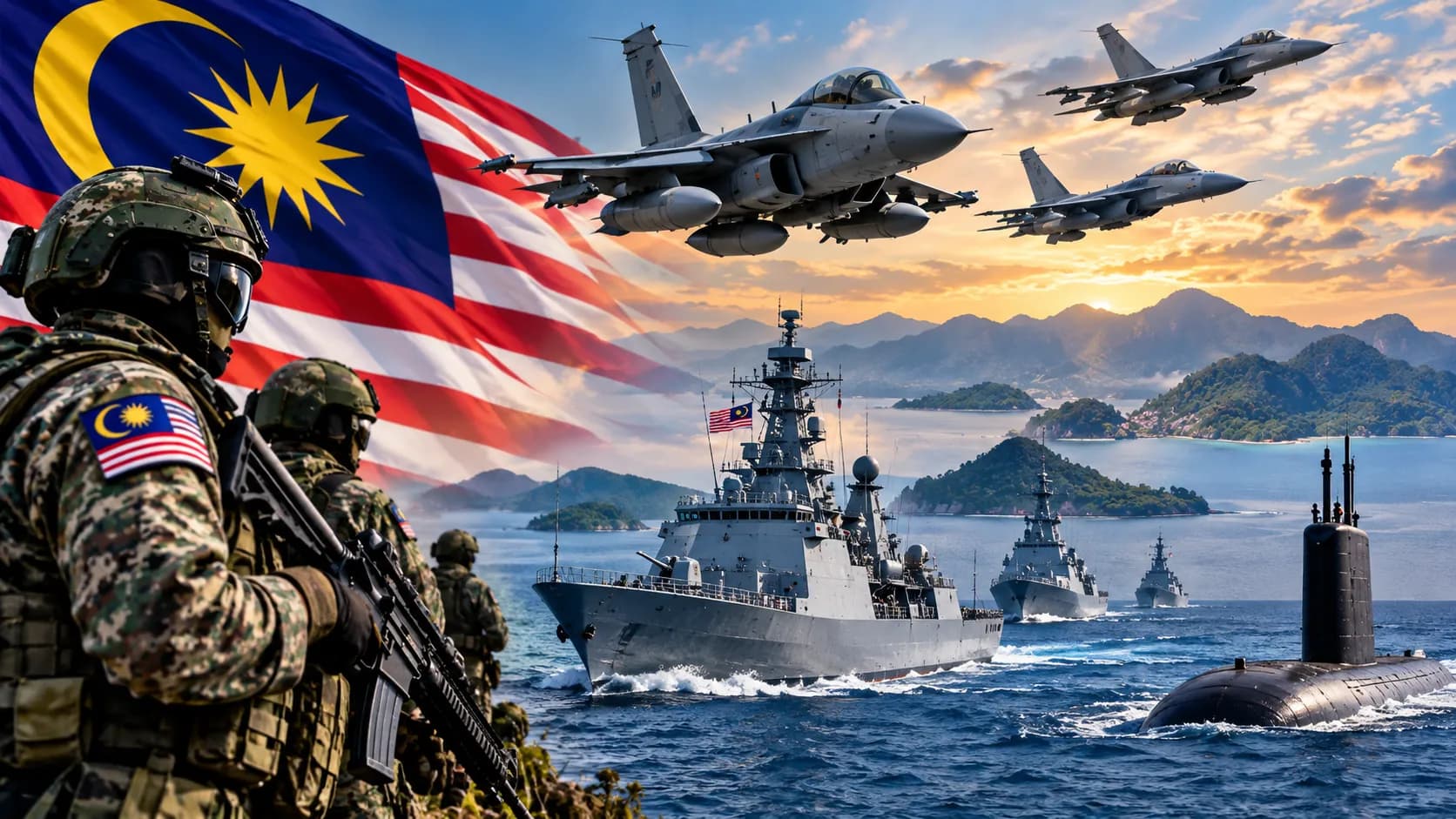
Malaysia is strengthening its military capabilities as shifting geopolitical dynamics in the Indo-Pacific and growing security concerns in the South China Sea push Kuala Lumpur to accelerate defence modernisation.
According to the 2026 Global Firepower (GFP) ranking, Malaysia stands 42nd among 145 countries assessed worldwide, with a Power Index score of 0.7379. Global Firepower evaluates countries through a broad range of indicators covering manpower, air and naval power, land forces, logistics, financial capacity and geography.
Malaysia's position is particularly notable in several naval categories. GFP estimates that the country operates around 100 naval assets, including 2 frigates, 4 corvettes, 2 submarines and 72 patrol vessels. Malaysia ranks 17th globally for frigates, 13th for corvettes and 15th for submarines under GFP's methodology.
Air power remains another important component. Global Firepower lists Malaysia with 132 military aircraft, including 25 fighters, 11 dedicated attack aircraft, 15 transport aircraft and 45 helicopters. Its land inventory includes an estimated 48 tanks, 15,415 military vehicles, 196 towed artillery pieces and 36 multiple-launch rocket systems.
$5.1 Billion Defence Budget
Global Firepower estimates Malaysia's defence budget at approximately $5.1 billion for 2026, placing the country 57th globally in defence spending in its database.
Malaysia's official 2026 Ministry of Defence allocation is RM21.74 billion, with around RM6 billion dedicated to strategic asset procurement and related defence requirements. The modernisation programme includes medium-, short- and very-short-range air-defence systems and two Multi-Role Support Ships.
Another significant upgrade is coming to the Royal Malaysian Air Force. Malaysia is scheduled to begin receiving 18 FA-50 light combat aircraft from Korea Aerospace Industries in early 2027, with the aircraft expected to be based at Kuantan Air Base.
South China Sea Shapes Defence Strategy
Malaysia's military modernisation cannot be separated from developments in the South China Sea.
Defence Minister Mohamed Khaled Nordin has explicitly connected the need for technologically advanced military assets with emerging conventional and non-conventional security challenges, including those in the South China Sea.
In June 2026, Malaysia also launched its National Defence Strategic Plan 2026–2030, establishing a five-year framework containing seven strategic pillars, 29 principal strategies and 103 specific initiatives aimed at strengthening national defence capabilities and resilience.
The issue is gaining further political importance. In August, Prime Minister Anwar Ibrahim said Malaysia may require additional defence allocations—potentially ranging from hundreds of millions to billions of ringgit—as the regional security environment becomes increasingly influenced by strategic competition between the United States and China.
Malaysia's Strategic Advantage
Malaysia may not possess the scale of Asia's largest military powers, but its geography gives its armed forces considerable strategic importance.
Located between the South China Sea and the Strait of Malacca, Malaysia sits close to some of the world's most important maritime trade routes. Its defence priorities therefore extend beyond conventional military strength to maritime surveillance, naval readiness, air defence and the protection of strategic sea lanes.
The 2026 Global Firepower ranking shows a military with clear limitations in some heavy land-force categories but comparatively stronger maritime capabilities. Combined with new aircraft, air-defence systems and naval procurement, Malaysia is gradually developing a more technologically capable force.
For Kuala Lumpur, the objective is increasingly clear: not to compete numerically with Asia's military giants, but to build a modern, balanced and credible defence capability suited to Malaysia's strategic geography.
Alvara Merrick
Contributing writer at EUReflect.
Follow EUReflect
See more of our reporting on Google
Mark EUReflect as a preferred source and our stories are ranked higher for you in Top Stories, Discover and Google News — and carry a “preferred” badge when they are cited in AI results.
Add EUReflect as a preferred source