Middle East Faces a Deepening Water Crisis
Iran, Iraq, Lebanon, Syria and Gaza all face distinct water challenges, from Iran's depleted Lake Urmia to Iraq's fragile recovery after heavy rains.
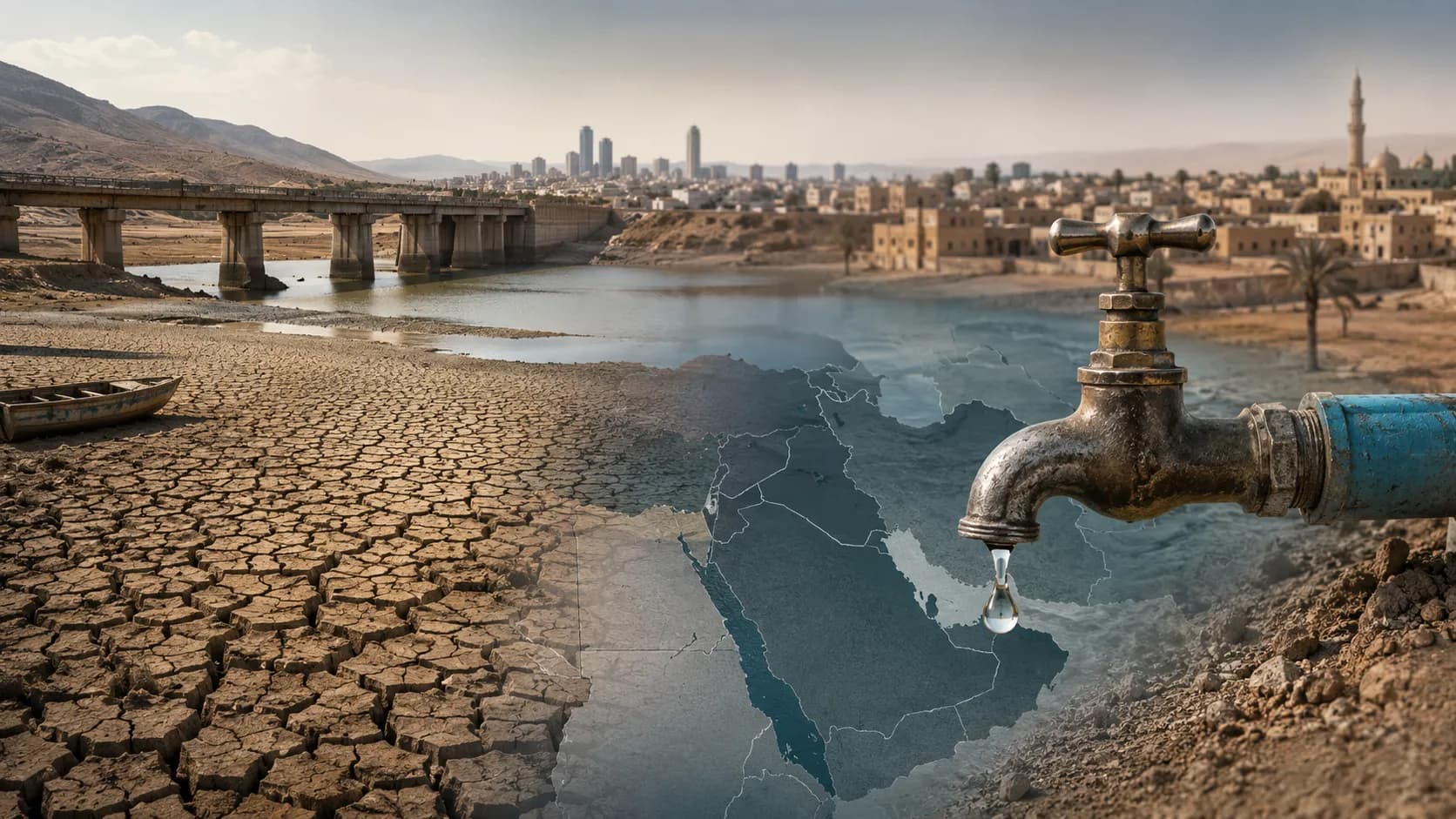
The Middle East is entering a new phase of water insecurity as drought, rising temperatures, population pressure, conflict and aging infrastructure place increasing strain on already limited resources.
Recent developments in Iran, Iraq, Lebanon, Syria and Gaza show that water scarcity is no longer simply an environmental issue. It is becoming a challenge for food production, public health, migration, economic stability and regional cooperation.
Iran’s Water Emergency Deepens
Iran is facing one of the region’s most serious water challenges.
Years of drought, declining rainfall, intensive agricultural consumption and excessive groundwater extraction have severely depleted rivers, reservoirs and aquifers. Iran is classified as facing extremely high baseline water stress, meaning that more than 80 percent of its available renewable water supply is being used annually.
Lake Urmia illustrates the scale of the problem. Once covering nearly 6,000 square kilometers, the lake has fallen to around 581 square kilometers in 2026. Around 27,000 Iranian villages, home to more than 10 million people, are also experiencing water shortages.
The crisis increasingly raises questions about whether major cities and agricultural regions can maintain current levels of water consumption.
Iraq Gets Relief, but the Problem Remains
Iraq has experienced an important improvement in 2026 after above-normal winter rainfall increased national water reserves. The United Nations says the country now has enough stored water to cover drinking and household requirements for roughly two years.
But this recovery does not mean Iraq’s water crisis is over.
The UN warns that the recent gains represent only a fraction of the water lost since 2020, while high temperatures and evaporation continue to reduce reserves. Iraq also remains heavily dependent on the Tigris and Euphrates, making cooperation with upstream countries strategically important.
Baghdad and Ankara have recently moved toward closer cooperation. An Iraqi government adviser said in August that flows in the Tigris and Euphrates had increased to around 800–900 cubic meters per second, roughly double the previous year's level, as a new water cooperation mechanism with Türkiye entered implementation.
Iraq and Syria are also coordinating their positions ahead of technical discussions with Türkiye over management of the Euphrates and Tigris system.
Lebanon Struggles With Drought and Infrastructure
Lebanon presents another dimension of the regional crisis.
The country is experiencing what Oxfam describes as its worst drought in 65 years, while conflict and economic difficulties have further weakened water infrastructure. More than four million people depend on public water systems facing severe pressure.
This demonstrates how water crises can become particularly dangerous when drought overlaps with damaged infrastructure, energy shortages and political instability.
Gaza Faces an Immediate Water Threat
In Gaza, the problem is even more urgent.
Municipalities and water authorities warned in August that drinking-water and sewage systems were approaching collapse. Fuel shortages have restricted wells and pumping stations, while groundwater contamination is creating additional public-health risks for more than two million people.
Unlike long-term water scarcity elsewhere in the region, Gaza therefore faces a combination of physical water shortages, infrastructure destruction and an immediate humanitarian emergency.
Water Is Becoming a Strategic Issue
The broader picture extends beyond individual countries. A new UNDP assessment describes the Arab States as the world's most water-scarce region and warns that rising temperatures, prolonged drought, desertification and land degradation will increasingly affect livelihoods, food security and displacement.
The emerging challenge for the Middle East is therefore not simply how to find more water.
Governments will have to reduce agricultural losses, modernize irrigation, expand wastewater recycling and desalination where economically feasible, protect groundwater reserves and improve cross-border management of shared rivers.
Water diplomacy may consequently become as important to regional stability as energy diplomacy.
The Middle East has spent decades managing competition over oil and gas. The next strategic resource shaping relations between states may increasingly be water.
Ahmet Balakan
Contributing writer at EUReflect.
Follow EUReflect
See more of our reporting on Google
Mark EUReflect as a preferred source and our stories are ranked higher for you in Top Stories, Discover and Google News — and carry a “preferred” badge when they are cited in AI results.
Add EUReflect as a preferred source